Artwork
Grosse Walchenseelandschaft (Large Walchen Sea Landscape)
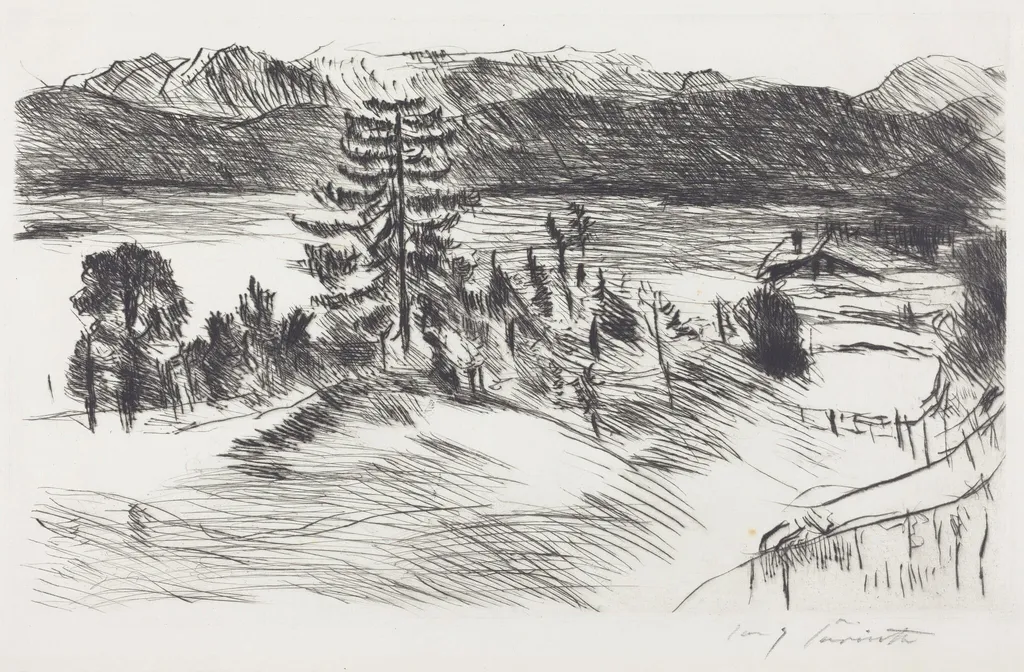
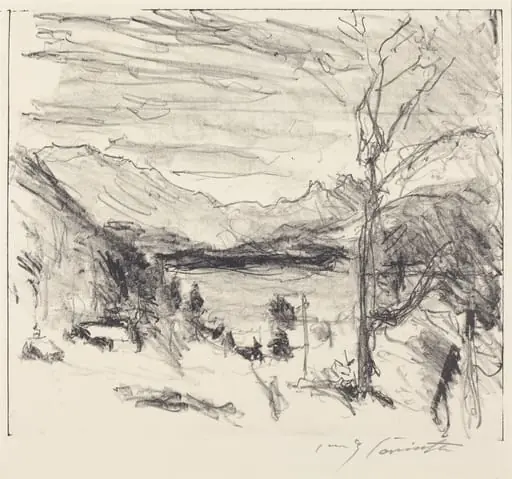
Grosse Walchenseelandschaft (Large Walchen Sea Landscape) is an ink print by Lovis Corinth. It dates from 1923 and is held in the collection of the National Gallery of Art.
About this work
Overview
It belongs to a series of landscapes produced in his later years, following a stroke in 1911 that reshaped his artistic approach.
Created in 1923, *Grosse Walchenseelandschaft* is a drypoint print by Lovis Corinth on wove paper. It belongs to a series of landscapes produced in his later years, following a stroke in 1911 that reshaped his artistic approach. The work captures the natural scenery around Walchensee in the Bavarian Alps, rendered entirely in black ink. Corinth’s shift toward expressive mark-making is evident in the work’s dynamic texture and emotional resonance.
Subject & Meaning
The print portrays a tranquil lakeside scene with sparse foreground trees and a distant mountain ridge. There is no human presence, emphasizing nature’s quiet permanence. The composition avoids narrative, instead focusing on atmosphere. Corinth’s choice of a serene, unpopulated landscape reflects a personal retreat into the natural world after illness, suggesting contemplation rather than spectacle.
Technique & Style
Using drypoint, Corinth incised lines directly into a metal plate, creating rich, velvety blacks and irregular textures. The inked lines vary in weight and density, suggesting light, shadow, and foliage without detail. The absence of tone or wash heightens the contrast between the white paper and the deep black marks. This technique, combined with loose, gestural strokes, aligns with his post-stroke expressionism, prioritizing emotional immediacy over precision.
History & Provenance
Corinth produced this print during a period of intense landscape work, following his relocation to Bavaria after his stroke. The Walchensee region became a frequent subject in his late output. While specific early ownership records are sparse, the print entered public collections in the mid-20th century, reflecting growing recognition of his graphic work beyond his paintings. It remains part of institutional holdings focused on German modernism.
Context
In the early 1920s, Corinth was distancing himself from the Berlin Secession, which he once led, and developing a more personal visual language. His landscapes from this time respond to broader European trends in expressionist printmaking but remain rooted in his own physical and emotional experience. The quiet intensity of *Grosse Walchenseelandschaft* contrasts with the turbulence of postwar Germany, offering a private sanctuary in art.
Legacy
This print exemplifies Corinth’s late style, where technical restraint and expressive force converge. It influenced later generations of German printmakers who valued emotional honesty over formal polish. While less widely known than his paintings, his drypoints like this one are now studied for their innovative use of line and texture, affirming his role in expanding the expressive potential of print media.
Artist & collection

Artist
Lovis Corinth was a German artist and writer whose mature work as a painter and printmaker realized a synthesis of impressionism and expressionism.