Artwork
Tiergarten (Zoological Garden)
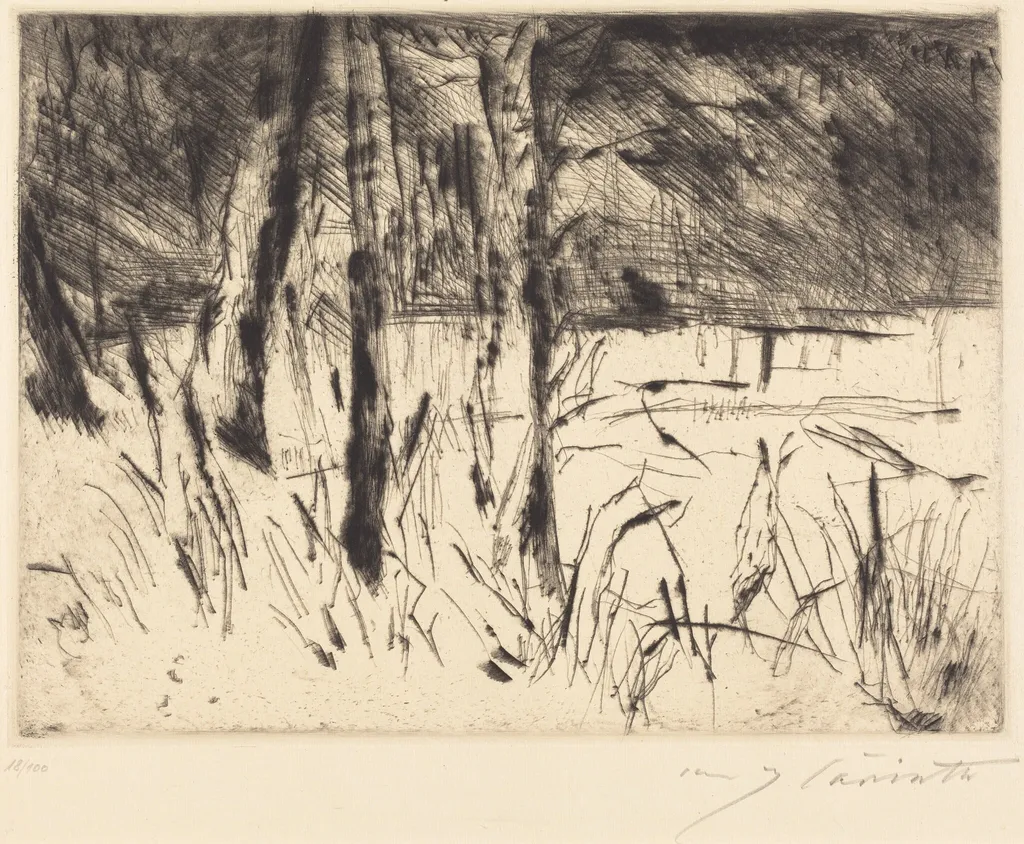
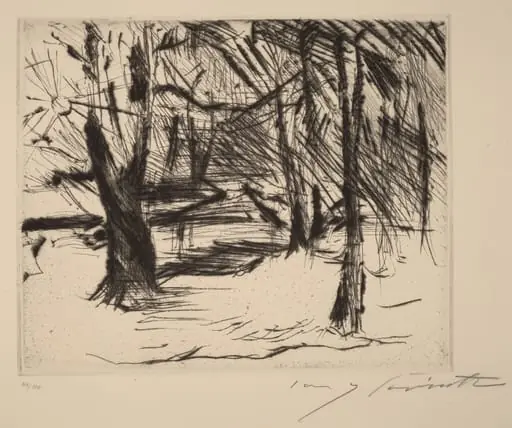
Tiergarten (Zoological Garden) is an ink print by Lovis Corinth. It dates from 1922 and is held in the collection of the National Gallery of Art.
About this work
Overview
Corinth’s approach emphasizes texture and movement, reflecting his evolving style after a stroke in 1911 that deepened his expressive approach to form and line.
Created in 1922, *Tiergarten (Zoological Garden)* is a drypoint print by German artist Lovis Corinth on wove paper. The work captures a dense, untamed section of Berlin’s central park, rendered through the direct, tactile method of drypoint. Corinth’s approach emphasizes texture and movement, reflecting his evolving style after a stroke in 1911 that deepened his expressive approach to form and line.
Subject & Meaning
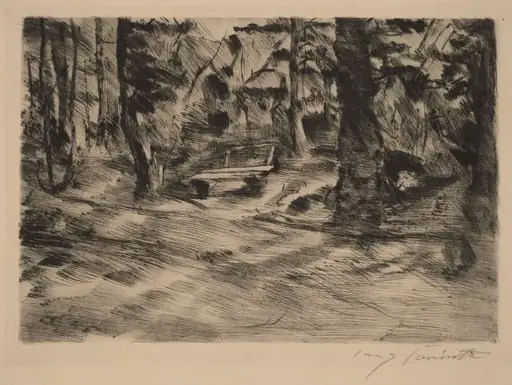
The scene depicts a wild, overgrown portion of the Tiergarten, Berlin’s historic urban park and zoo. Rather than presenting a tidy landscape, Corinth focuses on the chaotic interplay of trees and undergrowth. The absence of human figures or clear landmarks suggests a contemplative, almost primal view of nature—untamed and indifferent to human order, reflecting a postwar mood of fragmentation and introspection.
Technique & Style
Corinth employed drypoint, scratching directly into a metal plate with a hardened needle to create dense, grainy lines. The resulting print retains the roughness of the incisions, with thick, irregular strokes defining tree trunks and tangled branches. Light areas emerge as bare paper, contrasting with deep, shadowed masses. This technique amplifies the sense of immediacy, as if the image were drawn in real time from observation.
History & Provenance
Corinth produced this print during his later years in Berlin, after his 1911 stroke and subsequent shift toward more expressive forms. He had been a key figure in the Berlin Secession, serving as its president, and continued to explore printmaking alongside painting. *Tiergarten* belongs to a series of works from this period that reflect his personal and artistic reorientation, grounded in direct observation and emotional intensity.
Context
Made in the aftermath of World War I, the print resonates with a cultural atmosphere of upheaval and searching. Berlin’s Tiergarten, once a symbol of imperial order, now appeared in Corinth’s hands as a wild, ambiguous space. His depiction aligns with broader Expressionist tendencies to convey inner states through distorted or intensified natural forms, rejecting idealized landscapes in favor of visceral experience.
Legacy
This print exemplifies Corinth’s mature printmaking, where technical rawness serves emotional depth. It stands as a significant example of early 20th-century German printmaking that prioritized gesture and texture over precision. While not widely exhibited during his lifetime, it has since contributed to scholarly understanding of how artists used print media to explore psychological and environmental themes in the modern era.
Own this work as a print
Artist & collection

Artist
Lovis Corinth was a German artist and writer whose mature work as a painter and printmaker realized a synthesis of impressionism and expressionism.