Artwork
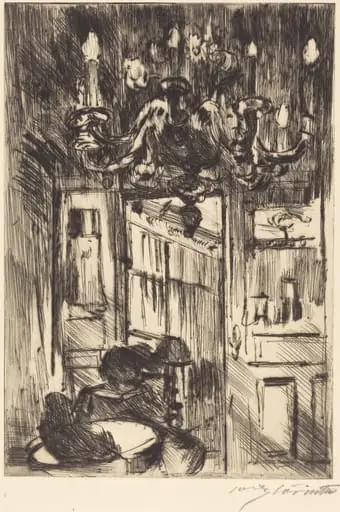
Interieur mit Stehlampe (Interior with Floor Lamp)
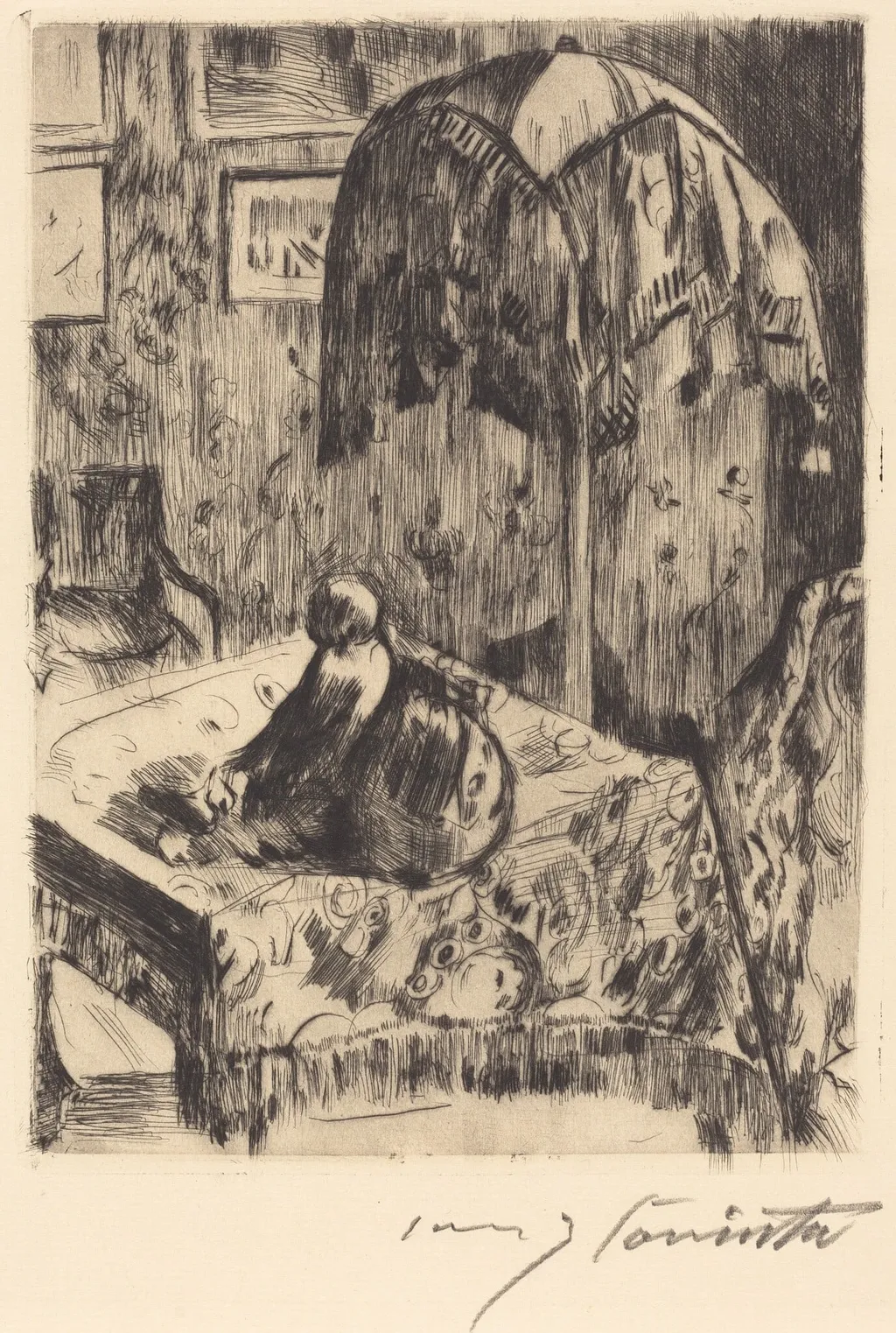
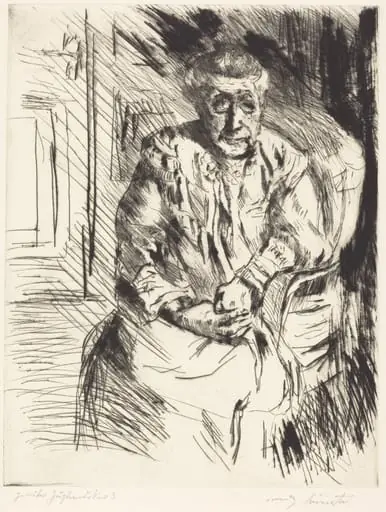
Interieur mit Stehlampe (Interior with Floor Lamp) is an ink print by Lovis Corinth. It dates from 1916 and is held in the collection of the National Gallery of Art.
About this work
Overview
Created in 1916, *Interieur mit Stehlampe* is a drypoint print by Lovis Corinth on Van Gelder Zonen laid paper.
Created in 1916, *Interieur mit Stehlampe* is a drypoint print by Lovis Corinth on Van Gelder Zonen laid paper. The work captures a quiet, dimly lit interior scene, rendered with urgent, tactile lines. Corinth, known for his transition from naturalism to expressionism after a stroke in 1911, employed the drypoint technique to achieve rich, velvety blacks and a sense of immediacy. The print reflects his deepening focus on intimate, psychological spaces during his later years.
Subject & Meaning
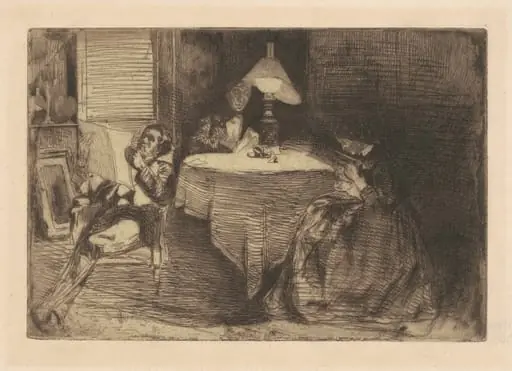
The scene portrays a solitary domestic interior centered on a tall floor lamp, its cord twisted on the floor. A couch, partially obscured, holds a figure wrapped in a blanket, suggesting rest or withdrawal. Crooked wall hangings and uneven surfaces imply neglect or emotional disarray. The lamp, the sole source of light, casts fragmented shadows, amplifying a mood of solitude and quiet introspection. The composition avoids narrative clarity, favoring emotional resonance over literal description.
Technique & Style
Corinth used drypoint to scratch directly into the plate, creating dense, grainy lines that hold ink deeply. The resulting print features rough, rapid strokes that convey urgency and physicality. Dark areas are built through layered, irregular marks rather than smooth shading, while light emerges through sparse, jagged voids. The technique mirrors his post-stroke style: less controlled, more expressive, with an emphasis on texture and emotional weight over precision.
History & Provenance
Produced in 1916, during Corinth’s mature period in Berlin, the print emerged from a phase of intense personal and artistic transformation. After his 1911 stroke, he turned inward, focusing on domestic subjects and printmaking as a means of direct expression. While specific ownership history is not documented here, the work aligns with his broader output from this time, which was widely exhibited and collected by German institutions and private patrons.
Context
Corinth was a key figure in the Berlin Secession, a movement that challenged academic traditions in favor of modernist experimentation. By 1916, Expressionism was gaining ground in Germany, and Corinth’s work reflected its preoccupations with inner states and raw perception. His shift from detailed realism to gestural, emotionally charged imagery paralleled broader cultural shifts in the years leading up to World War I, where art increasingly turned toward subjectivity and psychological depth.
Legacy
This print exemplifies Corinth’s late style, in which technical immediacy and emotional intensity became inseparable. His use of drypoint influenced later German printmakers drawn to expressive line and tactile surface. While not widely known outside specialist circles, *Interieur mit Stehlampe* remains a significant example of how personal crisis and artistic innovation converged in early 20th-century German art, bridging naturalism and expressionism through intimate, unidealized observation.
Artist & collection

Artist
Lovis Corinth was a German artist and writer whose mature work as a painter and printmaker realized a synthesis of impressionism and expressionism.