Artwork
The Devil's Tower
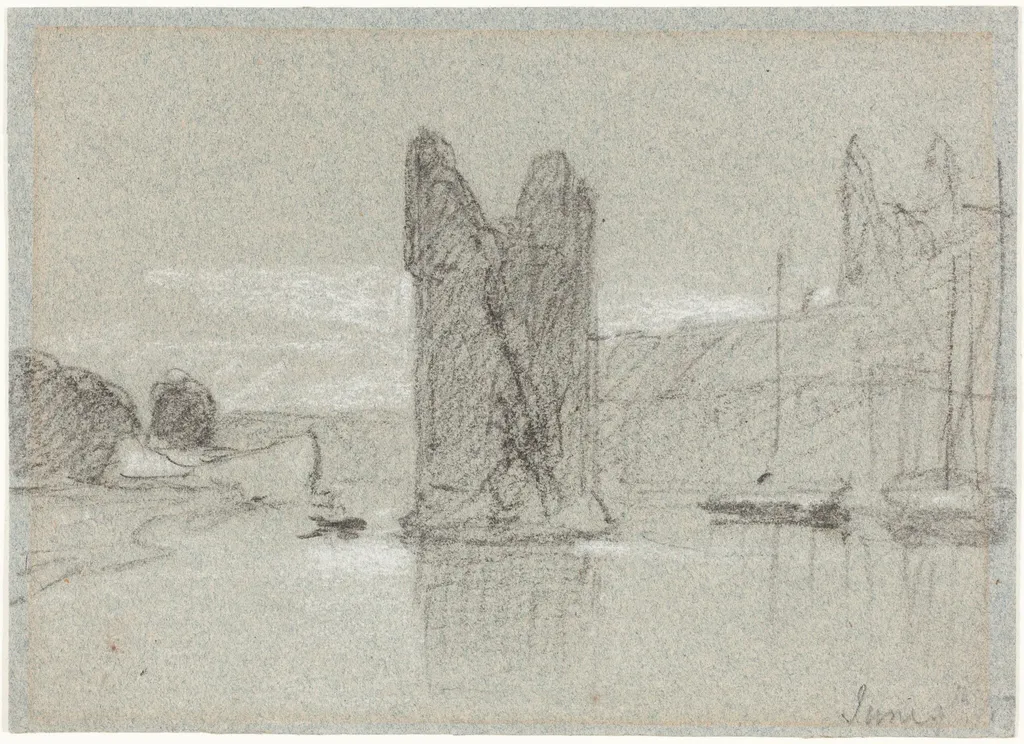
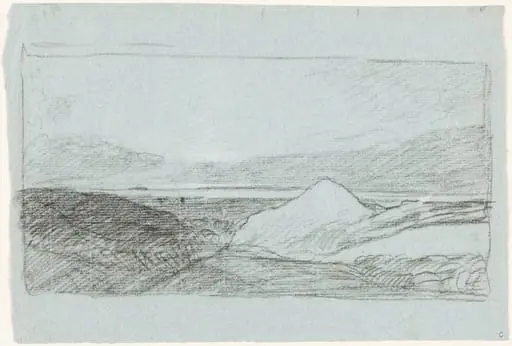
The Devil's Tower is a chalk drawing by the Romanticist artist John Sell Cotman. It dates from 1834 and is held in the collection of the National Gallery of Art.
About this work
Overview
Created in 1834, *The Devil’s Tower* is a drawing by John Sell Cotman, executed in black chalk with white highlights on blue wove paper.
Created in 1834, *The Devil’s Tower* is a drawing by John Sell Cotman, executed in black chalk with white highlights on blue wove paper. As a central figure in the Norwich School, Cotman focused on landscape subjects with quiet precision. This work reflects his lifelong interest in natural forms and his ability to convey texture and light through minimal, controlled media. The choice of blue paper suggests a deliberate tonal strategy, enhancing the contrast of the chalk.
Subject & Meaning
The subject is a solitary, vertical rock formation, likely inspired by a real geological feature, though not definitively identified. Its stark, towering presence evokes a sense of enduring natural force, isolated against a subdued sky. Cotman avoids romantic dramatization; instead, the form is rendered with observational clarity, suggesting contemplation rather than myth. The title, possibly a local name, adds a layer of folkloric resonance without overt narrative.
Technique & Style
Cotman employed black chalk for bold, linear definition and white chalk to suggest highlights and atmospheric haze. The blue paper serves as a mid-tone ground, allowing the artist to build contrast with minimal strokes. His technique is economical yet expressive, emphasizing form through tonal variation rather than detail. This approach reflects his training in watercolor and his interest in capturing the essence of landscape with restraint.
History & Provenance
Cotman, born in Norwich in 1782, trained in London under the influence of Turner and Girtin, though he remained rooted in regional subjects. *The Devil’s Tower* was made during a mature phase of his career, when he increasingly turned to drawing as a primary medium. The work’s survival suggests it was retained within his circle or collected by contemporaries who valued his quiet, methodical approach to landscape.
Context
In the 1830s, British art saw a growing interest in topographical accuracy and the sublime in nature, though Cotman’s work diverged from grandeur. He focused on modest, everyday landscapes, often in East Anglia. His drawings, like this one, responded to a shift toward intimate, personal observation rather than theatrical composition, aligning with broader trends in sketching practices among artists seeking authenticity.
Legacy
Cotman’s drawings, including *The Devil’s Tower*, are now recognized for their influence on later generations of British landscape artists who valued restraint and direct observation. His use of colored paper and chalk technique was innovative for its time and contributed to the evolution of drawing as an independent art form. Though less celebrated than his watercolors, these works reveal a disciplined, thoughtful engagement with the natural world.
Artist & collection
Artist
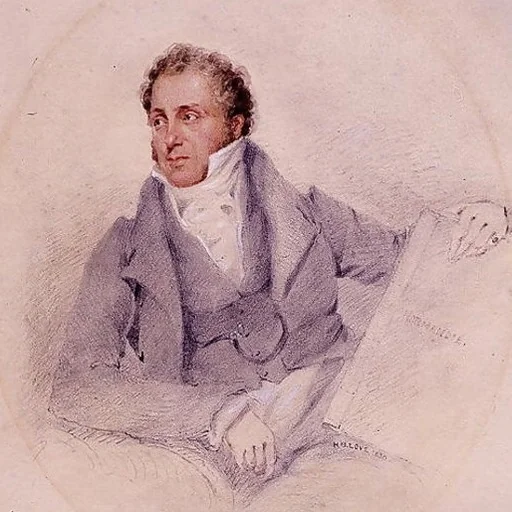
John Sell Cotman (16 May 1782 – 24 July 1842) was an English marine and landscape painter, etcher, illustrator, and a leading member of the Norwich School of painters.

![Shipping in the Port of London [recto], by Félix-Hilaire Buhot](https://artifactworldgallery.com/img/felix-hilaire-buhot--shipping-in-the-port-of-london-recto--fa2d562f3a9aff6c-w320.webp)
![Buildings along a Riverside [verso], by Hubert Robert](https://artifactworldgallery.com/img/hubert-robert--buildings-along-a-riverside-verso--2575ea57b917e17d-w320.webp)
![Gillingham Pier, London [verso], by Félix-Hilaire Buhot](https://artifactworldgallery.com/img/felix-hilaire-buhot--gillingham-pier-london-verso--641e03dd7de8217b-w320.webp)
![Seacoast by Moonlight [recto], by Edward Moran](https://artifactworldgallery.com/img/edward-moran--seacoast-by-moonlight-recto--3ad7ec1ad1d24c0b-w320.webp)