Artwork
Buildings along a Riverside [verso]
![Buildings along a Riverside [verso], by Hubert Robert, chalk, 1760](https://artifactworldgallery.com/img/hubert-robert--buildings-along-a-riverside-verso--2575ea57b917e17d-w1024.webp)
Buildings along a Riverside [verso] is a chalk drawing by the Romanticist artist Hubert Robert. It dates from 1760 and is held in the collection of the National Gallery of Art.
About this work
Overview
Robert, a French painter, was developing his distinctive approach to built environments during this period, blending real structures with poetic liberty.
Created around 1760, this drawing by Hubert Robert is executed in black chalk on laid paper. It belongs to a body of work centered on architectural landscapes, reflecting the artist’s early engagement with topographical observation and imaginative reconstruction. Robert, a French painter, was developing his distinctive approach to built environments during this period, blending real structures with poetic liberty.
Subject & Meaning
The drawing portrays a cluster of buildings lining a riverbank, their forms arranged with a sense of quiet rhythm rather than narrative drama. Though grounded in observed architecture, the composition suggests a fictionalized setting—neither strictly documentary nor entirely invented. It evokes a contemplative atmosphere, inviting the viewer to consider the relationship between human construction and natural surroundings.
Technique & Style
Robert employed black chalk with fluid, varied pressure to define forms, using soft hatching for shadows and sharper lines for architectural edges. The paper’s laid texture subtly enhances the tonal gradations, contributing to a sense of atmospheric depth. His style here balances precision in detail with loose, expressive strokes, characteristic of his early drawings that prioritize mood over rigid accuracy.
History & Provenance
The drawing dates from Robert’s formative years, likely produced during or shortly after his time in Rome, where he studied classical ruins and Italian landscapes. It remained in private hands until entering a public collection in the 20th century. Its verso remains unmarked, suggesting it was not intended as a study for a larger painting but rather a standalone observational piece.
Context
In the 1760s, French artists were increasingly drawn to landscapes that fused real sites with imaginative elements, a trend influenced by the Grand Tour and growing interest in the picturesque. Robert’s work aligned with this movement, distinguishing itself through its restrained elegance and sensitivity to architectural decay, setting him apart from more theatrical contemporaries.
Legacy
This drawing exemplifies Robert’s foundational role in shaping the French tradition of architectural fantasy. His ability to merge observation with invention influenced later generations of landscape and capriccio artists. Though less celebrated than his large-scale paintings, such intimate works reveal the quiet rigor behind his enduring reputation in 18th-century French art.
Artist & collection
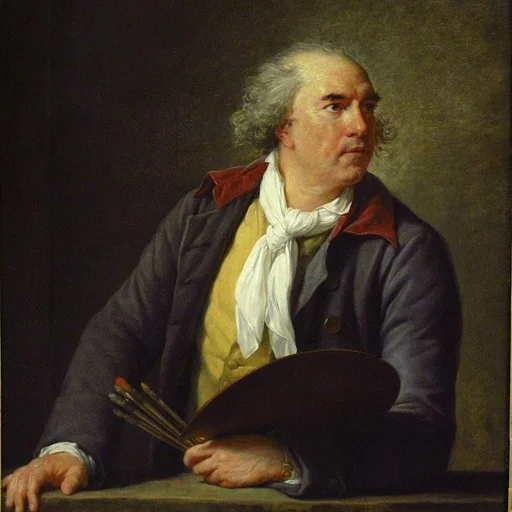
Artist
Hubert Robert (French pronunciation: ; 22 May 1733 – 15 April 1808) was a French painter in the school of Romanticism, noted especially for his landscape paintings and capricci, or semi-fictitious picturesque depictions of ruins in Italy…

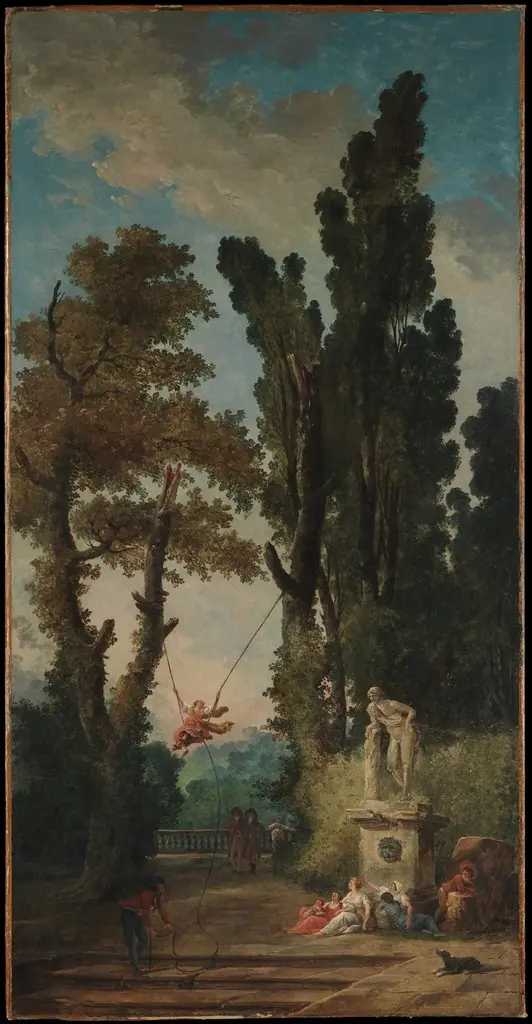
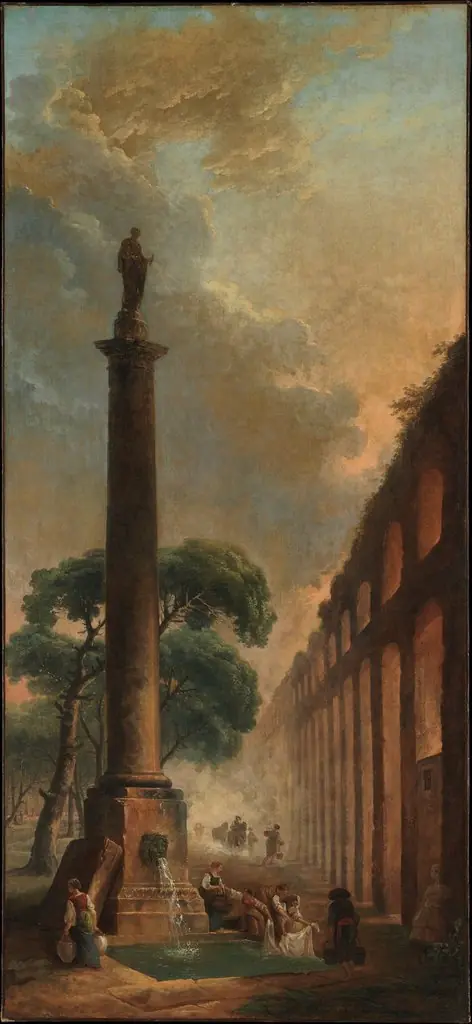
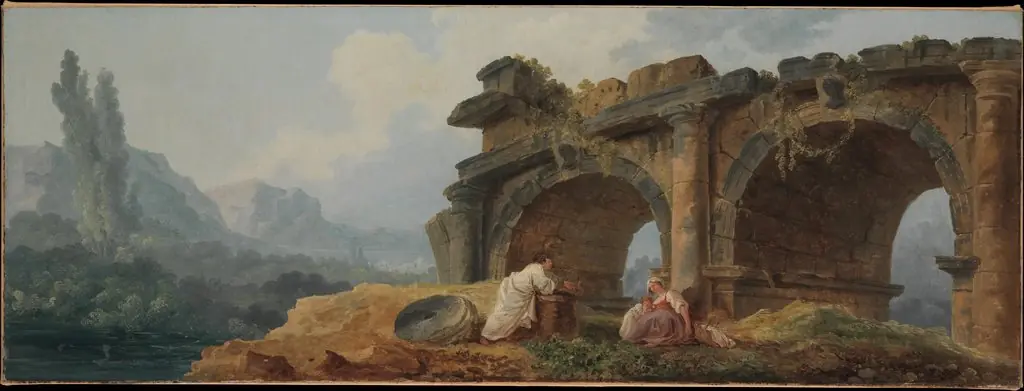
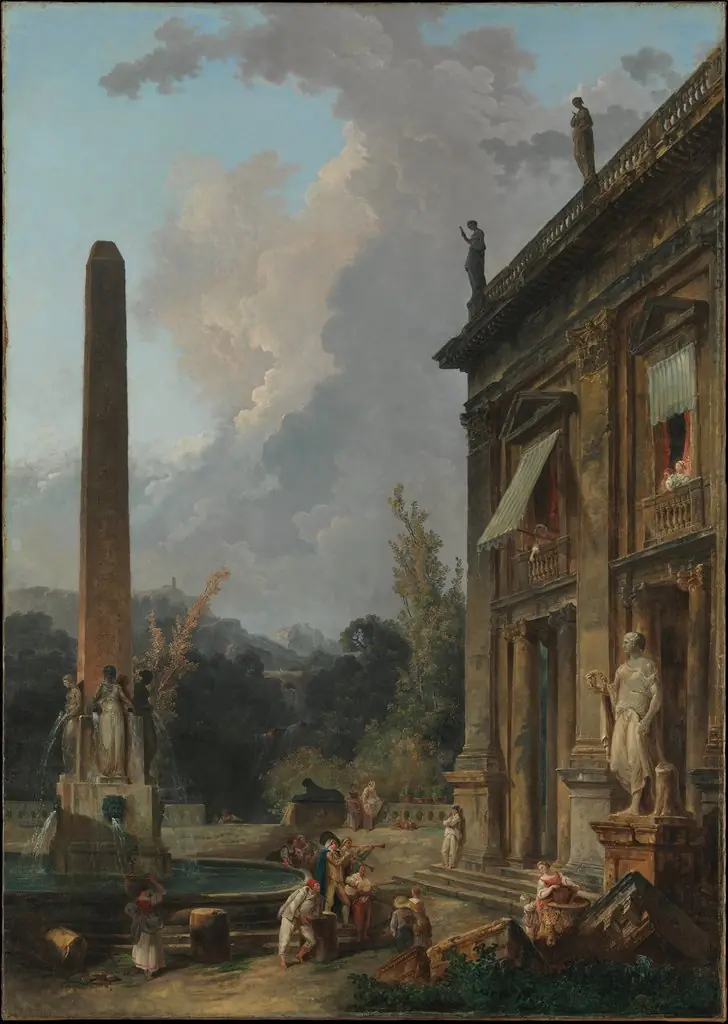
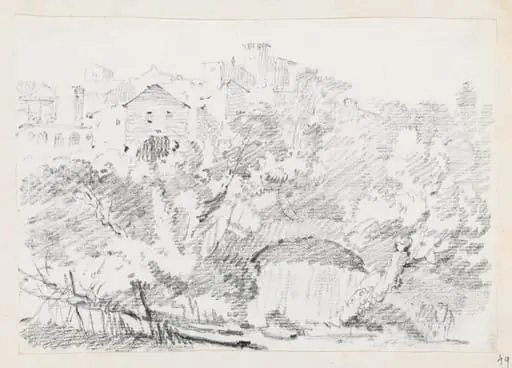 A Waterfall near a Hilltown in Italy
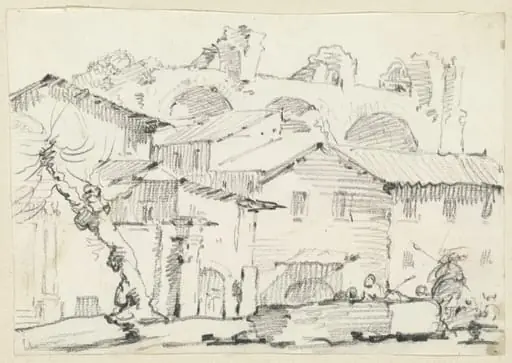 Houses on the North Side of the Forum with the Basilica of Maxentius Beyond
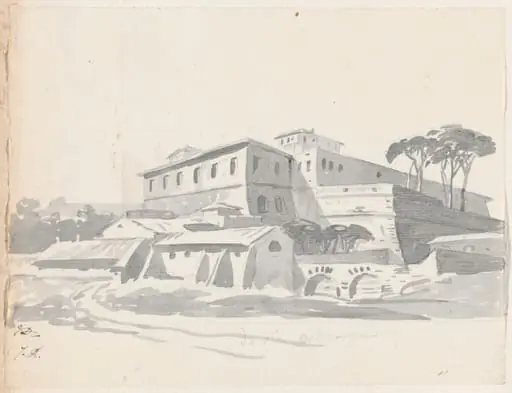 Roman View
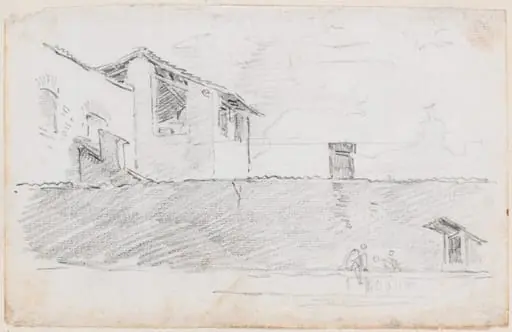 Housetops behind a Wall
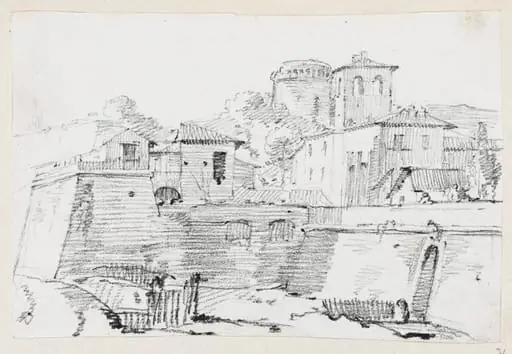 A Fortified Town in Italy
![The Ripetta in Rome [verso], by Augustin Pajou](https://artifactworldgallery.com/img/augustin-pajou--the-ripetta-in-rome-verso--4bc04e9c9476a91b-w320.webp) The Ripetta in Rome [verso]
The Ripetta in Rome [verso]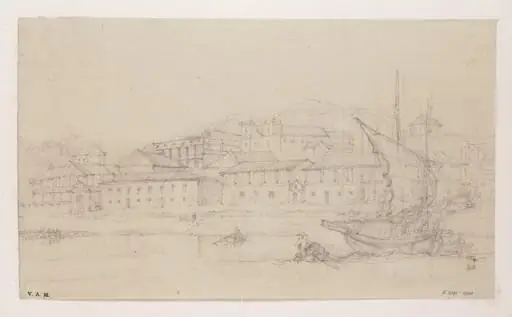 Macau with the church of S. Lourenço
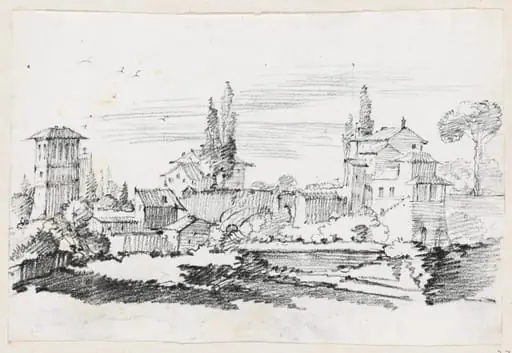 Houses in Italy
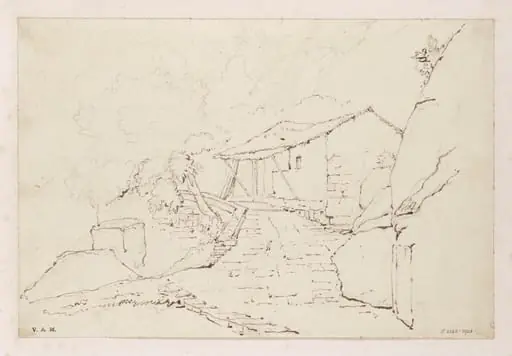 A small building on a rocky hillside, Macau
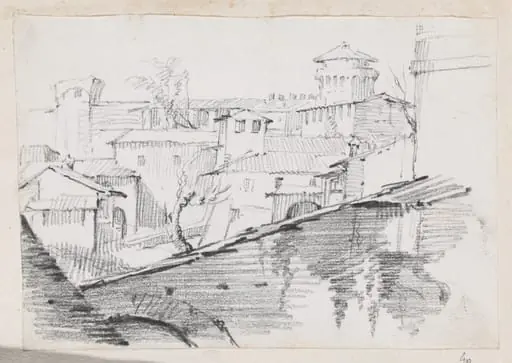 The Forno inside the Walls of the Vatican
![Buildings on a River Bank [verso], by Master of the Blue Landscapes](https://artifactworldgallery.com/img/master-of-the-blue-landscapes--buildings-on-a-river-bank-verso--87ce0f447b9c44c2-w320.webp) Buildings on a River Bank [verso]
Buildings on a River Bank [verso]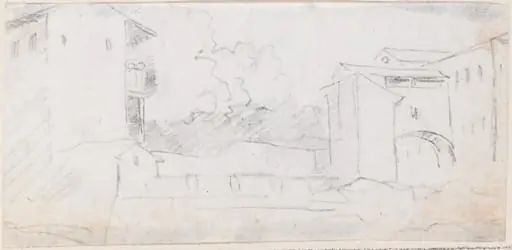 Italian City Scene