Artwork
Christ Crowned with Thorns
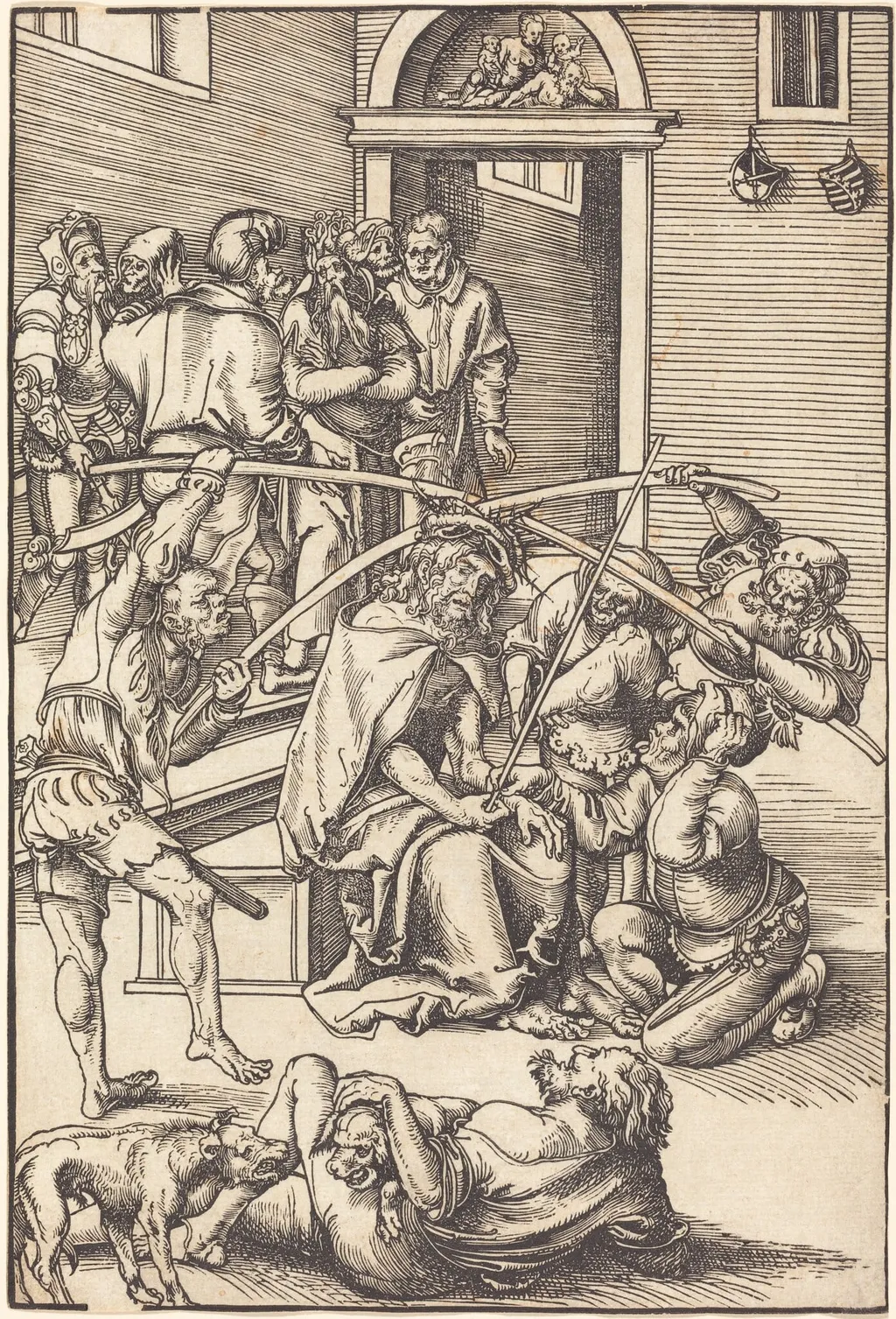
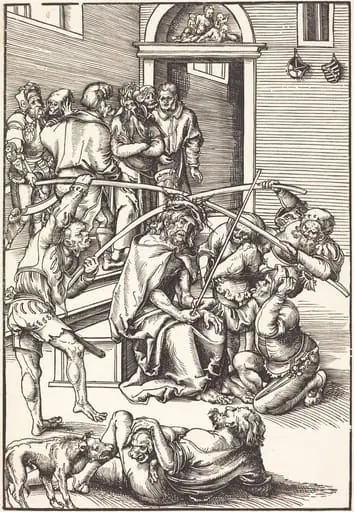
Christ Crowned with Thorns is an ink print by the Renaissance artist Lucas Cranach the Elder. It dates from 1512 and is held in the collection of the National Gallery of Art.
About this work
Overview
Created in 1512 by Lucas Cranach the Elder, this woodcut is a religious print from the early German Renaissance. As both a painter and printmaker, Cranach produced works for the Saxon court and later embraced Protestant reform. The image captures a moment from the Passion narrative, rendered through the technical demands of woodcut printing, which favored bold contrasts and linear clarity.
Subject & Meaning
The scene illustrates Christ’s humiliation as Roman soldiers force a crown of thorns onto his head and mock his claimed kingship. Figures surround him in a dense, agitated group, their gestures emphasizing cruelty and derision. The composition reflects a devotional focus on Christ’s suffering, intended to evoke empathy and spiritual reflection in viewers during a time of religious upheaval.
Technique & Style
The absence of shading and the rhythmic repetition of lines create a sense of urgency, characteristic of Northern European printmaking of the period.
Cranach employed sharp, incised lines to carve the design into a wooden block, producing a high-contrast image with black ink on a pale ground. Forms are simplified into clear silhouettes, allowing complex action to remain legible despite the crowded composition. The absence of shading and the rhythmic repetition of lines create a sense of urgency, characteristic of Northern European printmaking of the period.
History & Provenance
Made during Cranach’s tenure as court artist to the Electors of Saxony, the print likely circulated among religious and noble patrons. Its production coincided with rising interest in accessible religious imagery, preceding the full force of the Reformation. Surviving impressions suggest it was part of a broader series of Passion scenes, widely distributed through print networks in early 16th-century Germany.
Context
In the years before Luther’s theses, devotional prints like this served as tools for personal piety and moral instruction. The emphasis on Christ’s physical torment aligned with late medieval devotional trends, even as new Protestant ideals began to reshape religious imagery. Cranach’s style bridged traditional iconography with emerging Reformation sensibilities, making his prints both familiar and timely.
Legacy
This woodcut exemplifies Cranach’s role in advancing print culture as a vehicle for religious narrative. His clear, forceful compositions influenced later Protestant artists seeking to communicate biblical stories without elaborate ornamentation. Though not widely copied, its structural clarity and emotional intensity helped define the visual language of Reformation-era religious prints.
Artist & collection
Artist
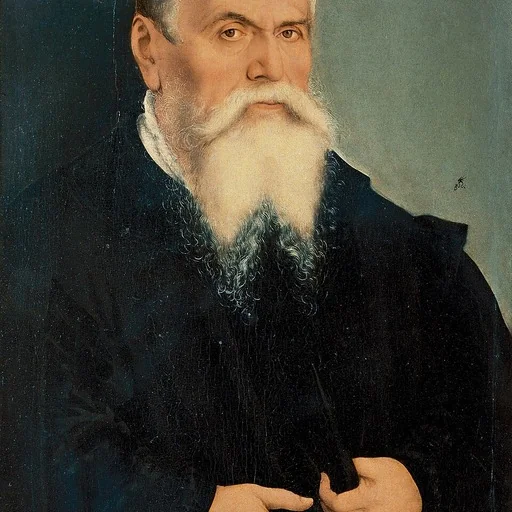
Lucas Cranach the Elder was a German Renaissance painter and printmaker in woodcut and engraving.