Artwork
Joachim's Offering Rejected
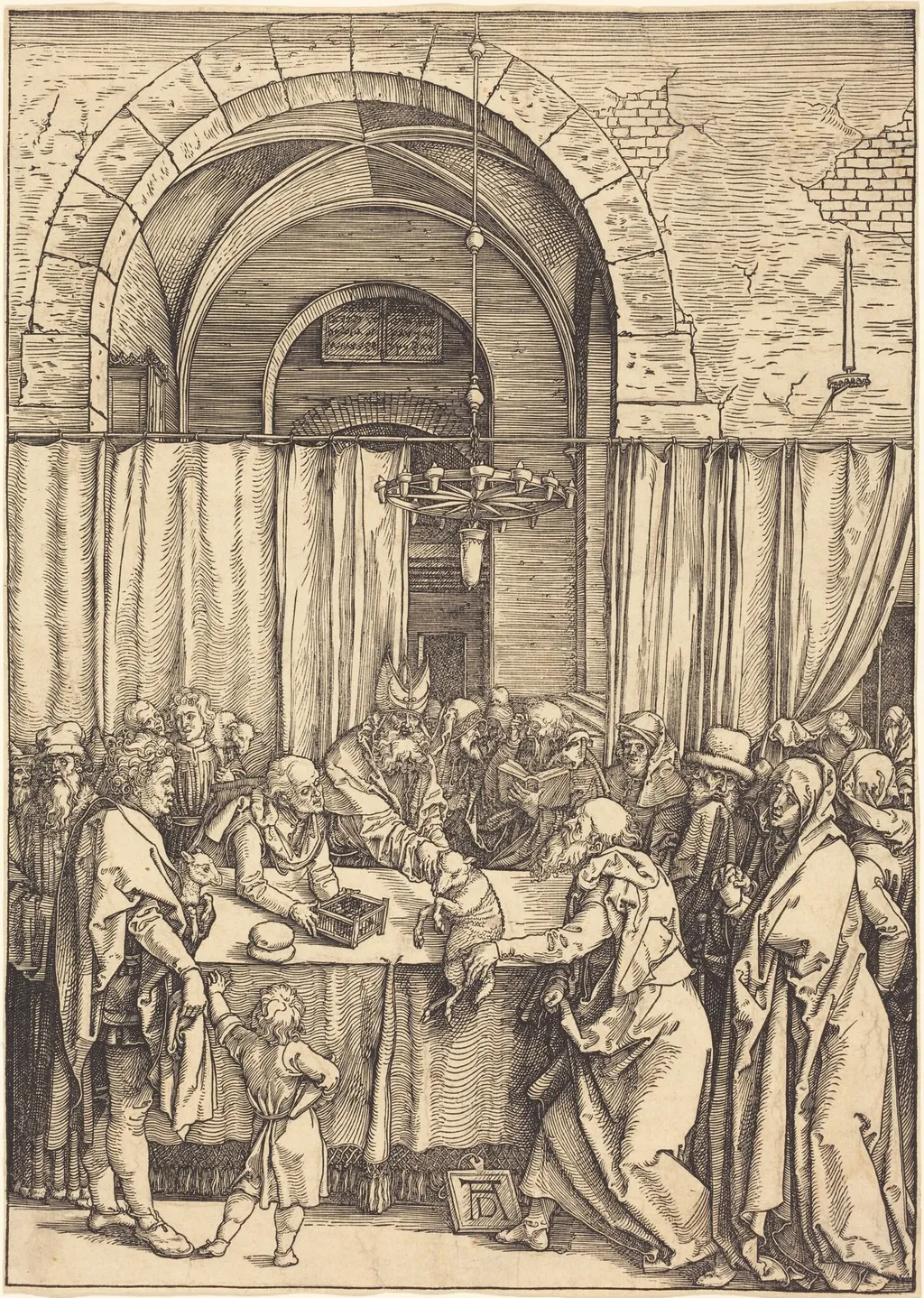
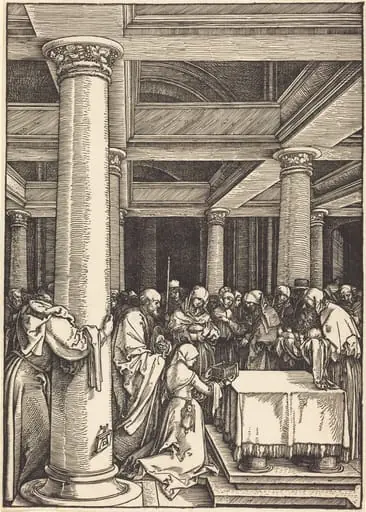
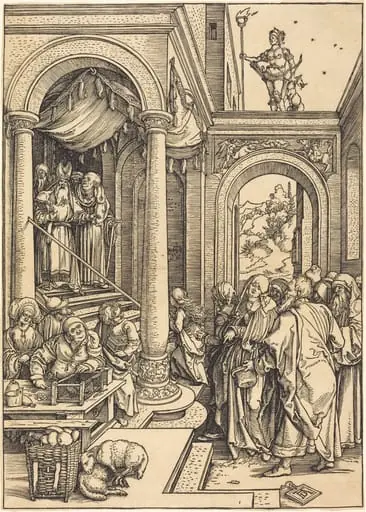
Joachim's Offering Rejected is an ink print by the Northern Renaissance artist Albrecht Dürer. It dates from 1504 and is held in the collection of the Metropolitan Museum of Art.
About this work
Overview
Created in 1504, 'Joachim's Offering Rejected' is a woodcut by Albrecht Dürer depicting a pivotal moment from the apocryphal Protoevangelium of James.
Created in 1504, 'Joachim's Offering Rejected' is a woodcut by Albrecht Dürer depicting a pivotal moment from the apocryphal Protoevangelium of James. The composition captures the narrative where Joachim, a pious but childless man, presents a lamb at the Temple in Jerusalem, only to have his sacrifice rejected by the high priest due to his perceived lack of divine favor. Dürer arranges the figures to emphasize the emotional weight of the scene: Joachim kneels in the foreground, his head bowed and hands tightly clutching the lamb, conveying deep humiliation and sorrow. The priest stands in profile, gesturing dismissively, while other onlookers observe the rejection. Executed with the artist's characteristic precision, the woodcut utilizes dense cross-hatching and varied line weights to render complex textures, from the heavy folds of the priest's robes to the soft fleece of the animal and the architectural details of the temple setting. This work is part of Dürer's extensive series on the Life of the Virgin, produced during his mature period in Nuremberg. It exemplifies the German Renaissance's fusion of Northern European attention to detail with Italianate principles of composition and human emotion, establishing a new standard for narrative clarity in printmaking.
Subject & Meaning
The composition captures Joachim on his knees, offering a lamb to a temple priest who refuses the sacrifice. Joachim’s downcast expression and the grip on the animal convey a sense of rejection and humility, reflecting themes of devotion and divine testing.
Technique & Style
Dürer employs delicate, intersecting lines to model shadows and surface textures. The priest’s garment is rendered with weighty folds, while the lamb’s fleece is depicted in fine detail, demonstrating the artist’s mastery of line work inherent to the woodcut medium.
History & Provenance
Created in the early sixteenth century, this print was produced as part of Dürer’s series on Joachim’s narrative. The work circulated among collectors of religious prints, though specific ownership records from its early years remain sparse.
Context
The image aligns with contemporary devotional practices that emphasized visual meditation on biblical stories. By illustrating a moment of failed offering, Dürer engages with theological discussions of faith, obedience, and divine providence prevalent in his era.
Artist & collection
Artist
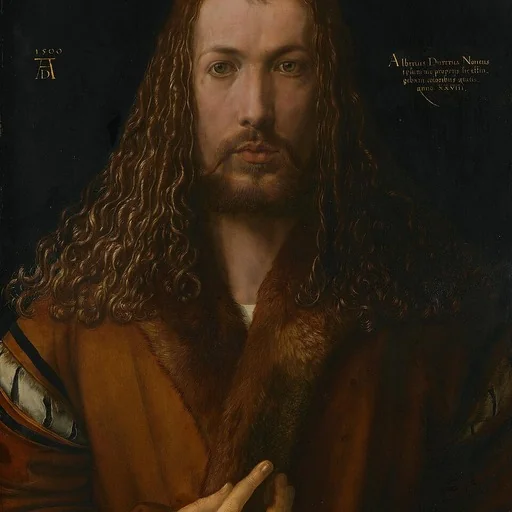
Albrecht Dürer spent his life in Nuremberg, a busy German city where artists traded prints like currency.

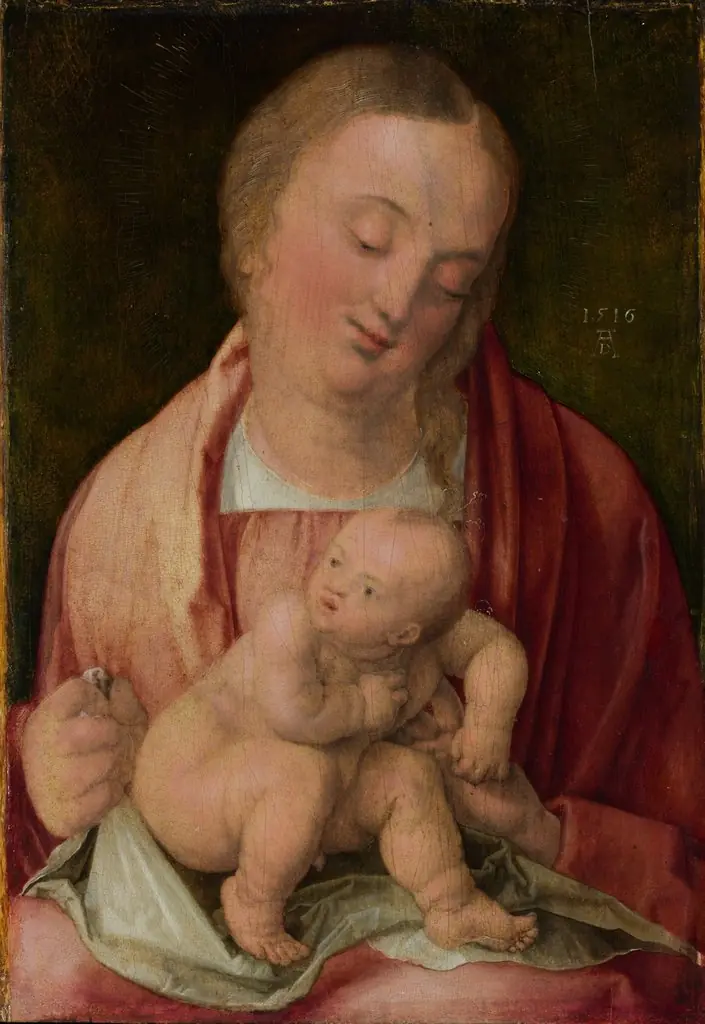
![Madonna and Child [obverse], by Albrecht Dürer](https://artifactworldgallery.com/img/albrecht-durer--madonna-and-child-obverse--d7b8ebf05d22ebe5-w320.webp)
![Lot and His Daughters [reverse], by Albrecht Dürer](https://artifactworldgallery.com/img/albrecht-durer--lot-and-his-daughters-reverse--b4ebf9b282faa17a-w320.webp)