Artwork
A Bucharest
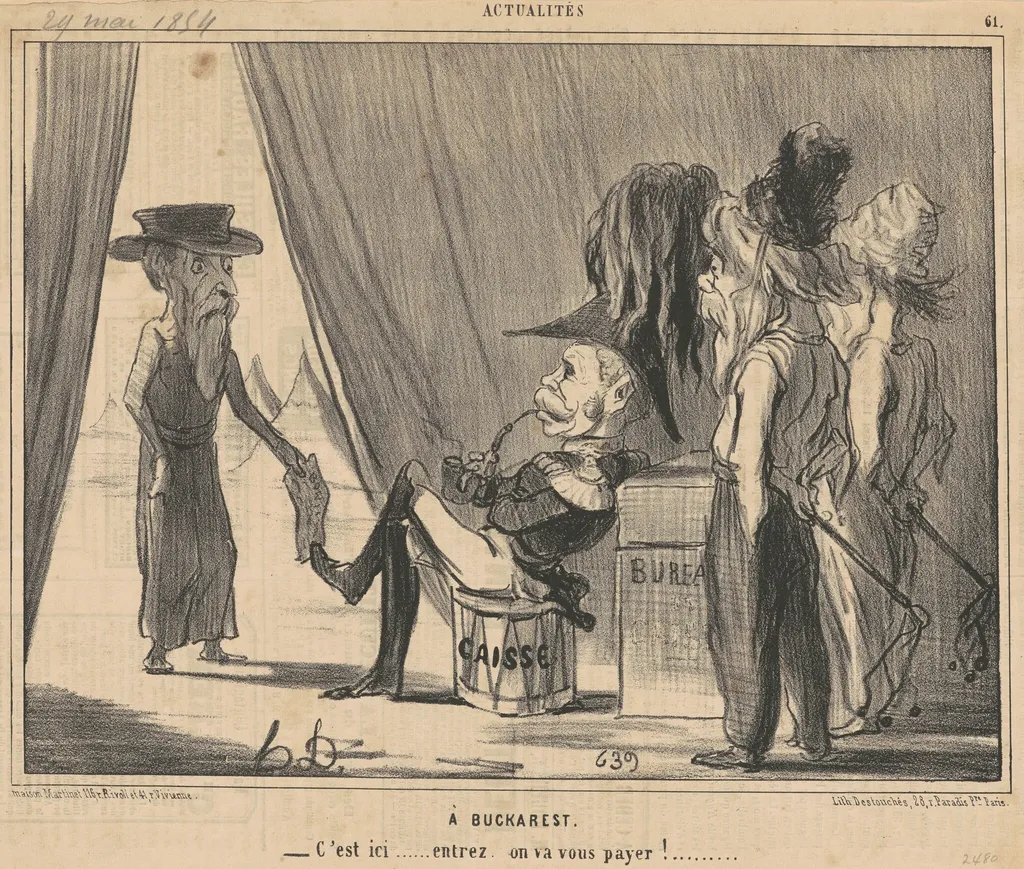
A Bucharest is an ink print by the Impressionist artist Honoré Daumier. It dates from 1854 and is held in the collection of the National Gallery of Art.
About this work
Daumier’s 1854 lithograph shows a chubby fellow on a “Bureau” box pointing at a newcomer.
Daumier’s 1854 lithograph shows a chubby fellow on a “Bureau” box pointing at a newcomer. The room looks messy, like an office or shop. The seated man’s big hands and tiny feet look silly on purpose.
This is a political joke in picture form. Daumier often mocked France’s leaders in prints sold cheap on the street. He used exaggerated faces to show who was in charge and who wasn’t.
Try looking up Daumier, Honoré next.
Overview
Honoré Daumier’s 1854 lithograph, often catalogued under the title “ACTUALITÉS,” presents a cramped interior scene populated by exaggerated characters. A stout figure perched on a crate marked “BUREAU” and “CAISSE” points toward an incoming individual, while the surrounding space suggests a disorderly office or shop. The composition combines humor with a pointed critique, typical of Daumier’s socially engaged prints.
Subject & Meaning
The central figure’s oversized hands and diminutive feet create a deliberately comic distortion, underscoring the absurdity of the situation. By gesturing at the newcomer, the seated man appears to announce or mock a new development, likely a political or bureaucratic change. The work thus functions as a visual satire, using caricature to comment on contemporary power dynamics.
Technique & Style
Executed as a lithograph, the image relies on bold line work and stark contrasts to emphasize the figures’ exaggerated proportions. Daumier’s characteristic use of thick outlines and simplified shading enhances the immediacy of the scene, while the printed medium allowed for rapid production and wide distribution among the urban public.
History & Provenance
Produced in the mid‑nineteenth century, the print was part of Daumier’s prolific output of inexpensive street‑sold caricatures. Copies circulated in Parisian markets, reaching a broad audience beyond elite patrons. The work has since entered museum collections, where it is cited as an example of Daumier’s engagement with current events through print media.
Context
During the 1850s France experienced frequent political turnover and bureaucratic reforms, subjects that Daumier routinely lampooned. The labels “BUREAU” and “CAISSE” reference official offices and cash registers, hinting at the entanglement of administration and finance. The chaotic setting mirrors the perceived disorder of public life at the time.
Own this work as a print
Artist & collection

Artist
Honoré-Victorin Daumier was a French painter, sculptor, and printmaker, whose many works offer commentary on the social and political life in France, from the Revolution of 1830 to the fall of the Second French Empire in 1870.