Artwork
Allons lancez vous père goutot...
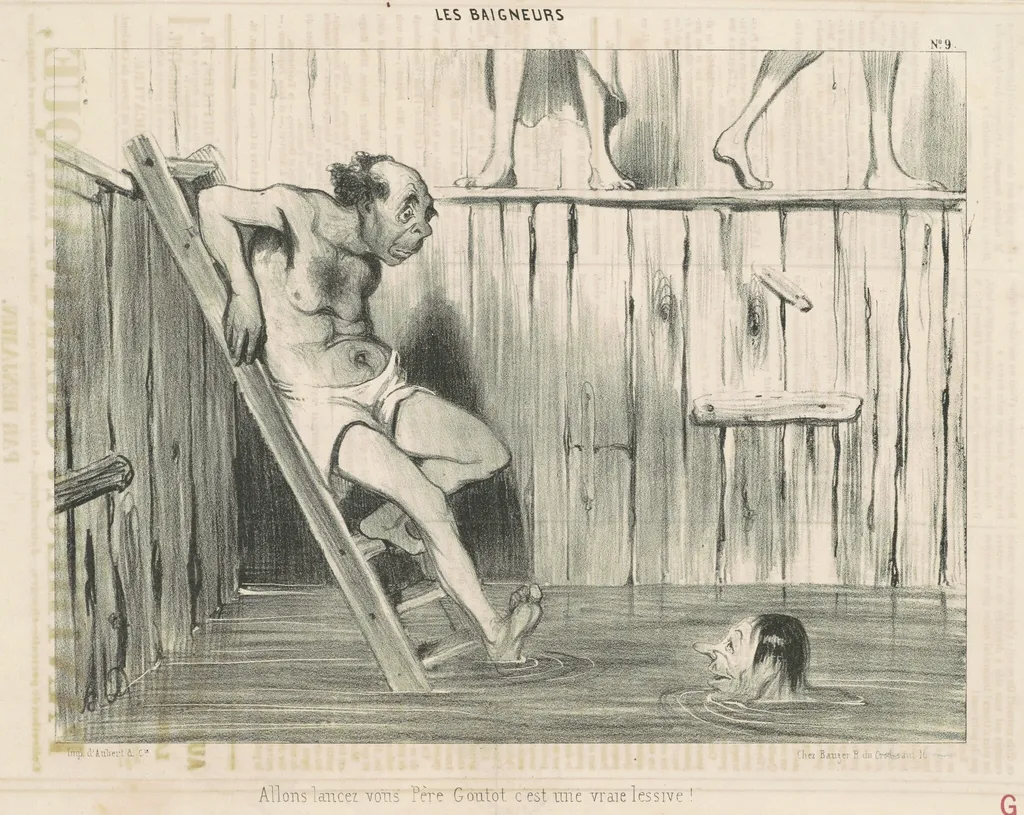
Allons lancez vous père goutot... is an ink print by the Romanticist artist Honoré Daumier. It dates from 1839 and is held in the collection of the National Gallery of Art.
About this work
You see a round man in striped pants about to step into a wooden bathing hut. His big hat is crooked. One foot hovers over a puddle.
Daumier loved to mock Paris fads. This 1839 lithograph laughs at beach culture before beaches were cool. Notice how the hut’s shadow cuts him off—like society cutting off silly trends.
It’s a quick sketch in stone ink called lithography.
Overview
Honoré Daumier’s 1839 lithograph presents a single figure poised before a modest wooden bathing hut. The composition captures a fleeting moment as the man, dressed in striped trousers and a lopsided hat, lifts one foot toward a shallow puddle. The work’s brisk line work and exaggerated anatomy mark it as a satirical study of contemporary leisure.
Subject & Meaning
The image caricatures a Parisian gentleman about to enter a makeshift bathing enclosure, a scene that lampoons the emerging popularity of seaside recreation. By inflating the figure’s facial features and posture, Daumier critiques the pretensions of fashionable fads, suggesting that such pursuits are as shallow as the puddle beneath the man’s foot.
Technique & Style
Executed in lithography, the print relies on a stone‑based ink process that allows rapid, gestural drawing. Daumier’s use of bold contours, stark contrasts, and a limited palette emphasizes the figure’s comic distortion while preserving a sense of immediacy, characteristic of his socially charged caricatures.
History & Provenance
Created in 1839, the print emerged during a period when Daumier regularly contributed satirical images to Parisian journals. Though originally circulated as a newspaper illustration, the lithograph later entered private collections, reflecting the artist’s growing reputation for incisive commentary on urban life.
Context
The work appears at a time when French society was beginning to embrace coastal outings, yet such activities were still novel and often mocked. Daumier’s depiction aligns with his broader oeuvre that targets the frivolities of the bourgeois class, using humor to expose the fleeting nature of trends.
Artist & collection

Artist
Honoré-Victorin Daumier was a French painter, sculptor, and printmaker, whose many works offer commentary on the social and political life in France, from the Revolution of 1830 to the fall of the Second French Empire in 1870.