Artwork
Conducteur ... j'avais pris vos messageries ...
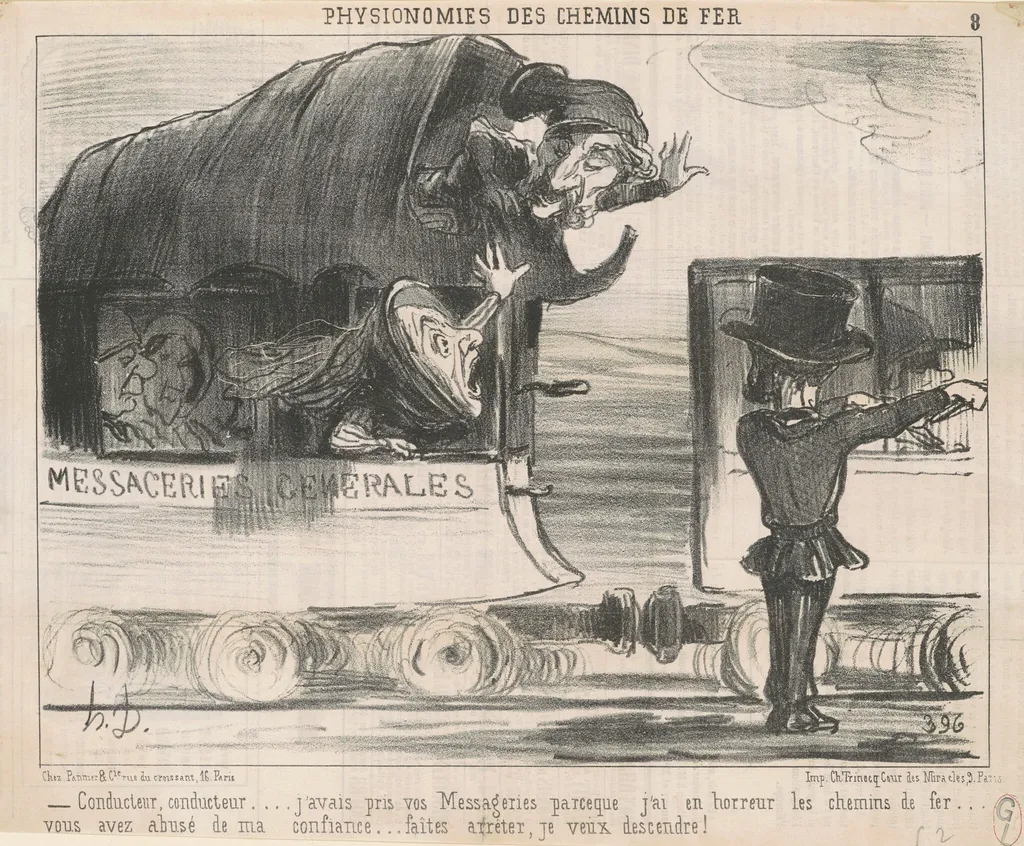
Conducteur ... j'avais pris vos messageries ... is an ink print by the Impressionist artist Honoré Daumier. It dates from 1852 and is held in the collection of the National Gallery of Art.
About this work
” A man in a top hat stands out front while passengers wave arms and stretch faces in distress.
This lithograph shows a crowded train carriage labeled “MESSAGERIES GENERALES.” A man in a top hat stands out front while passengers wave arms and stretch faces in distress. They look like they’re fighting over space, not tickets.
Daumier made this in 1852 to mock early rail travel—crowded cars were new and scary. He used lithography so prints could reach lots of people fast.
He did more of these scenes—look up Honoré Daumier.
Overview
Honoré Daumier’s 1852 lithograph, titled *Conducteur … j’avais pris vos messageries …*, presents a bustling railway carriage marked “MESSAGERIES GENERALES.” The scene is crowded with passengers whose outstretched arms and exaggerated expressions convey a sense of panic and competition for space, while a solitary figure in a top hat occupies the foreground.
Subject & Meaning
The print satirizes the early experience of rail travel, portraying commuters as frantic and disoriented. By emphasizing the chaotic gestures and strained faces, Daumier critiques the social upheaval brought by the new mode of transportation, suggesting that the speed and density of trains unsettled traditional notions of order and personal space.
Technique & Style
Executed in lithography, the work exploits the medium’s capacity for rapid, reproducible images. Daumier’s bold line work and stark contrasts heighten the caricatural quality, while the simplified forms and exaggerated anatomy reinforce the humorous yet critical tone typical of his social commentary prints.
History & Provenance
Created in 1852, the lithograph was produced for wide circulation, allowing Daumier’s commentary to reach a broad audience soon after the expansion of France’s railway network. Original impressions remain in several public collections, reflecting the work’s continued relevance as a document of mid‑nineteenth‑century urban life.
Context
During the 1850s, French society grappled with the rapid growth of rail infrastructure, which transformed travel, commerce, and daily routines. Daumier’s series of railway scenes captures this transitional moment, positioning the artist among contemporaries who used satire to comment on the technological and social changes of the Second Empire.
Artist & collection
Artist
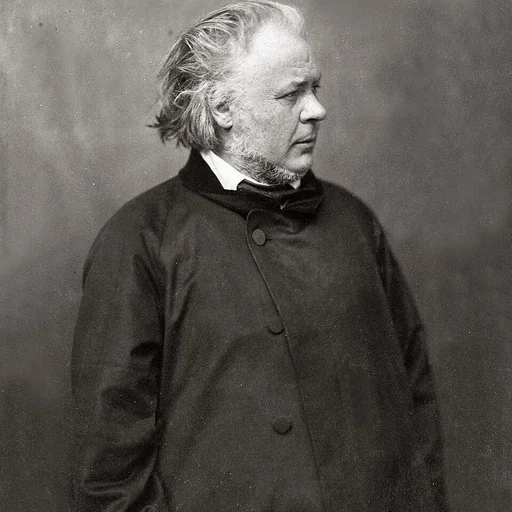
Honoré-Victorin Daumier was a French painter, sculptor, and printmaker, whose many works offer commentary on the social and political life in France, from the Revolution of 1830 to the fall of the Second French Empire in 1870.

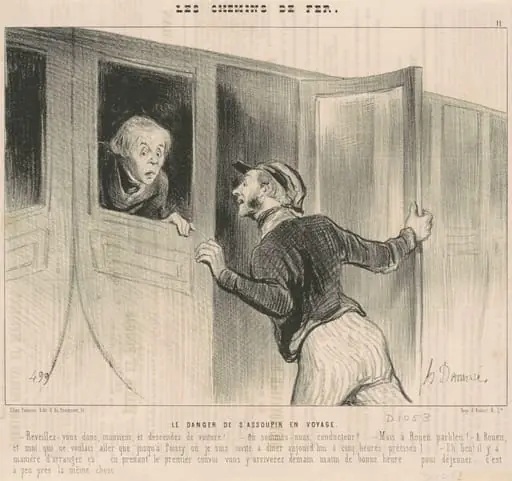 Le danger de s'assoupir en voyage
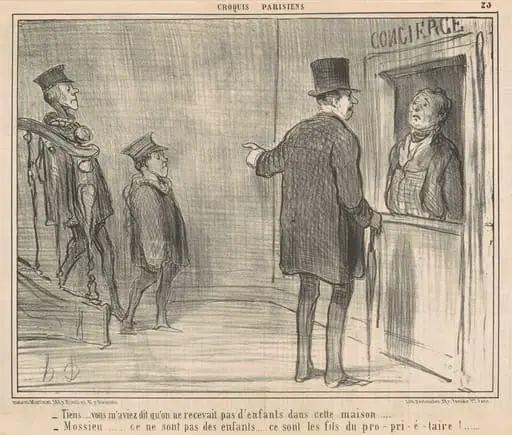 Tiens ... vous m'aviez dit ...
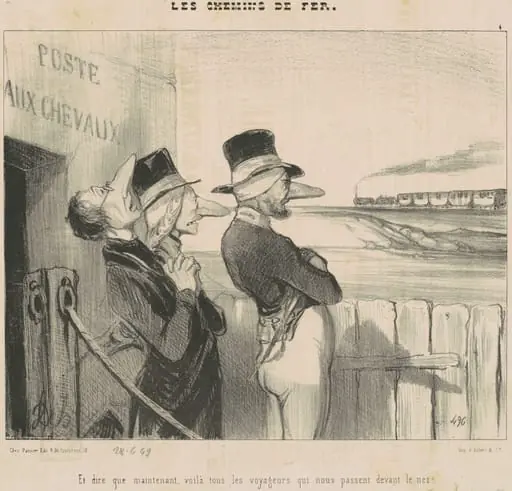 Et ... Voila ...Les voyageurs qui nous passent devant le nez!
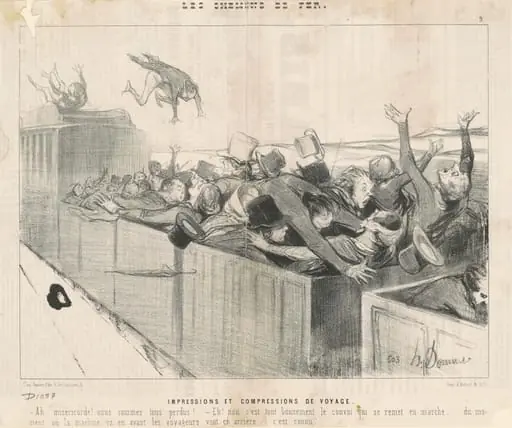 Impressions et compressions de voyage
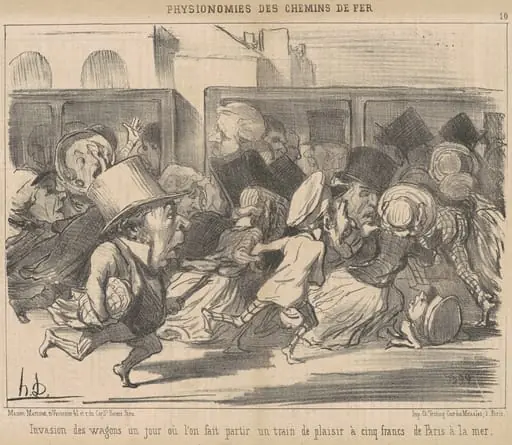 Invasion es wagons un jour ou l'on fait partir
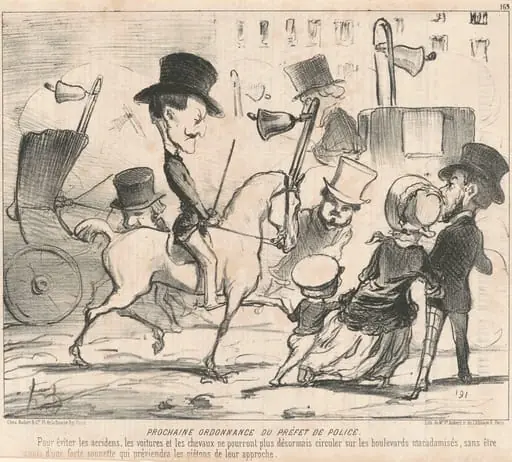 Prochaine ordannace du préfet de police
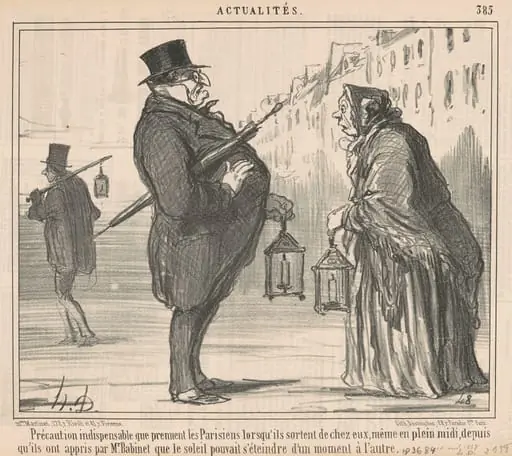 Précaution indispensable que prennent les Parisiens ...