Artwork
Je pars plus amoureux que... jamais...
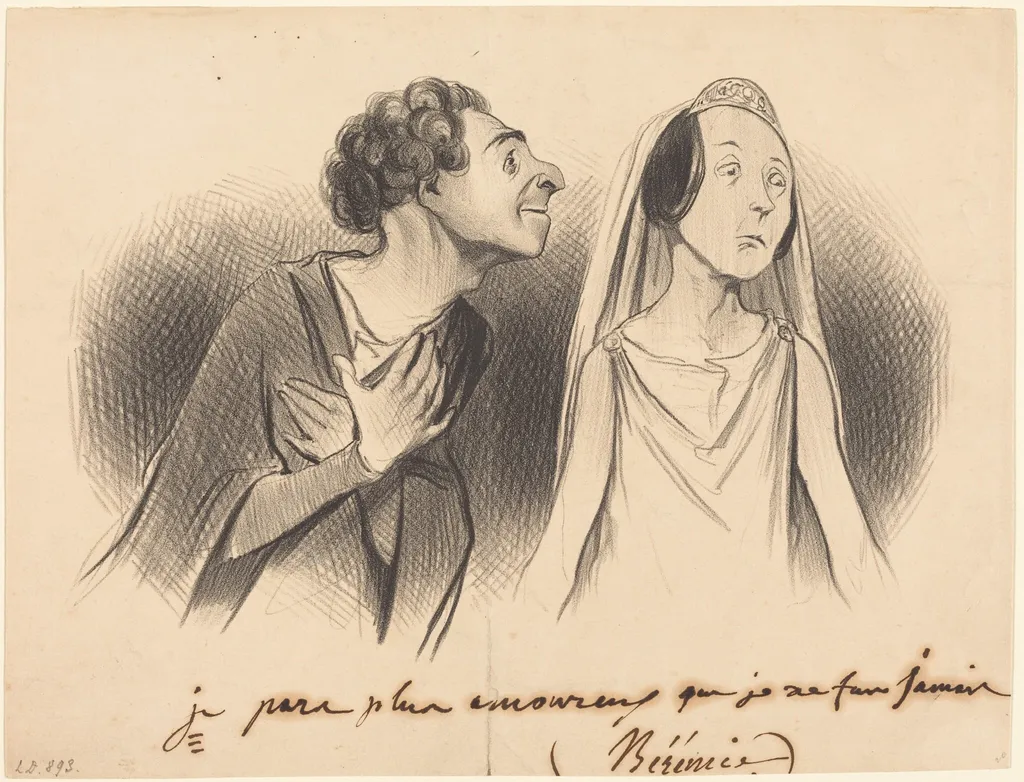
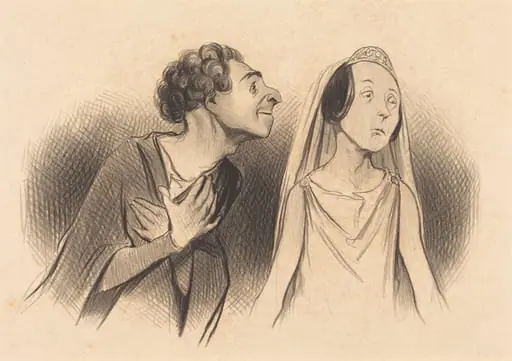
Je pars plus amoureux que... jamais... is an ink print by the Romanticist artist Honoré Daumier. It dates from 1841 and is held in the collection of the National Gallery of Art.
About this work
Overview
Created in 1841, this lithograph by Honoré Daumier exemplifies his extensive work as a printmaker engaged in social and political satire. Produced for the republican-leaning periodicals La Caricature and Le Charivari, the image captures a fleeting, informal moment between two figures, rendered in a sketch‑like style that emphasizes immediacy over finish.
Subject & Meaning
The composition presents a man in a loose jacket with crossed arms standing beside a woman in a plain, veiled gown. Both wear serious, almost anxious expressions, suggesting a scene of private concern rather than public spectacle. The pairing and their demeanor hint at Daumier’s interest in everyday human interactions as a mirror for broader societal tensions.
Technique & Style
Executed in lithography, the work relies on rapid, gestural lines and dense shading, producing a rough, smudged surface. Daumier’s use of the medium allows for swift production and a spontaneous feel, characteristic of his satirical sketches that prioritize narrative immediacy over polished finish.
History & Provenance
The print was originally circulated through La Caricature and Le Charivari, publications that served as platforms for Daumier’s critiques of mid‑19th‑century French politics. Its distribution in these outlets situates the work within the era’s vibrant press culture, where lithographs functioned as accessible commentary for a growing literate public.
Context
Mid‑century France experienced intense political upheaval, with republican ideas challenging established hierarchies. Daumier’s prints, including this piece, responded to that climate by employing caricature and everyday scenes to reflect public sentiment and to subtly question authority.
Artist & collection
Artist
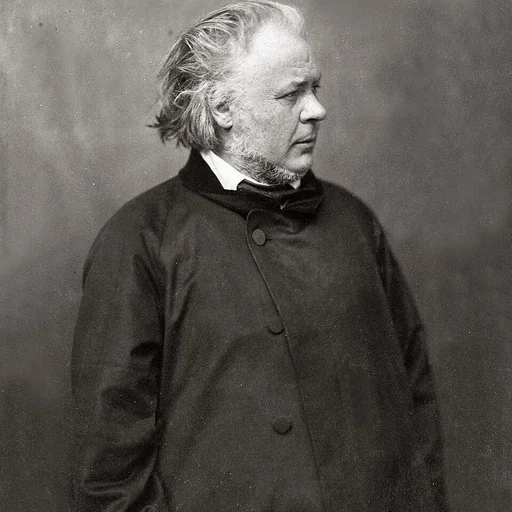
Honoré-Victorin Daumier was a French painter, sculptor, and printmaker, whose many works offer commentary on the social and political life in France, from the Revolution of 1830 to the fall of the Second French Empire in 1870.