Artwork
Le quatrième acte d'un drame intéressant
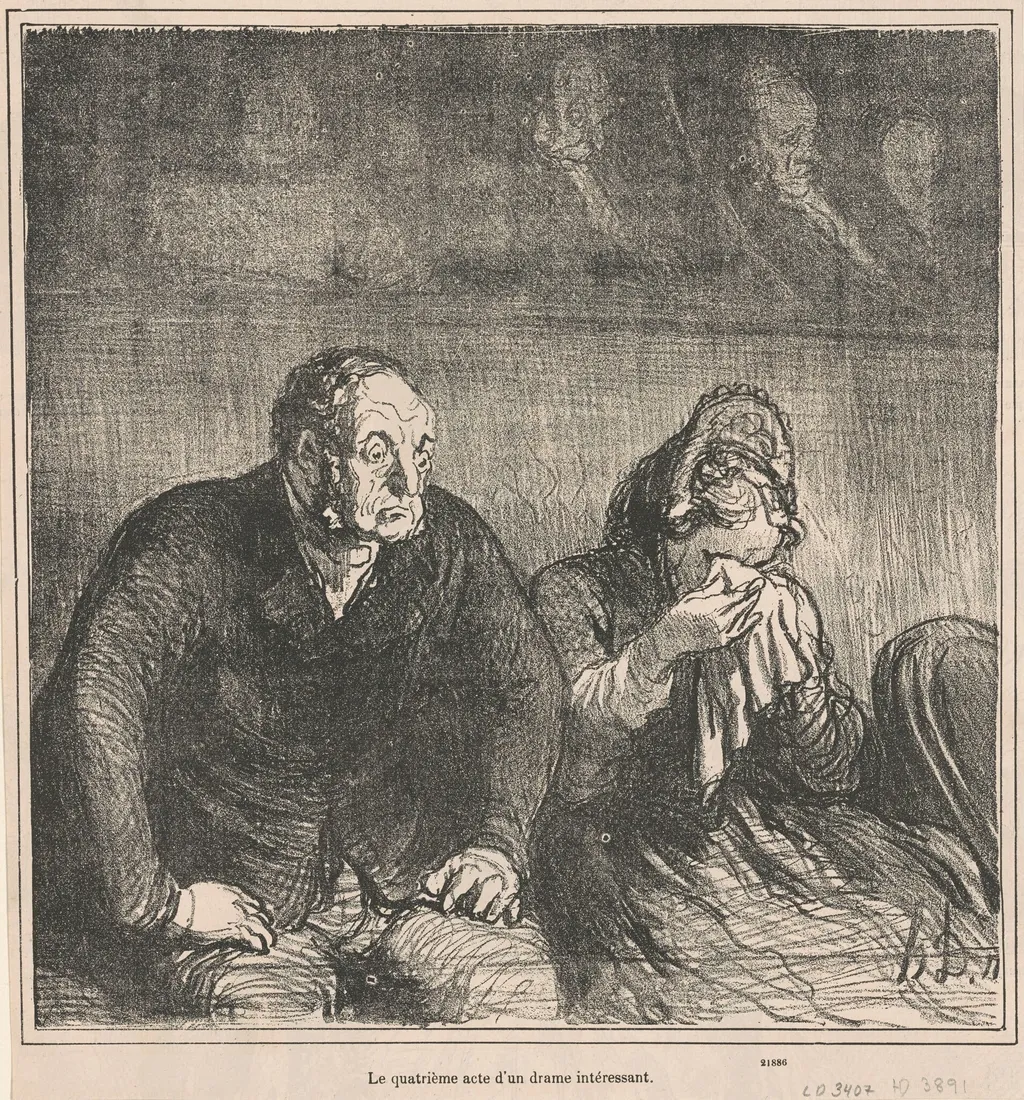
Le quatrième acte d'un drame intéressant is an ink print by the Impressionist artist Honoré Daumier. It dates from 1864 and is held in the collection of the National Gallery of Art.
About this work
Overview
The work belongs to a series illustrating scenes from contemporary life, rendered with minimal detail yet maximal emotional weight.
Created in 1864 by Honoré Daumier, this lithograph captures a quiet, emotionally charged moment between two figures. Unlike theatrical depictions of drama, it focuses on stillness and unspoken tension. The work belongs to a series illustrating scenes from contemporary life, rendered with minimal detail yet maximal emotional weight. Daumier’s choice of lithography allowed for rapid, expressive execution suited to his observational style.
Subject & Meaning
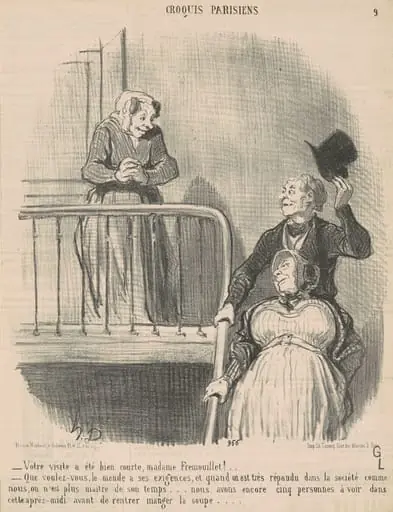
An elderly man and a woman sit in close proximity, their postures suggesting shared sorrow or reflection. Their interaction is restrained, avoiding overt gesture, which amplifies the sense of private grief or resignation. The blurred, spectral faces in the background imply the presence of unseen observers or memories, deepening the psychological atmosphere without clarifying narrative specifics.
Technique & Style
Daumier employed lithography to achieve tonal subtlety and fluid line work. By manipulating the stone’s surface with washes and hatching, he created soft gradations that define form without hard outlines. The background’s ghostly smudges contrast with the sharper silhouettes of the figures, directing focus to their emotional stillness while evoking the ephemeral nature of human presence.
History & Provenance
This print was produced during Daumier’s mature period, when he increasingly turned from political satire to intimate domestic scenes. It was likely published in a periodical or as part of a portfolio, circulating among Parisian middle-class audiences. Its survival in institutional collections reflects its recognition as a significant example of 19th-century graphic art, though its early ownership remains undocumented.
Context
In mid-19th century France, lithography was a dominant medium for illustrated journalism and social commentary. Daumier, long associated with caricature, used the technique to explore quieter human experiences as urban life grew more complex. This work aligns with a broader shift in his oeuvre toward psychological realism, away from overt satire toward nuanced portrayals of ordinary emotion.
Legacy
Daumier’s ability to convey depth through simplicity influenced later artists, including the Expressionists and early modern printmakers. This lithograph exemplifies his capacity to transform mundane moments into resonant visual poetry. While not widely exhibited in his lifetime, it now stands as a quiet testament to his mastery of emotional nuance in graphic media.
Own this work as a print
Artist & collection

Artist
Honoré-Victorin Daumier was a French painter, sculptor, and printmaker, whose many works offer commentary on the social and political life in France, from the Revolution of 1830 to the fall of the Second French Empire in 1870.