Artwork
Décadence du drame en 1866
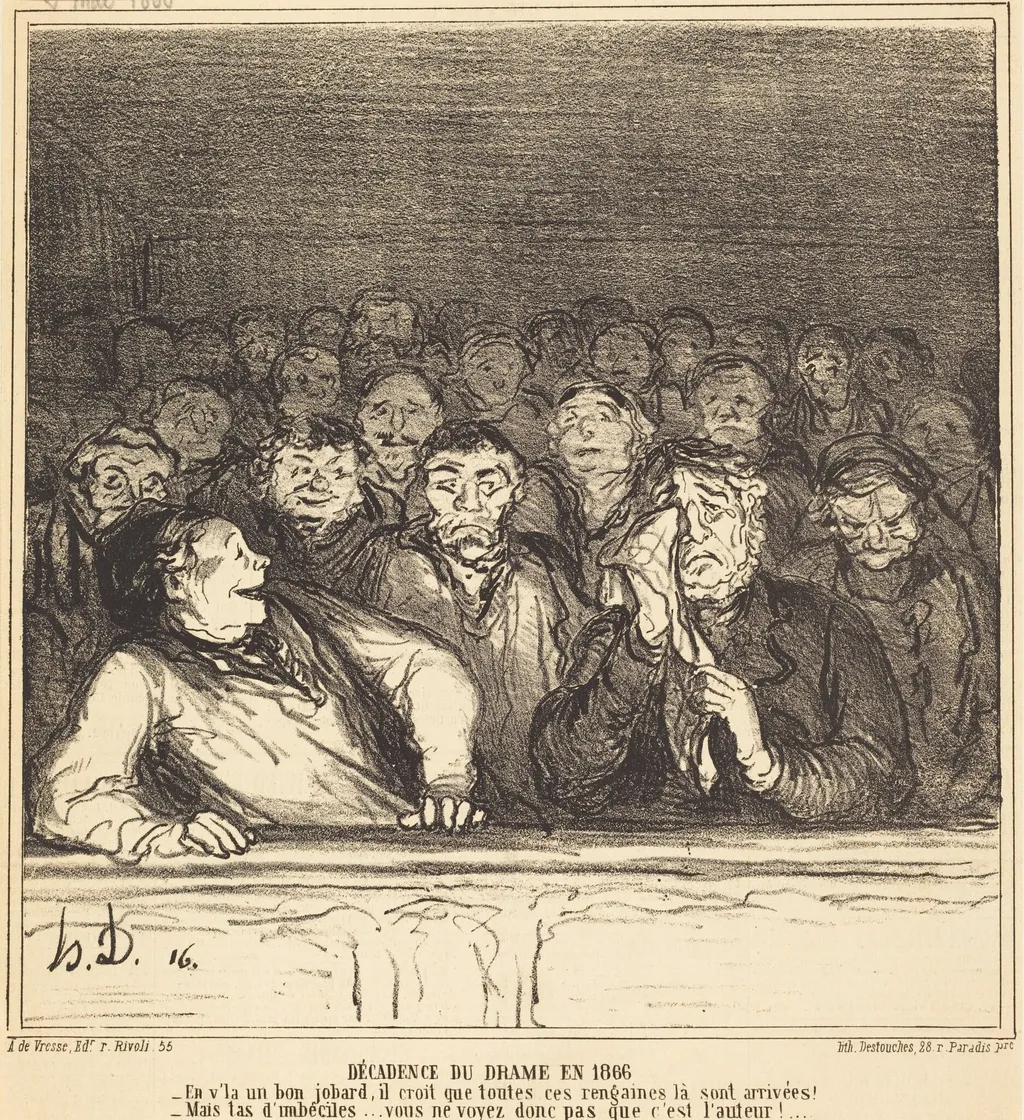
Décadence du drame en 1866 is an ink print by the Impressionist artist Honoré Daumier. It dates from 1866 and is held in the collection of the National Gallery of Art.
About this work
The lines are rough and sketchy, almost like a quick drawing—no smooth shading, just quick strokes to show expressions.
This sketch shows a crowded group of faces pressed together in a theater balcony. The people look bored, some yawning or staring blankly, while others lean on the railing. The lines are rough and sketchy, almost like a quick drawing—no smooth shading, just quick strokes to show expressions.
The title at the bottom calls it *"Decadence of the Drama in 1866"* and jokes about the audience not seeing the play. Daumier made this as a lithograph, a printmaking method where artists draw directly onto a stone.
Next, check out lithography to see how this sketchy style was made.
Overview
Created in 1866, this lithograph by Honoré Daumier captures a moment of theatrical disillusionment during France’s Second Empire. Executed on newsprint, the work belongs to a series of satirical prints that scrutinized cultural life under Napoleon III. Daumier, long engaged with print journalism, used the accessibility of lithography to reach a broad public, turning everyday scenes into incisive social commentary.
Subject & Meaning
The scene depicts an audience in a theater balcony, their expressions ranging from fatigue to indifference. Faces press against the railing, eyes glazed or mouths open in yawns, suggesting a disconnect between performance and reception. The title, 'Decadence of the Drama in 1866,' underscores a critique of theatrical stagnation—implying that the audience’s apathy mirrors the emptiness of the plays themselves.
Technique & Style
Daumier employed rapid, expressive linework characteristic of lithography on newsprint, favoring immediacy over refinement. The absence of shading and the sketch-like quality convey a sense of spontaneity, as if the image were drawn in real time. This raw aesthetic amplifies the work’s satirical edge, transforming the audience’s boredom into a visual rhythm of weary gestures and slumped postures.
History & Provenance
Produced during a period of tightened censorship, the print likely circulated privately or in limited editions, avoiding official suppression. Daumier had faced legal consequences for earlier political caricatures, yet his focus on cultural themes like theater allowed him to continue critiquing society under the guise of entertainment. The work survives as part of a broader archive of his printmaking output from the 1860s.
Context
Under the Second Empire, state-sponsored theater often prioritized spectacle over substance, catering to elite tastes while alienating broader audiences. Daumier’s observation of public disengagement reflects a wider cultural fatigue with formulaic drama. His work aligns with contemporary critiques of bourgeois complacency and the erosion of artistic integrity in a regime that favored appearances over authenticity.
Legacy
Daumier’s lithographs, including this one, helped redefine printmaking as a vehicle for social observation rather than mere illustration. His unembellished style and focus on ordinary people influenced later realist and modernist artists. Though not widely exhibited in his lifetime, these works gained recognition in the 20th century as vital documents of 19th-century French cultural life.
Own this work as a print
Artist & collection
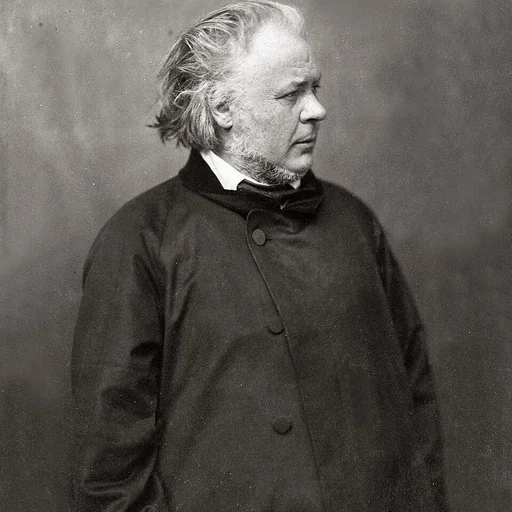
Artist
Honoré-Victorin Daumier was a French painter, sculptor, and printmaker, whose many works offer commentary on the social and political life in France, from the Revolution of 1830 to the fall of the Second French Empire in 1870.









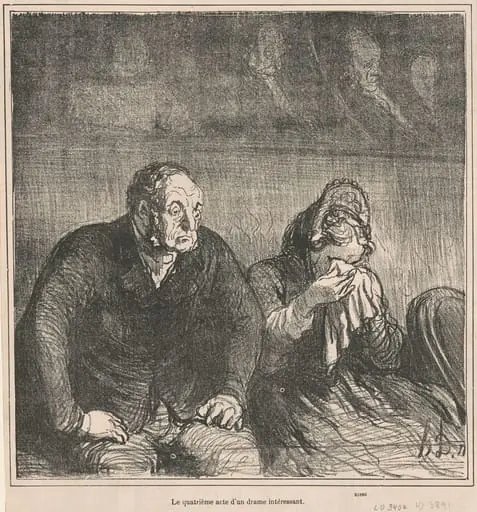 Le quatrième acte d'un drame intéressant
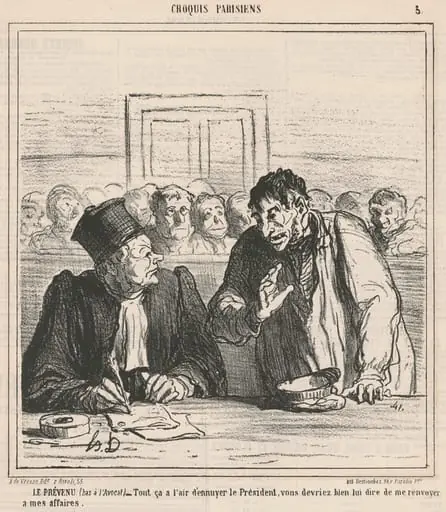 Le prèvenu
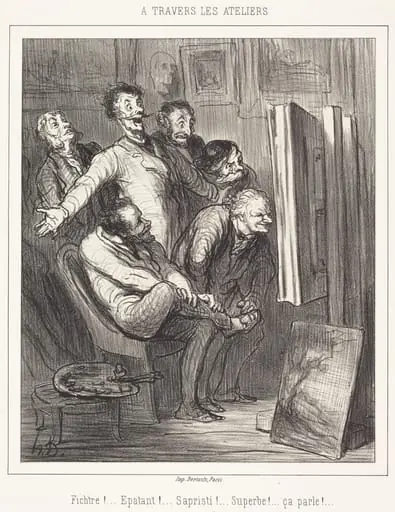 A travers les ateliers
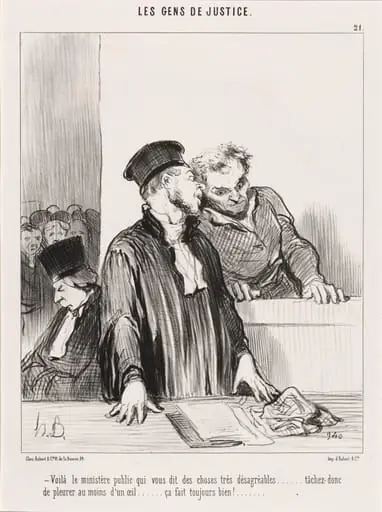 Voila le ministère public qui vous dit des choses... désagréables...
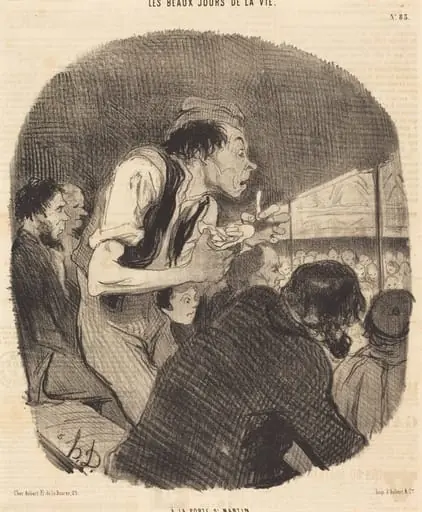 A la porte Saint-Martin
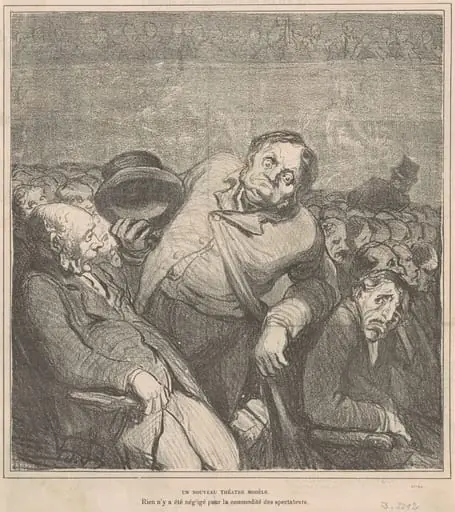 Un nouveau théatre modèle
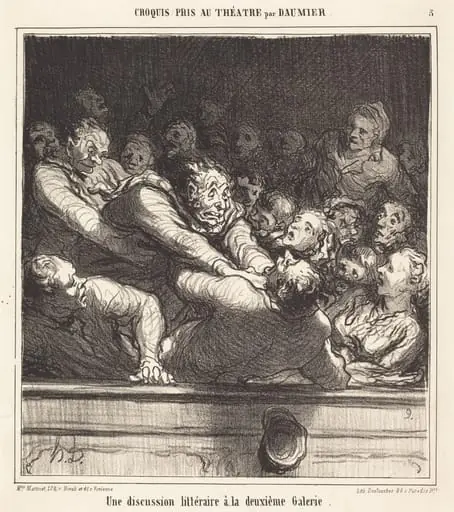 Une Discussion littéraire a la deuxième Galerie
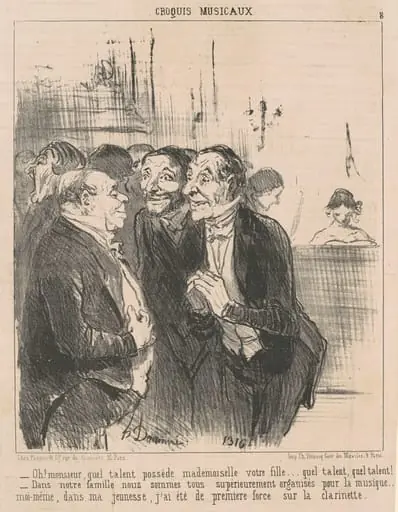 Oh! Monsieur, quel talent possède ...
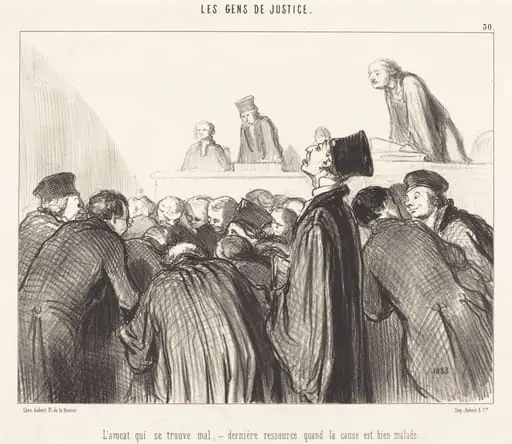 L'Avocat que se trouve mal
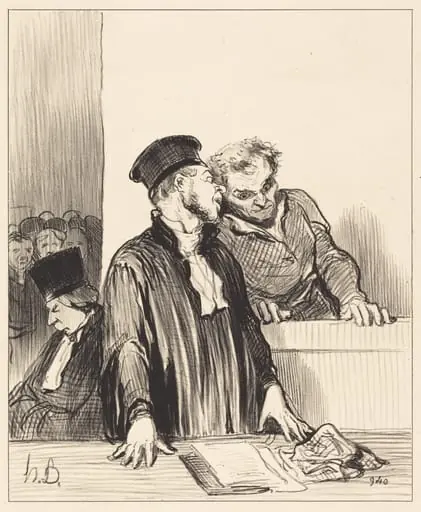 Voila le ministère public qui vous dit des choses... désagréables...