Artwork
Mon cher monsieur... impossible de plaider votre affaire
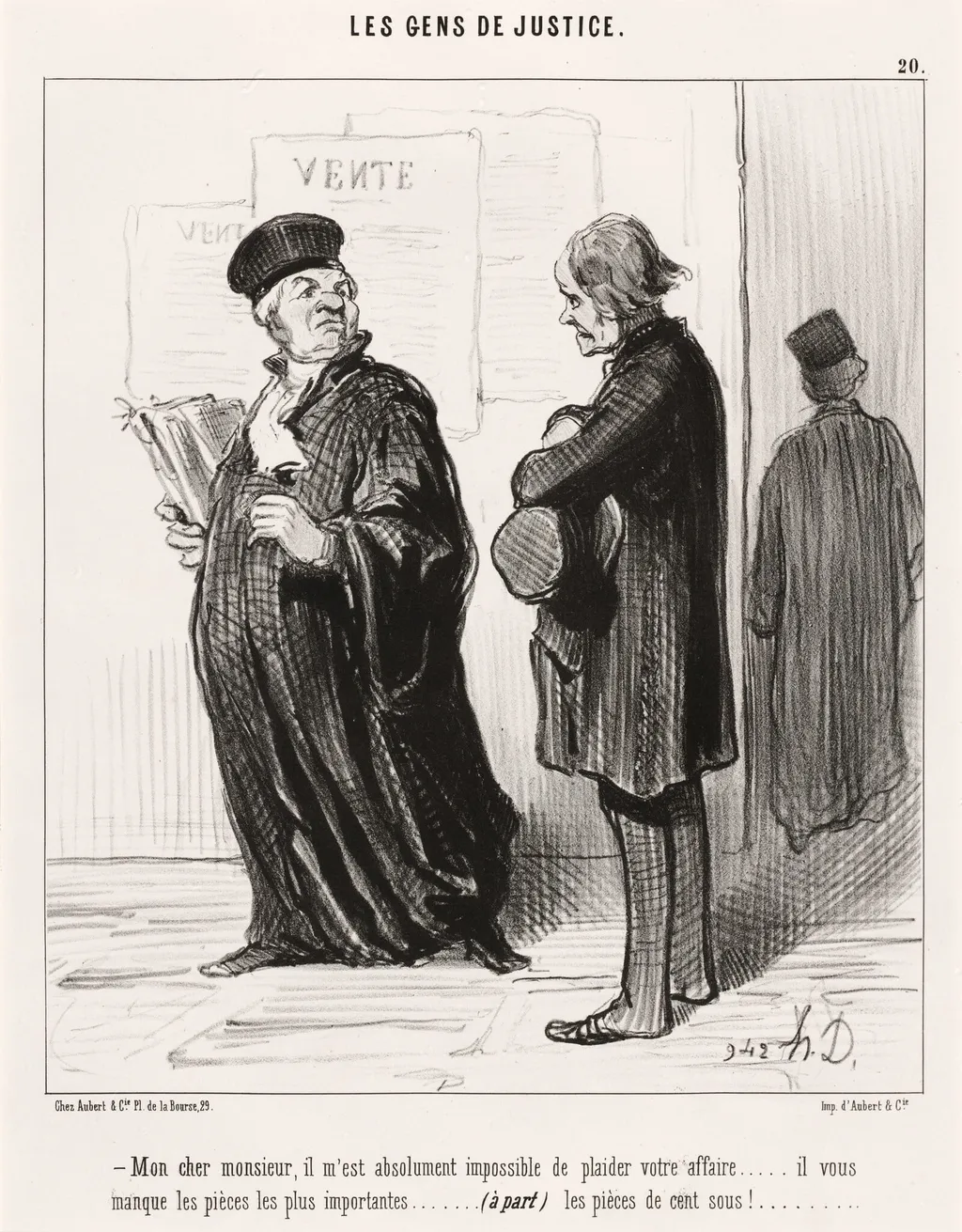
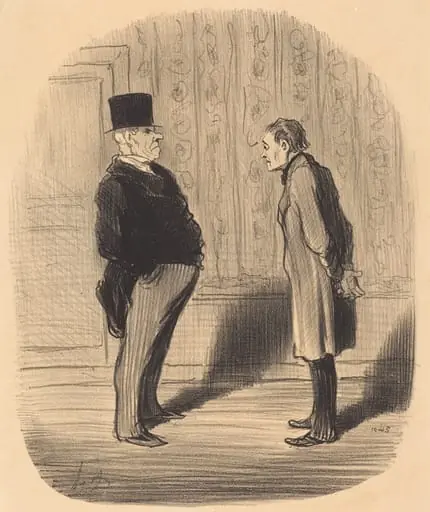
Mon cher monsieur... impossible de plaider votre affaire is an ink print by the Romanticist artist Honoré Daumier. It dates from 1846 and is held in the collection of the National Gallery of Art.
About this work
Overview
Created in 1846, this lithograph by Honoré Daumier captures a moment of bureaucratic indifference in urban France. Part of a broader series critiquing legal and social institutions, the work reflects Daumier’s role as a visual commentator in the press. Its informal composition and raw execution align with his commitment to exposing everyday injustices through accessible imagery.
Subject & Meaning
The scene suggests a failed appeal or dismissed petition, with the central figure’s frustration contrasting the passive or detached demeanor of the others.
Three figures stand in a shadowed alley: a man clutching legal papers, a woman with arms crossed, and a top-hatted figure in the background. The scene suggests a failed appeal or dismissed petition, with the central figure’s frustration contrasting the passive or detached demeanor of the others. The word 'VENTE' on a distant sign hints at the commodification of justice, implying legal rights are negotiable or for sale.
Technique & Style
Daumier employed rapid, expressive linework typical of lithographic sketching, allowing him to convey motion and emotion with minimal detail. The rough texture of the ground and the loose rendering of clothing enhance the scene’s immediacy. Shadows dominate the composition, focusing attention on facial expressions and posture rather than environmental precision, reinforcing the emotional weight of the moment.
History & Provenance
Produced during the July Monarchy, the print emerged from Daumier’s collaboration with satirical journals like *Le Charivari*, where he regularly published political caricatures. Though not widely exhibited in his lifetime, such works circulated among urban readers and were later collected by institutions recognizing their social significance. The lithograph survives as part of a larger archive of 19th-century French graphic satire.
Context
In 1840s France, legal access was uneven, and the judicial system often favored the wealthy. Daumier’s work responded to public frustration with corruption and inefficiency, especially after the 1830 revolution failed to deliver broad democratic reforms. His images gave visual form to the grievances of ordinary citizens, positioning art as a tool for civic critique amid rising censorship.
Legacy
Daumier’s lithographs influenced later generations of social realists and cartoonists by demonstrating how simple, direct imagery could convey complex societal critiques. Though initially dismissed as journalistic, these works are now studied for their psychological depth and formal innovation. They remain key examples of how print media could challenge power without overt propaganda.
Own this work as a print
Artist & collection

Artist
Honoré-Victorin Daumier was a French painter, sculptor, and printmaker, whose many works offer commentary on the social and political life in France, from the Revolution of 1830 to the fall of the Second French Empire in 1870.