Artwork
Nouvelles positions prises par les russes ...
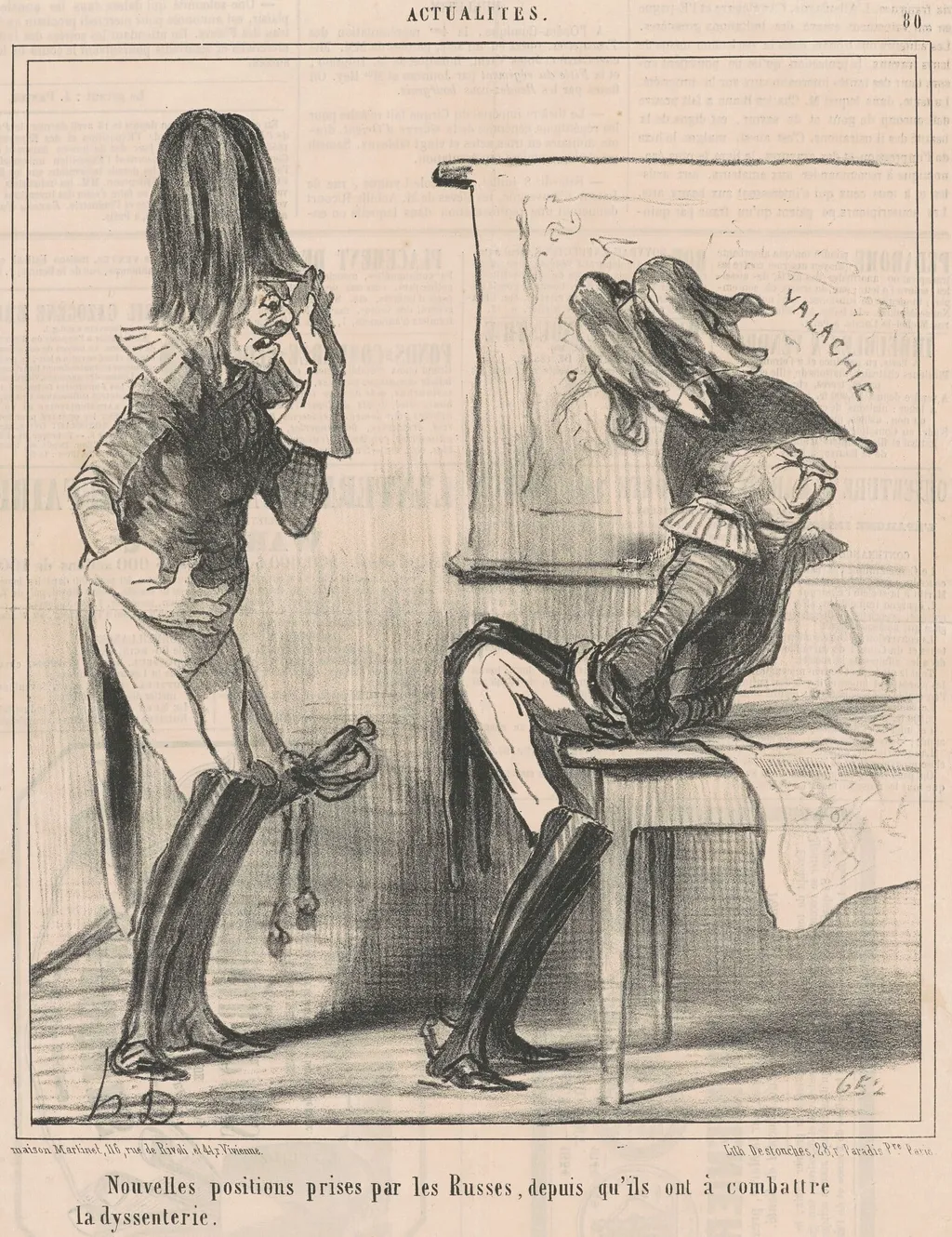
Nouvelles positions prises par les russes ... is an ink print by the Impressionist artist Honoré Daumier. It dates from 1854 and is held in the collection of the National Gallery of Art.
About this work
You see two men in silly uniforms hunched over a map. One points with a giant glove while the other squints at tiny letters. The paper says “VALACHIE” under their hands.
Daumier made this in 1854 to mock how armies over-planned and under-acted. The huge gloves and stiff poses turn real officers into clowns.
Want to see more sharp satire? Hunt for Daumier, Honoré.
Overview
Created in 1854, this lithograph by Honoré Daumier captures two uniformed officers studying a map marked 'VALACHIE.' Rendered in sharp, exaggerated lines, the scene transforms military seriousness into absurdity. The work belongs to a series of satirical prints Daumier produced during the Crimean War, targeting the disconnect between strategic posturing and actual military effectiveness.
Subject & Meaning
The two figures, dressed in comically oversized uniforms, appear absorbed in a map of Wallachia, a region contested during the Crimean War. Their exaggerated gestures—pointing with a giant glove, squinting at minute script—mock the pretense of military precision. The image suggests bureaucratic ineptitude, reducing high-stakes geopolitics to farcical deliberation.
Technique & Style
Daumier employed lithography to achieve bold contrasts and fluid, expressive lines. The figures are rendered with caricatured proportions—elongated limbs, inflated coats—while the map’s legibility is deliberately obscured. The stark black-and-white palette heightens the absurdity, emphasizing gesture over detail to amplify the satirical tone without relying on color or ornament.
History & Provenance
Produced during the height of the Crimean War, the print was likely distributed in French periodicals where Daumier regularly published political commentary. It reflects his long-standing engagement with public affairs through visual satire. Though originally ephemeral, the work entered institutional collections in the late 19th century as his reputation as a social critic solidified.
Context
In 1854, France and Britain allied against Russia over influence in the Balkans. Public sentiment in France was mixed, with growing skepticism toward military leadership. Daumier’s print tapped into this unease, using humor to question the competence of officers who prioritized appearances over action, mirroring broader critiques of state bureaucracy.
Legacy
Daumier’s lithographs, including this one, helped redefine political satire in print media. His ability to distill complex political failures into visually sharp, universally readable images influenced later generations of cartoonists and illustrators. The work remains a reference point for how visual art can interrogate power through irony and understatement.
Artist & collection

Artist
Honoré-Victorin Daumier was a French painter, sculptor, and printmaker, whose many works offer commentary on the social and political life in France, from the Revolution of 1830 to the fall of the Second French Empire in 1870.