Artwork
Oui je viens, dans son temple...
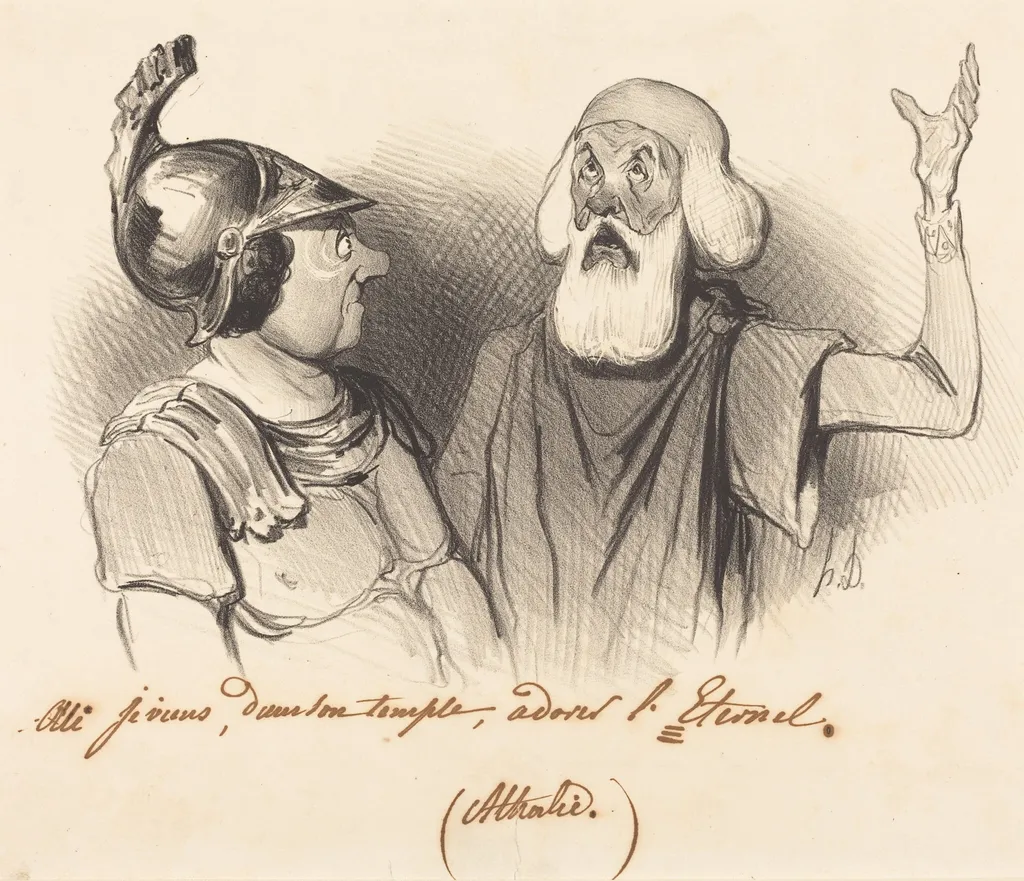
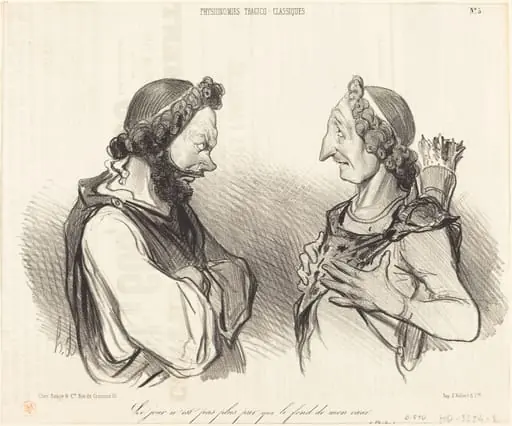
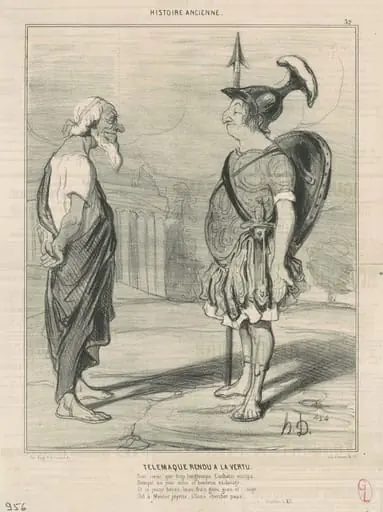
Oui je viens, dans son temple... is an ink print by the Romanticist artist Honoré Daumier. It dates from 1841 and is held in the collection of the National Gallery of Art.
About this work
A notable detail in the image is the contrast between the two men's attire, which suggests a sense of difference or conflict between them.
The image depicts a lithograph titled "Oui je viens, dans son temple..." created by Honoré Daumier between 1865 and 1868. The artwork showcases a man dressed in a helmet and armor, standing alongside another individual adorned in a robe and head covering. The scene is rendered in a range of grays, with the figures set against a light gray background.
A notable detail in the image is the contrast between the two men's attire, which suggests a sense of difference or conflict between them. This contrast is emphasized by the use of different shades of gray, which adds depth and nuance to the scene.
The lithograph is part of the Romanticism movement and is held at the National Gallery of Art, Washington. For more information on the artist, explore the works of Honoré Daumier.
Overview
Created between 1865 and 1868, this lithograph by Honoré Daumier bears the title *Oui je viens, dans son temple...*. Executed in grayscale tones, it presents two figures in contrasting attire—one in armor and helmet, the other in a draped robe and head covering—against a muted background. As a print made for mass circulation, it reflects Daumier’s enduring engagement with visual critique, though its specific context diverges from his earlier political caricatures.
Subject & Meaning
The two figures appear to represent opposing forces: one armored, possibly a soldier or knight; the other robed, suggesting religious or clerical authority. Their proximity, without direct interaction, implies tension or uneasy coexistence. The title, translating to 'Yes, I come to his temple...', hints at submission or ritual, perhaps questioning the alliance between secular power and institutional religion in post-revolutionary France.
Technique & Style
Daumier employed lithography to achieve subtle gradations of gray, using ink washes and hatching to model form and suggest texture. The figures are rendered with simplified, expressive lines, avoiding ornate detail in favor of symbolic clarity. The composition’s stark contrast in costume and posture enhances the narrative ambiguity, characteristic of Daumier’s late style, which grew more introspective and less overtly satirical.
History & Provenance
This work belongs to Daumier’s later period, produced after his most politically charged years for *La Caricature* and *Le Charivari*. It was likely created for private circulation or as part of a thematic series, rather than for a newspaper. The print is now held in the collection of the National Gallery of Art, Washington, D.C., where it is preserved as an example of his evolving artistic concerns in the 1860s.
Context
By the 1860s, Daumier had moved away from direct political satire due to censorship and shifting public sentiment. His later works often explored spiritual, existential, or institutional themes. This lithograph may reflect broader anxieties about the role of religion in public life under the Second Empire, or the lingering influence of medieval hierarchies in modern France, even as republican ideals continued to circulate.
Legacy
Though less widely known than his earlier caricatures, this lithograph exemplifies Daumier’s ability to convey complex social tensions through minimal means. His late prints influenced later generations of artists who sought to merge psychological depth with social observation. The work remains a quiet but potent testament to his lifelong interest in power, ritual, and human vulnerability.
Artist & collection

Artist
Honoré-Victorin Daumier was a French painter, sculptor, and printmaker, whose many works offer commentary on the social and political life in France, from the Revolution of 1830 to the fall of the Second French Empire in 1870.