Artwork
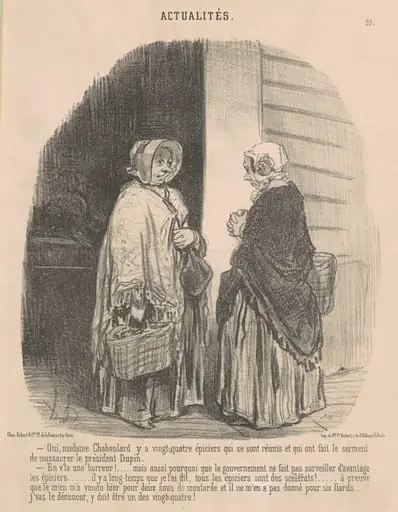
Oui, madame Chaboulard... vingt-quatre épiciers... [recto]
![Oui, madame Chaboulard... vingt-quatre épiciers... [recto], by Honoré Daumier, ink, 1850](https://artifactworldgallery.com/img/honore-daumier--oui-madame-chaboulard-vingt-quatre-epiciers-recto--e54ef32ef25a1625-w1024.webp)
Oui, madame Chaboulard... vingt-quatre épiciers... [recto] is an ink print by the Impressionist artist Honoré Daumier. It dates from 1850 and is held in the collection of the National Gallery of Art. Oui, madame Chaboulard.
About this work
Overview
Oui, madame Chaboulard... vingt-quatre épiciers... [recto] is a lithograph created by Honoré Daumier in 1850, characteristic of his prolific output as a caricaturist for satirical publications.
Subject & Meaning
The print satirically depicts two women outside a dimly lit doorway, with one in a hooded cloak and basket, and the other with a shawl and bag. The scene critiques aspects of contemporary society through Daumier's republican democratic lens, though the specific target is not immediately clear from the image alone.
Technique & Style
Daumier employed lithography's direct-drawing-on-stone method, visible in the rough, sketchy lines that convey a sense of immediacy. This technique facilitated rapid mass production, suiting his work for periodicals like *La Caricature* and *Le Charivari*.
History & Provenance
Produced in 1850 for a satirical publication, the exact provenance and ownership history of this specific print are not detailed here, reflecting its status as one among many in Daumier's prolific caricature output.
Context
This work is part of Daumier's broader critique of monarchy, aristocracy, and clergy through exaggerated figures and dialogue, aligning with his republican views prevalent during this period.
Legacy
As part of Daumier's body of work, it contributes to his legacy as a sharp social commentator, though its individual impact within his extensive oeuvre is not specifically highlighted.
Own this work as a print
Artist & collection

Artist
Honoré-Victorin Daumier was a French painter, sculptor, and printmaker, whose many works offer commentary on the social and political life in France, from the Revolution of 1830 to the fall of the Second French Empire in 1870.









 Oui, Madame Chaboulard ...
 The Pedestrian
 Poids et mesures
 "Voyons! Mme Majeste..."
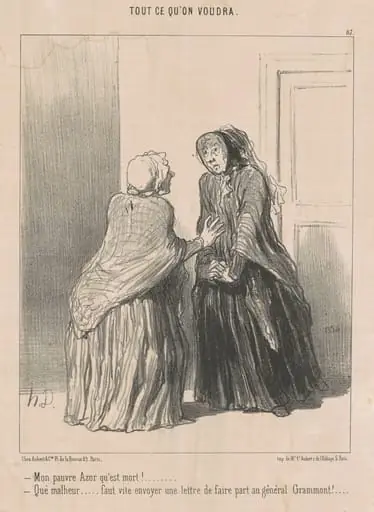 Mon pauvre azor qu'est mort! ...
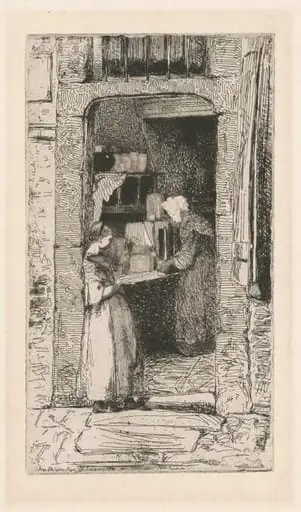 La Marchande de Moutarde
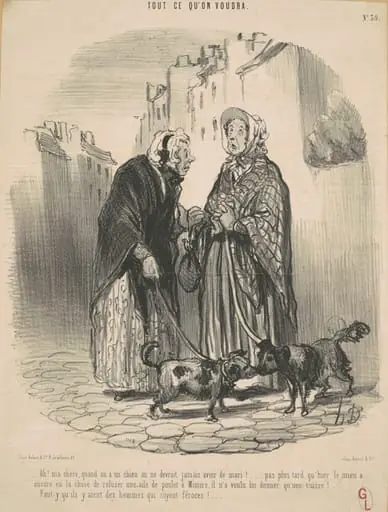 Ah! Ma chère, quand on a un chien ...
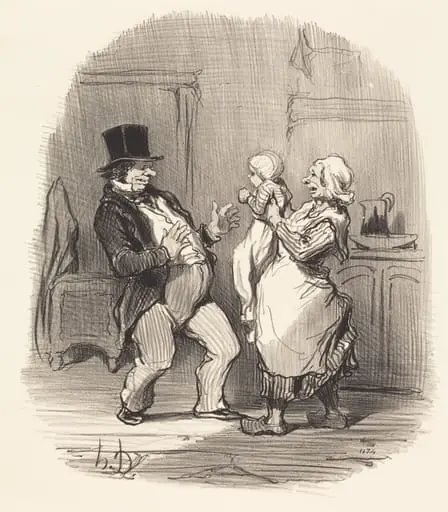 Ah! monsieur... faut pas lui rire comme ça...
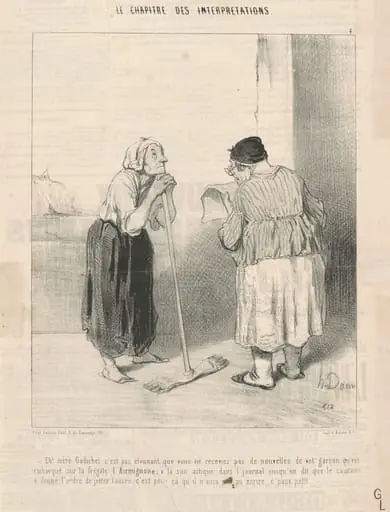 Eh! Mère Godichet c'est pas étonnant ...
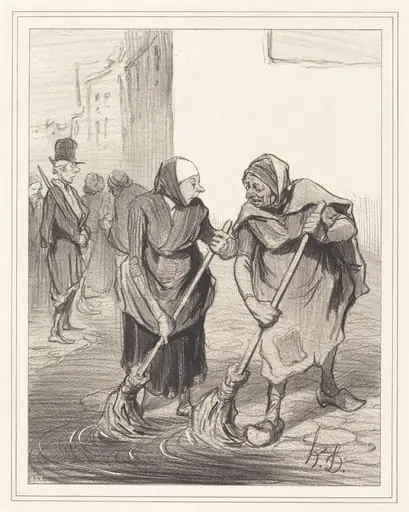 Dites donc, mame Giboulard...
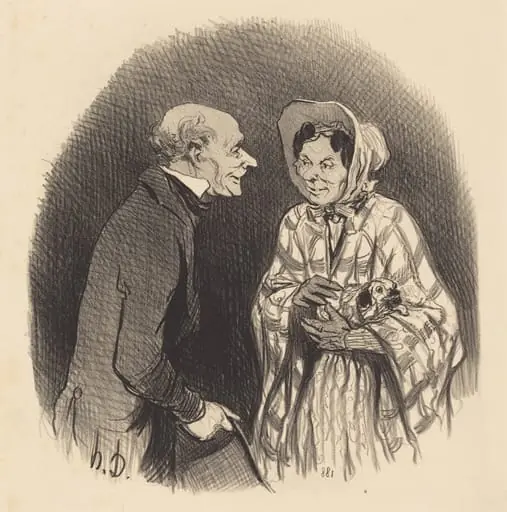 Une Nouvelle connaissance
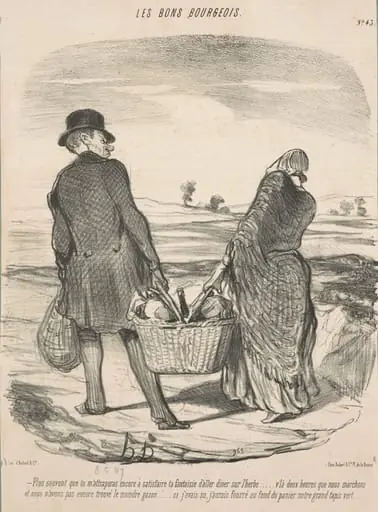 Plus souvent que tu m'attraperas encore à satisfaire ta fantaisie d'aller dîner sur l'herbe . . . V'là deux heures que nous marchons et nous n'avons pas encore trouvé le moindre qazon . . . Si j'avais su, j'aurais fourré au fond du panier notre grand tapis vert.