Artwork
Plus que ca d'ballon ... Excusez! ...
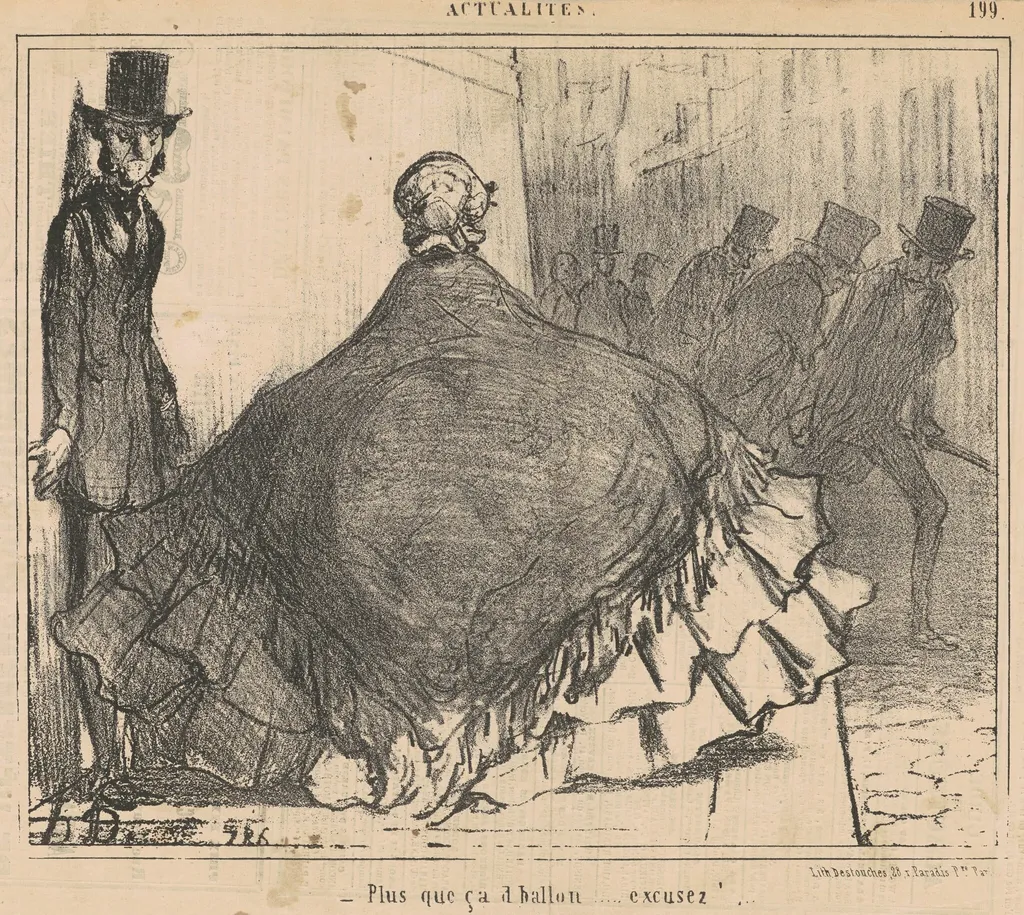
Plus que ca d'ballon ... Excusez! ... is an ink print by the Impressionist artist Honoré Daumier. It dates from 1855 and is held in the collection of the National Gallery of Art.
About this work
Overview
The composition isolates her against a muted backdrop, emphasizing the absurdity of the trend through visual imbalance rather than overt caricature.
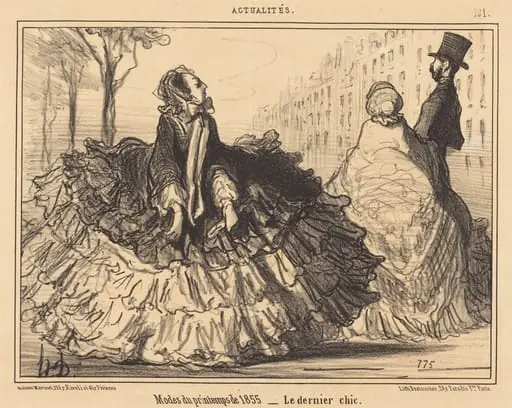
This lithograph by Honoré Daumier captures a moment of social satire through a single dominant figure. The print, titled 'Plus que ça d'ballon ... Excusez!', uses the exaggerated scale of a woman’s dress to critique the excesses of contemporary fashion. The composition isolates her against a muted backdrop, emphasizing the absurdity of the trend through visual imbalance rather than overt caricature.
Subject & Meaning
The central figure, clad in an enormous, ruffled skirt, occupies nearly the entire frame, dwarfing the small, indistinct figures in top hats behind her. These background figures, likely male bourgeois onlookers, are rendered with minimal detail, suggesting their irrelevance compared to the spectacle of fashion. The title’s casual exclamation implies public annoyance, framing the dress as an intrusive, almost comical disruption of social space.
Technique & Style
Daumier employed lithography to achieve sharp contrasts between the intricate, textured folds of the dress and the flat, sparse rendering of the background. The dress’s layers are suggested through rhythmic lines and tonal gradations, while the figures behind are reduced to silhouettes. This selective detail directs the viewer’s attention and reinforces the satirical tone without relying on exaggerated facial expressions.
History & Provenance
Created in the mid-19th century, this print was part of Daumier’s broader series published in French periodicals, targeting urban life and class behaviors. It circulated widely among middle-class readers, functioning as both entertainment and social critique. Its survival in museum collections reflects its recognition as a key example of political and cultural commentary in print media of the era.
Context
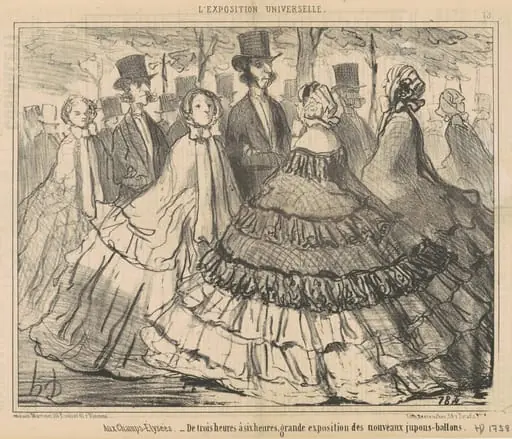
During the July Monarchy and Second Empire, women’s fashion in Paris became increasingly elaborate, with crinolines expanding to extreme proportions. Daumier, observing these trends from his position as a journalist-artist, used his prints to mock the performative nature of social status. This work aligns with a broader tradition of French graphic satire that linked clothing to power, vanity, and public spectacle.
Legacy
Daumier’s lithographs, including this one, influenced later generations of illustrators and cartoonists who sought to merge social observation with visual wit. The work remains a reference point for studies of 19th-century gender, class, and media, demonstrating how print culture could shape public discourse through subtle, image-based critique rather than overt polemic.
Artist & collection

Artist
Honoré-Victorin Daumier was a French painter, sculptor, and printmaker, whose many works offer commentary on the social and political life in France, from the Revolution of 1830 to the fall of the Second French Empire in 1870.