Artwork
Premier prix de croissance - La Prusse
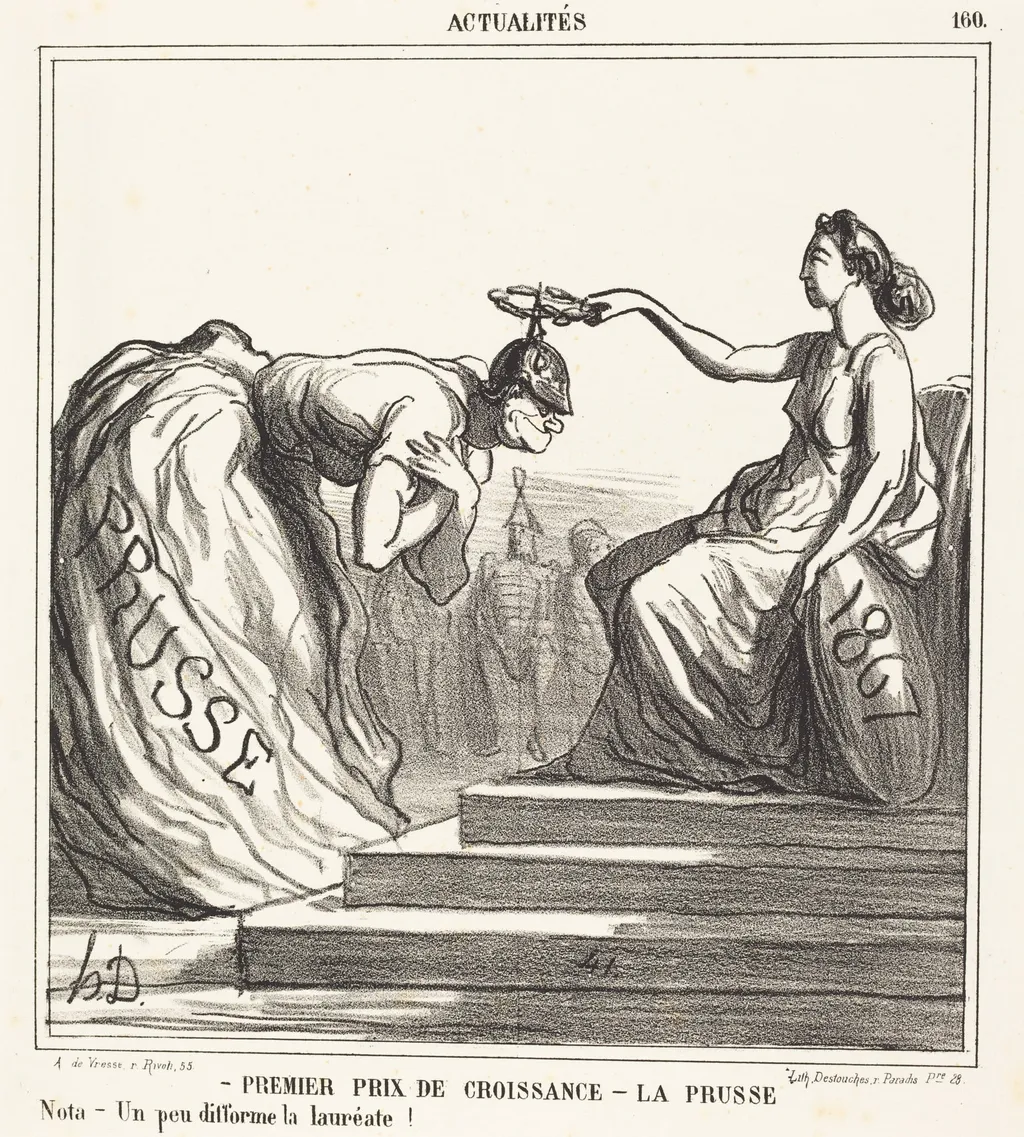
Premier prix de croissance - La Prusse is an ink print by the Impressionist artist Honoré Daumier. It dates from 1867 and is held in the collection of the National Gallery of Art.
About this work
This lithograph depicts a woman in a long dress, seated on a throne-like chair with the year "1867" inscribed on it.
This lithograph depicts a woman in a long dress, seated on a throne-like chair with the year "1867" inscribed on it. She is holding a crown above a man's head, who is dressed in a toga and appears to be bowing down. The man's garment has the word "PRUSSE" written on it.
In the background, there is a faint outline of a cityscape, but it is not clearly defined. The overall atmosphere of the image suggests a sense of ceremony or celebration.
The artist's use of lithography creates a sense of depth and texture in the image. For more on the artist behind this work, look up Daumier, Honoré.
Overview
Premier prix de croissance - La Prusse is a lithographic print executed by French artist Honoré Daumier in 1867. The image portrays a formally dressed woman seated on a throne‑like chair, holding a crown above a kneeling male figure clad in a toga marked with the word “PRUSSE.” A faint cityscape looms behind the scene, lending a ceremonial ambience to the composition.
Subject & Meaning
The work juxtaposes a regal female figure bestowing a crown on a submissive male, suggesting a satirical commentary on the political dynamics of the era. By labeling the man “PRUSSE,” Daumier alludes to contemporary Germanic power, while the act of crowning hints at the conferral of authority that the artist viewed with irony.
Technique & Style
Daumier employed the lithographic process, exploiting its capacity for fine tonal variation to render depth and texture in the figures and background. The print’s line work and shading create a sense of three‑dimensional space, while the crisp lettering on the chair and garment underscores the satirical intent.
History & Provenance
Created during a period of political turbulence in France, the lithograph reflects Daumier’s ongoing engagement with republican ideas and his critique of monarchical and foreign influences. The piece was produced for the French print market, where Daumier’s caricatures were widely circulated in periodicals such as La Caricature and Le Charivari.
Context
In the mid‑nineteenth century, France grappled with the aftermath of the 1848 Revolution and the rise of Prussia as a European power. Daumier’s print responds to these tensions, using allegorical figures to lampoon the perceived threat of Prussian ascendancy and to reinforce his democratic convictions.
Artist & collection
Artist
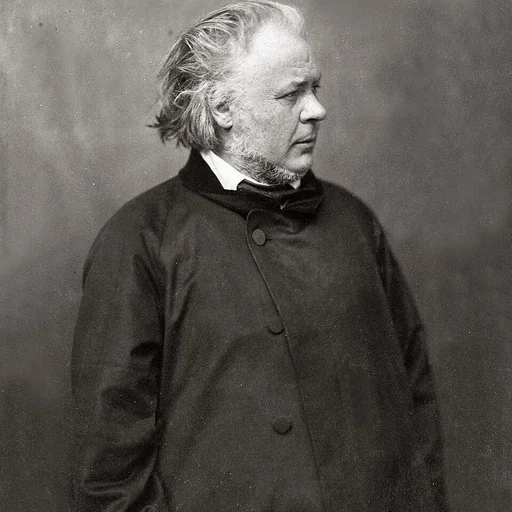
Honoré-Victorin Daumier was a French painter, sculptor, and printmaker, whose many works offer commentary on the social and political life in France, from the Revolution of 1830 to the fall of the Second French Empire in 1870.