Artwork
Souvenirs
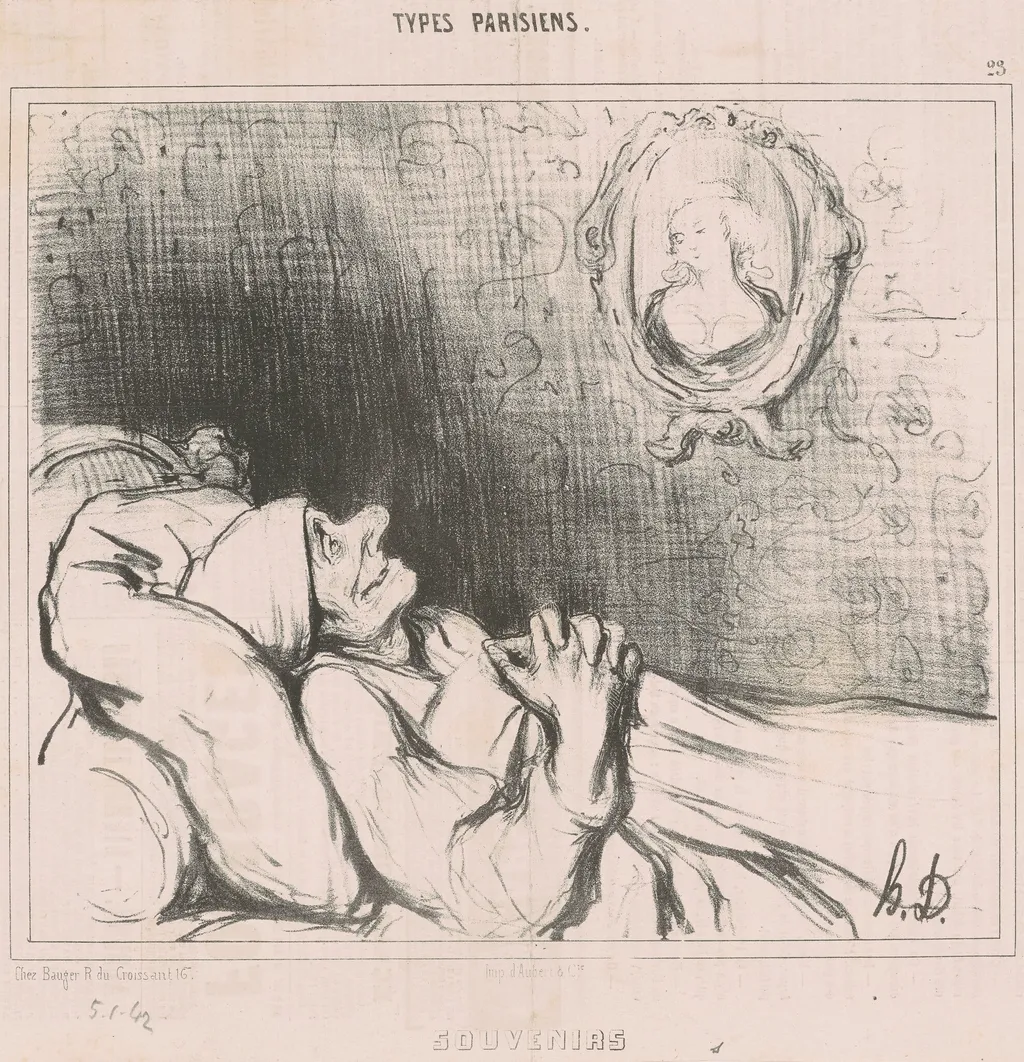
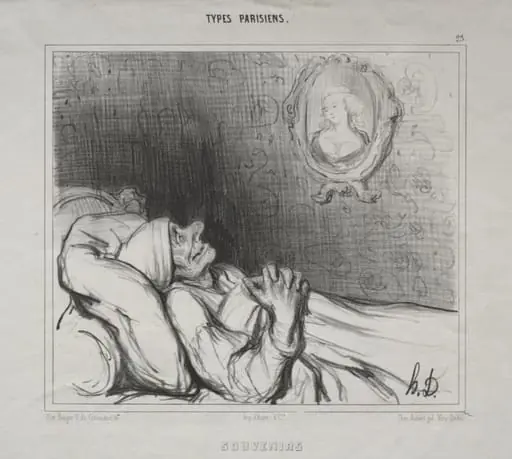
Souvenirs is an ink print by the Romanticist artist Honoré Daumier. It dates from 1840 and is held in the collection of the National Gallery of Art.
About this work
Overview
Honoré Daumier’s lithograph titled Souvenirs presents a quiet interior scene centered on an aged man reclined on a bed. His brow is creased and his eyes are shut, conveying a moment of pause or introspection. Above the bed hangs a finely rendered portrait of a classical female figure, its idealized features contrasting sharply with the frailty of the sitter.
Subject & Meaning
The composition juxtaposes the vulnerability of the elderly figure with the timeless beauty of the painted woman, inviting reflection on the passage of time and the persistence of aesthetic ideals. Daumier appears to probe how memory and longing intersect, suggesting that the man’s contemplation may be directed toward the unattainable or remembered past embodied by the portrait.
Technique & Style
Executed in lithography, the work exploits the medium’s capacity for fine tonal variation and delicate line work. Daumier’s handling of the stone surface yields a soft modeling of the man's features and a crisp, decorative quality in the portrait frame, highlighting the contrast between the muted realism of the bedside scene and the stylized classicism of the hanging image.
History & Provenance
Created during Daumier’s mature period, Souvenirs reflects his continued interest in everyday subjects rendered with social nuance. The print was issued in the mid‑19th century and circulated among collectors of French graphic art. It has since entered public museum collections, where it is cited as an example of Daumier’s skill in merging genre observation with allegorical content.
Artist & collection

Artist
Honoré-Victorin Daumier was a French painter, sculptor, and printmaker, whose many works offer commentary on the social and political life in France, from the Revolution of 1830 to the fall of the Second French Empire in 1870.