Artwork
The Prodigal Son
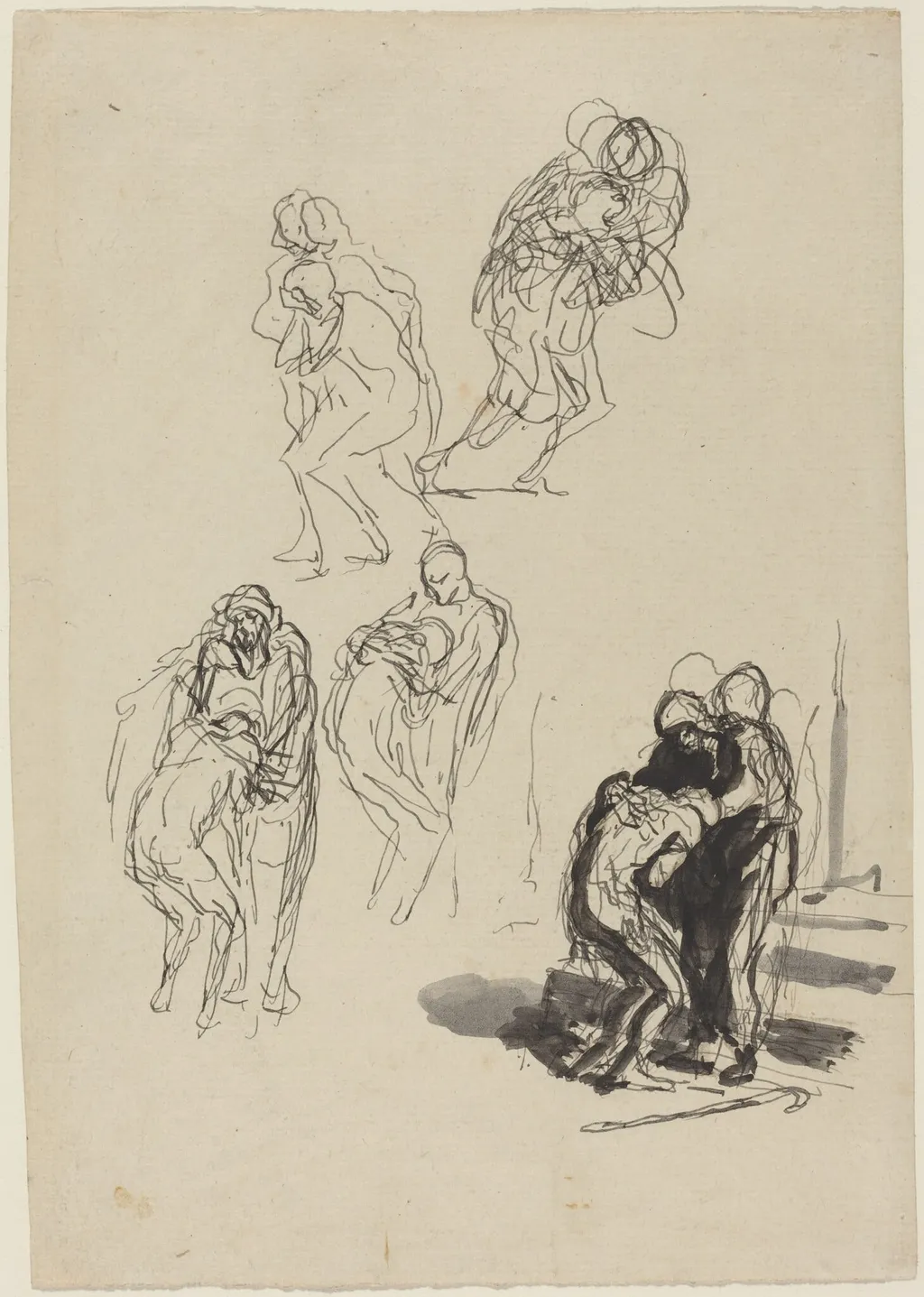
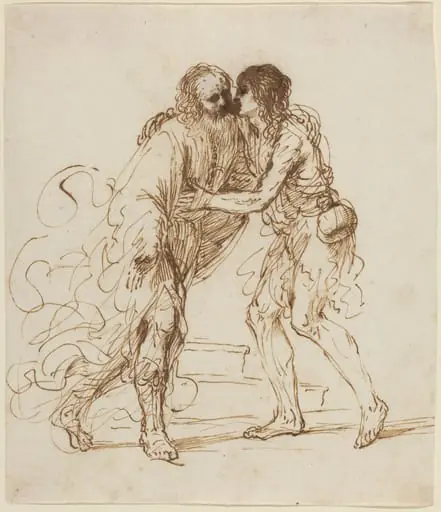
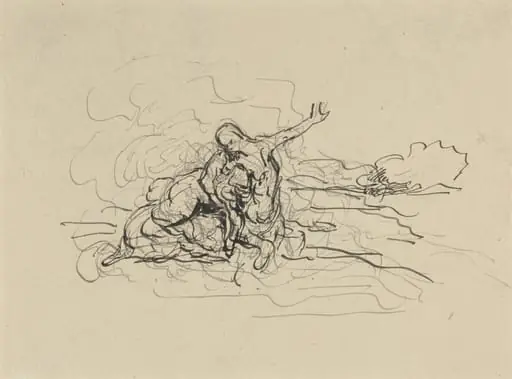
The Prodigal Son is an ink drawing by the Romanticist artist Honoré Daumier. It dates from 1844 and is held in the collection of the National Gallery of Art.
About this work
Overview
Executed on laid paper with rapid, expressive lines, the work exemplifies Daumier’s preference for immediate, unpolished draftsmanship.
Created in 1844, this ink and wash drawing by Honoré Daumier interprets the biblical parable of the Prodigal Son through a distinctly human, socially grounded lens. Executed on laid paper with rapid, expressive lines, the work exemplifies Daumier’s preference for immediate, unpolished draftsmanship. Its informal quality reflects the artist’s habit of capturing fleeting moments, turning religious narrative into a quiet observation of human vulnerability and isolation.
Subject & Meaning
The scene depicts the moment of the prodigal’s return, but without grandeur or divine intervention. Five figures are arranged in a sparse, emotionally charged grouping: two on the left carry the weight of departure, the central figure stands passive, and two on the right convey surrender and proximity. Daumier strips the story of its moral certainty, focusing instead on the raw, unspoken tension between shame, exhaustion, and hesitant reconciliation.
Technique & Style
Daumier employed pen and black ink with diluted wash to create contrast and depth with minimal means. Loose, trembling lines suggest urgency, while concentrated shadows—especially around the kneeling figure’s cloak—anchor the composition. The absence of fine detail and the sketch-like quality reflect his journalistic approach: drawing as a tool of rapid observation rather than polished finish, prioritizing emotional resonance over technical refinement.
History & Provenance
This drawing emerged during a period when Daumier was actively producing satirical lithographs for Parisian periodicals, often at risk of censorship. Though less overtly political than his published caricatures, this work belongs to his broader body of drawings made between the 1830 Revolution and the fall of the Second Empire. Its survival as a standalone sheet suggests it was retained by the artist or a close associate, possibly as a study or personal reflection.
Context
In 1840s France, religious imagery was frequently repurposed by artists to comment on contemporary moral and social conditions. Daumier, disillusioned by the failures of revolutionary ideals and the rise of bourgeois complacency, turned to biblical tales as allegories for human frailty. His depiction of the Prodigal Son avoids ecclesiastical grandeur, instead framing the story as a private, almost anonymous encounter—reflecting the quiet despair of ordinary lives amid political instability.
Legacy
Daumier’s approach to biblical subjects influenced later realist and modernist artists who sought to humanize sacred narratives. This drawing, like many of his works, demonstrates how sketch-like immediacy could convey psychological depth without embellishment. Its unadorned form and emotional restraint helped redefine the potential of drawing as a medium for social and spiritual inquiry beyond traditional academic conventions.
Artist & collection
Artist
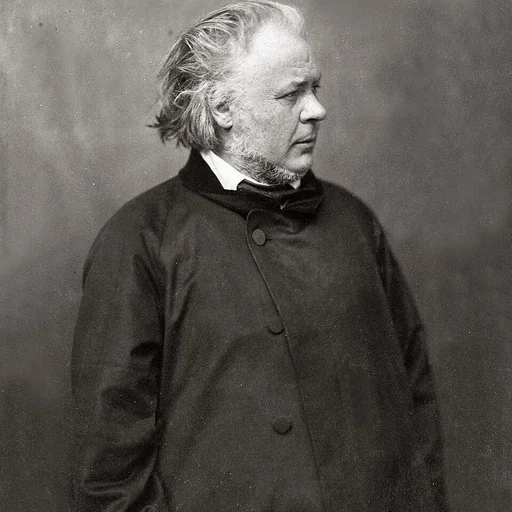
Honoré-Victorin Daumier was a French painter, sculptor, and printmaker, whose many works offer commentary on the social and political life in France, from the Revolution of 1830 to the fall of the Second French Empire in 1870.

![Figure Studies [recto], by Giovanni Battista Cipriani](https://artifactworldgallery.com/img/giovanni-battista-cipriani--figure-studies-recto--32b47b1a71716a78-w320.webp)