Artwork
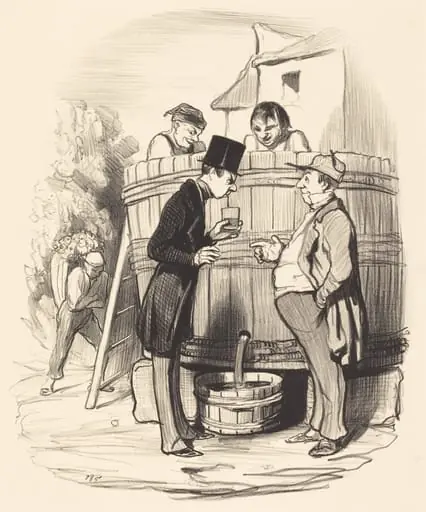
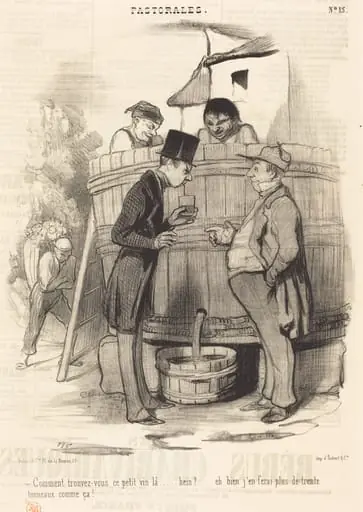
Un marchand de vin contrarié dans son commerce
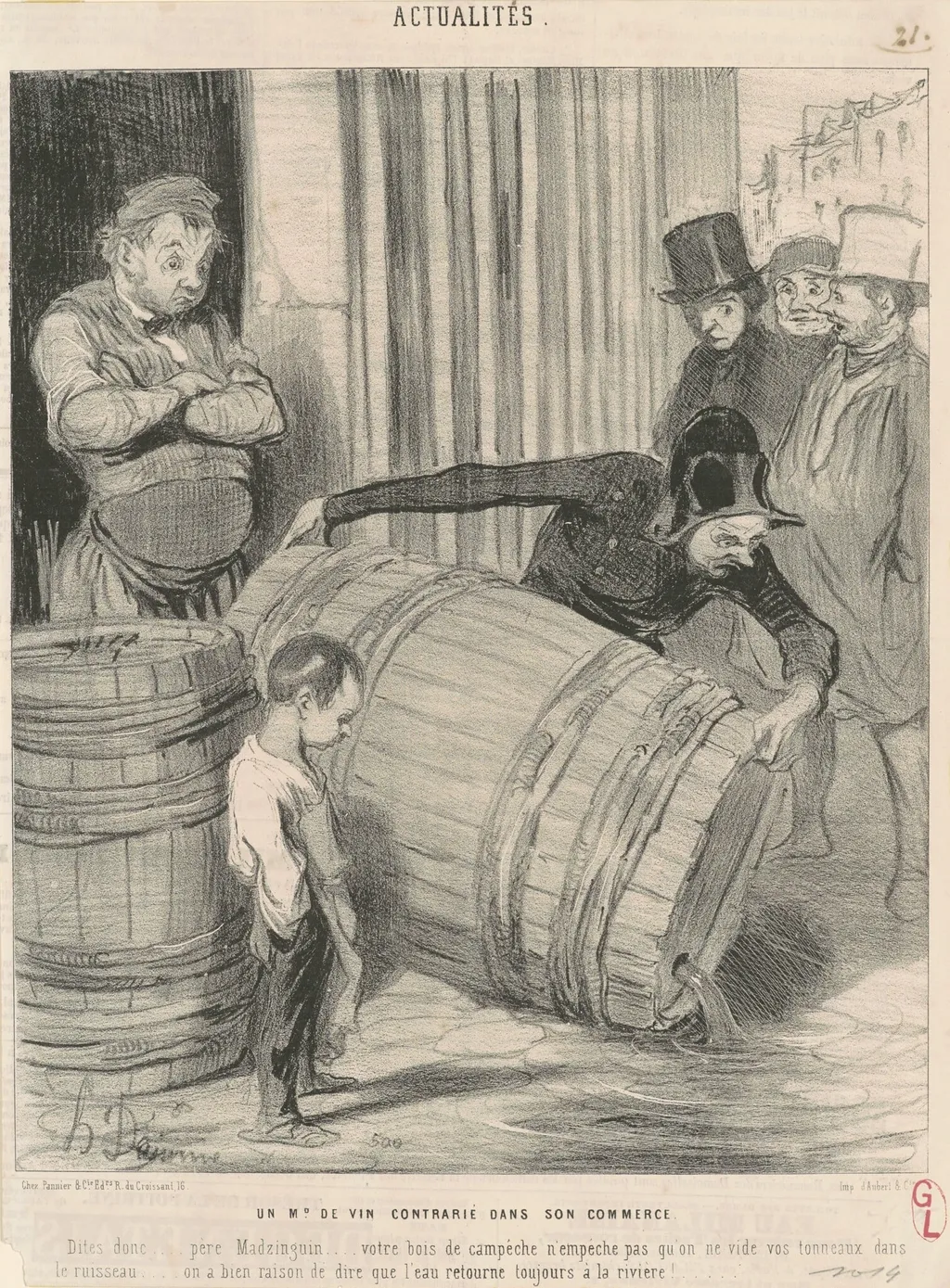
Un marchand de vin contrarié dans son commerce is an ink print by the Romanticist artist Honoré Daumier. It dates from 1843 and is held in the collection of the National Gallery of Art.
About this work
Overview
This lithograph by Honoré Daumier depicts a moment of disruption in a wine merchant’s daily routine. Six figures are gathered around a street-side barrel as a uniformed official drains its contents. The scene captures an ordinary yet charged encounter, revealing the fragility of small-scale commerce under state intervention in mid-19th-century France.
Subject & Meaning
The central figure, a distressed wine merchant, embodies the vulnerability of independent traders facing bureaucratic authority.
The central figure, a distressed wine merchant, embodies the vulnerability of independent traders facing bureaucratic authority. A barefoot child watches silently, suggesting the broader social impact of such interventions. The uniformed agent, impersonal and efficient, represents institutional power. Daumier frames the moment not as comedy but as quiet injustice, highlighting tensions between livelihood and regulation.
Technique & Style
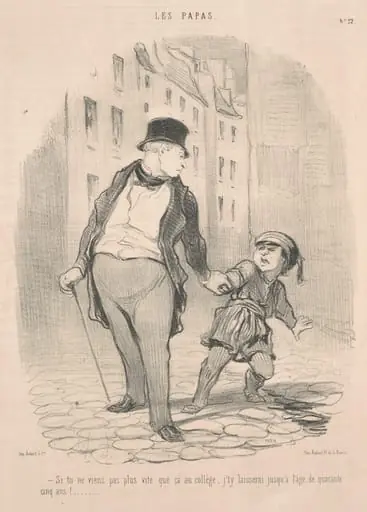
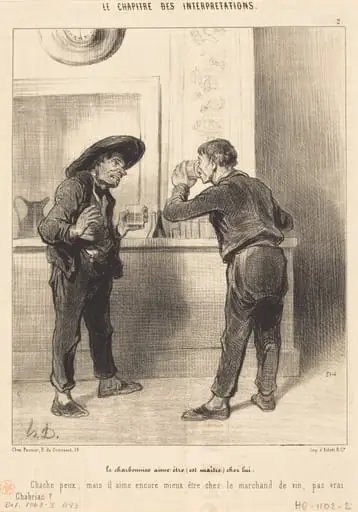
Executed in lithography, the work uses bold, fluid lines and stark contrasts to convey emotional weight. Daumier’s loose, expressive strokes capture movement and tension without fine detail, emphasizing gesture over realism. The monochrome palette focuses attention on posture and facial expression, reinforcing the narrative urgency of the scene.
History & Provenance
Created in the 1860s, the print was likely produced for publication in a periodical, as was common for Daumier’s social commentaries. It circulated among urban audiences familiar with the pressures of taxation and trade regulation. The work remained within private collections after Daumier’s death, its significance recognized more for its social insight than its commercial value.
Context
In 19th-century France, wine merchants faced increasing state oversight, including excise duties and inspections. Daumier, long critical of bureaucratic overreach, used such scenes to reflect the daily struggles of the working class. This image aligns with his broader body of work that scrutinized power imbalances in public and economic life.
Legacy
The lithograph endures as a quiet testament to Daumier’s ability to distill social tension into a single, resonant moment. It influenced later artists who sought to depict everyday injustice with empathy and restraint. Though not widely exhibited, it remains a key example of printmaking as a vehicle for social observation.
Artist & collection

Artist
Honoré-Victorin Daumier was a French painter, sculptor, and printmaker, whose many works offer commentary on the social and political life in France, from the Revolution of 1830 to the fall of the Second French Empire in 1870.