Artwork
Vous sentez bien, mon cher monsieur...
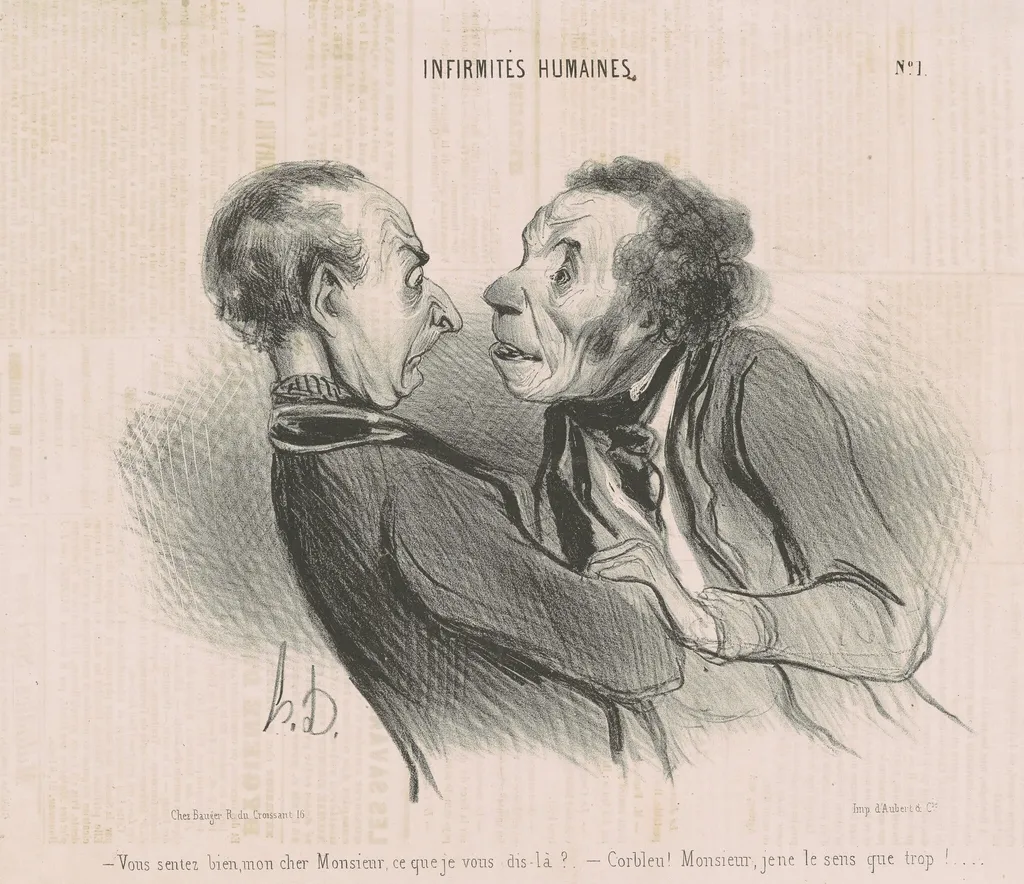
Vous sentez bien, mon cher monsieur... is an ink print by the Romanticist artist Honoré Daumier. It dates from 1840 and is held in the collection of the National Gallery of Art.
About this work
Overview
This lithograph by Honoré Daumier captures a tense, intimate exchange between two men, their faces locked in exaggerated expressions of irritation or disbelief.
This lithograph by Honoré Daumier captures a tense, intimate exchange between two men, their faces locked in exaggerated expressions of irritation or disbelief. Rendered in ink on paper, the work belongs to a series of satirical prints Daumier produced for French periodicals in the 1830s and 1840s. Its immediacy and sharp observation reflect the artist’s focus on everyday social interactions, stripped of idealization.
Subject & Meaning
The two figures, positioned face-to-face, seem engaged in a heated, possibly absurd, conversation. Their distorted features—bulging eyes, twisted mouths, and wrinkled brows—amplify emotional volatility, suggesting petty human frailties rather than grand drama. Daumier uses caricature not for mockery alone, but to reveal the vulnerability and absurdity inherent in ordinary social encounters.
Technique & Style
Daumier employed lithography to achieve rapid, expressive lines and tonal contrasts, allowing him to convey movement and emotion with minimal detail. The heavy ink washes and angular contours emphasize facial distortion, while the lack of background focuses attention entirely on the psychological tension between the figures. His style blends realism with grotesque exaggeration, characteristic of his journalistic approach to printmaking.
History & Provenance
Created around 1840, this print was likely published in a French satirical journal such as La Caricature or Le Charivari, where Daumier regularly contributed. These publications circulated widely among the Parisian middle class and were instrumental in shaping public discourse. The work’s survival in museum collections reflects its recognition as a key example of 19th-century political and social satire in print.
Context
In post-revolutionary France, the press became a vital arena for social commentary. Daumier’s lithographs responded to the rising middle class and its pretensions, using humor to expose hypocrisy and emotional excess. His work stood apart from academic art by privileging the common man’s experience, often at the expense of dignity, offering a counter-narrative to official representations of society.
Legacy
Daumier’s use of caricature to explore psychological depth influenced later artists, including Toulouse-Lautrec and modern cartoonists. His ability to distill complex social dynamics into a single, charged image established a precedent for visual satire. Though produced for ephemeral publications, these prints endure as documents of human behavior, valued for their unflinching honesty and formal economy.
Artist & collection

Artist
Honoré-Victorin Daumier was a French painter, sculptor, and printmaker, whose many works offer commentary on the social and political life in France, from the Revolution of 1830 to the fall of the Second French Empire in 1870.









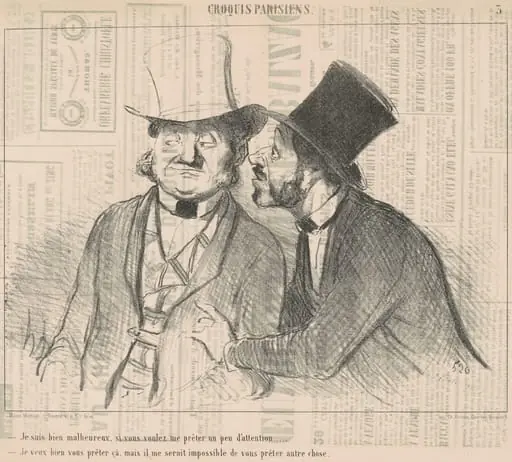 Je suis bien malheureux, si vous voulez ...
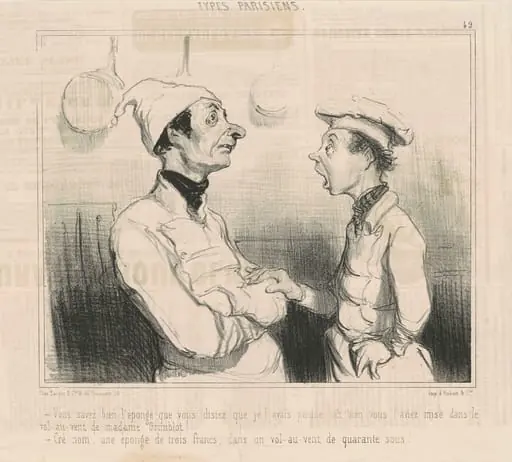 Vous savez bien l'éponge que vous disiez...
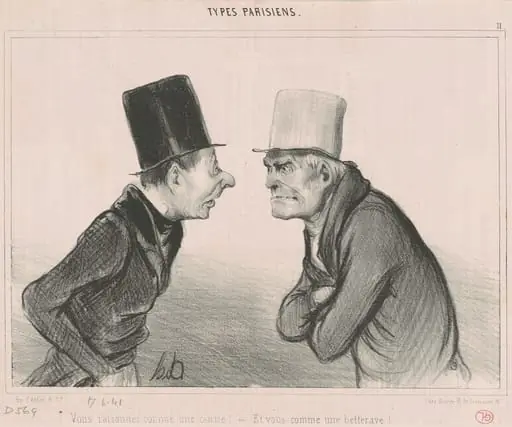 Vous raisonnez comme une canne!
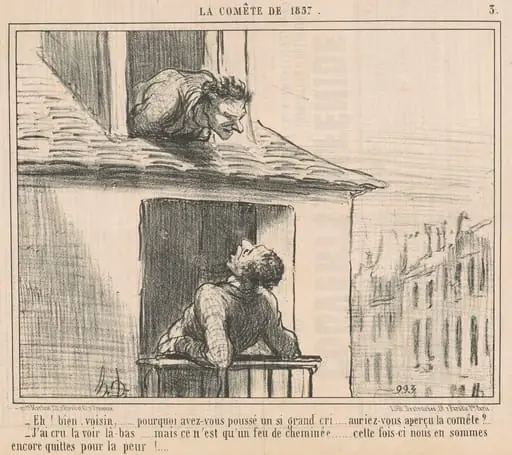 Eh! Bien, voisin ... pourquoi avez-vous poussé ...
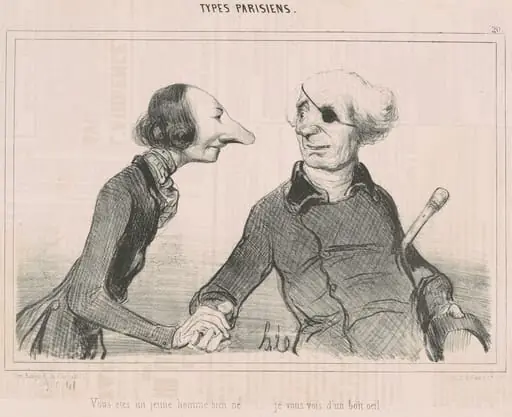 Vous êtes un jeune homme bien né!...
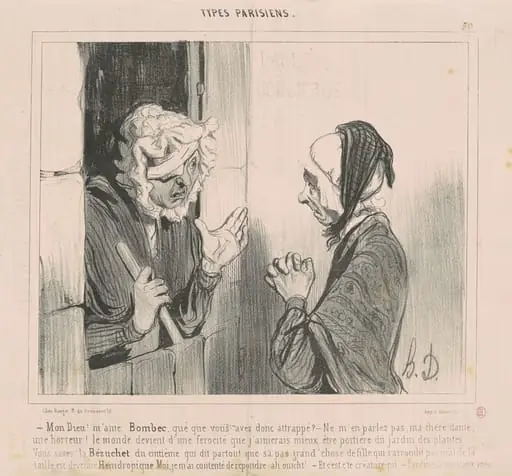 Mon dieu! M'ame Bombec qué que vous avez attrapé?
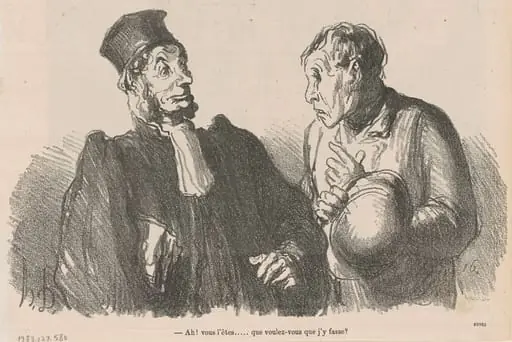 Ah! Vous l'êtes ... que voulez-vous que ...
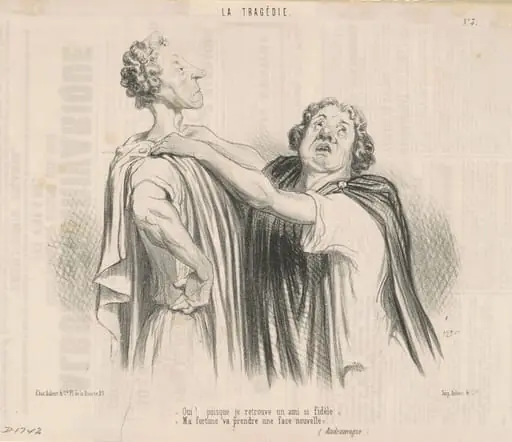 Oui! Puisque je trouve un ami si fidèle ...
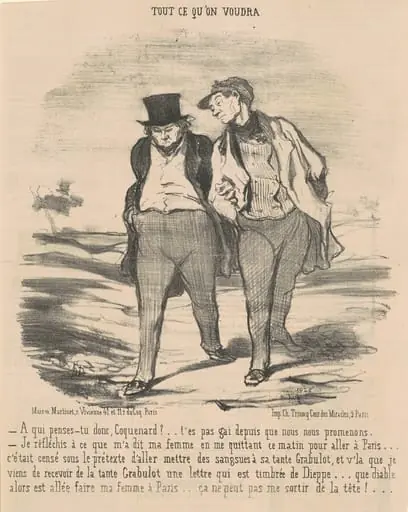 A qui penses-tu donc, coquenard? ...