Artwork
Mon dieu! M'ame Bombec qué que vous avez attrapé?
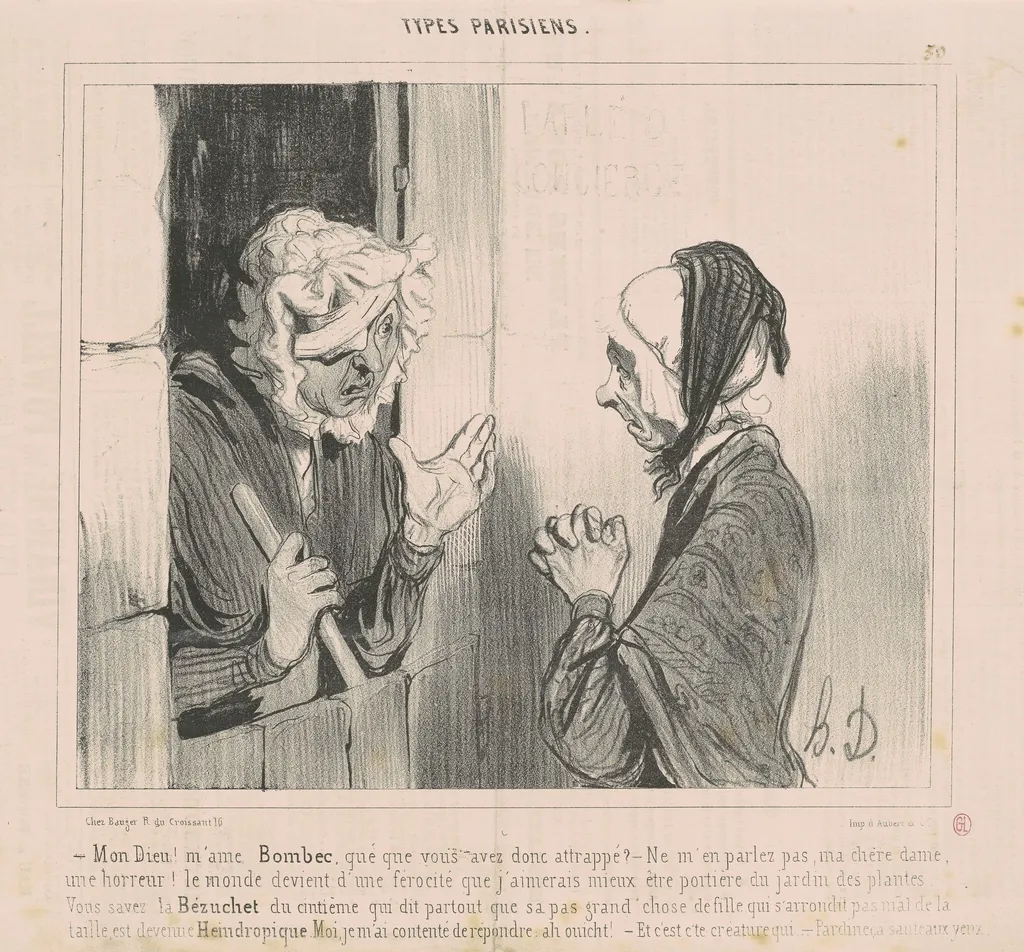
Mon dieu! M'ame Bombec qué que vous avez attrapé? is an ink print by the Romanticist artist Honoré Daumier. It dates from 1840 and is held in the collection of the National Gallery of Art.
About this work
Overview
The composition relies on minimal background detail, focusing attention on the expressive gestures and facial features of the subjects.
This lithograph by Honoré Daumier depicts a brief, unguarded moment between two elderly figures in a modest urban setting. The composition relies on minimal background detail, focusing attention on the expressive gestures and facial features of the subjects. Rendered with swift, economical lines, the print exemplifies Daumier’s ability to convey narrative and emotion through understated visual cues rather than elaborate scenery.
Subject & Meaning
An older woman, her hand pressed to her mouth in surprise, confronts an elderly man emerging from a doorway, clutching a wooden bucket. The scene suggests a sudden, possibly absurd revelation—perhaps the bucket’s contents or its origin has startled her. Daumier captures the quiet drama of everyday life among the working poor, using humor to highlight the vulnerability and dignity of aging individuals in 19th-century Paris.
Technique & Style
Daumier employed lithography to achieve rapid, expressive line work that emphasizes texture and movement. The figures are rendered with exaggerated wrinkles and posture, their forms defined by bold contours and subtle tonal contrasts. The blurred, indistinct background isolates the interaction, directing focus to the emotional exchange. His technique prioritizes immediacy and psychological insight over realism.
History & Provenance
Created during Daumier’s prolific period of social satire in the 1860s, this print was likely published in a periodical or as part of a series targeting urban life. Though exact publication records are sparse, it aligns with his broader body of work produced for journals like Le Charivari, where his lithographs reached a broad, middle-class audience through affordable reproduction.
Context
In mid-19th-century France, lithography became a vital medium for political and social commentary. Daumier’s prints responded to the rising urban population and the struggles of ordinary citizens. This image reflects a cultural moment when the elderly, often overlooked, were increasingly visible in public spaces—subjects ripe for his wry, empathetic observation.
Legacy
Daumier’s lithographs, including this one, influenced later generations of illustrators and cartoonists by demonstrating how minimal lines could convey complex human behavior. His unflinching yet humane portrayals of everyday life helped redefine printmaking as a vehicle for social observation, bridging the gap between art and journalism in the modern era.
Artist & collection
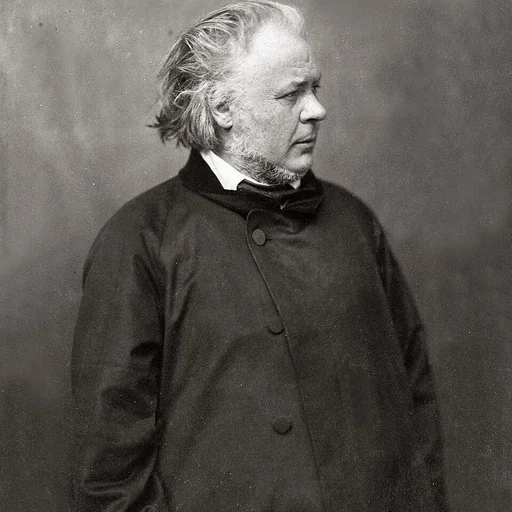
Artist
Honoré-Victorin Daumier was a French painter, sculptor, and printmaker, whose many works offer commentary on the social and political life in France, from the Revolution of 1830 to the fall of the Second French Empire in 1870.