Artwork
Voyons témoin il serait important de...
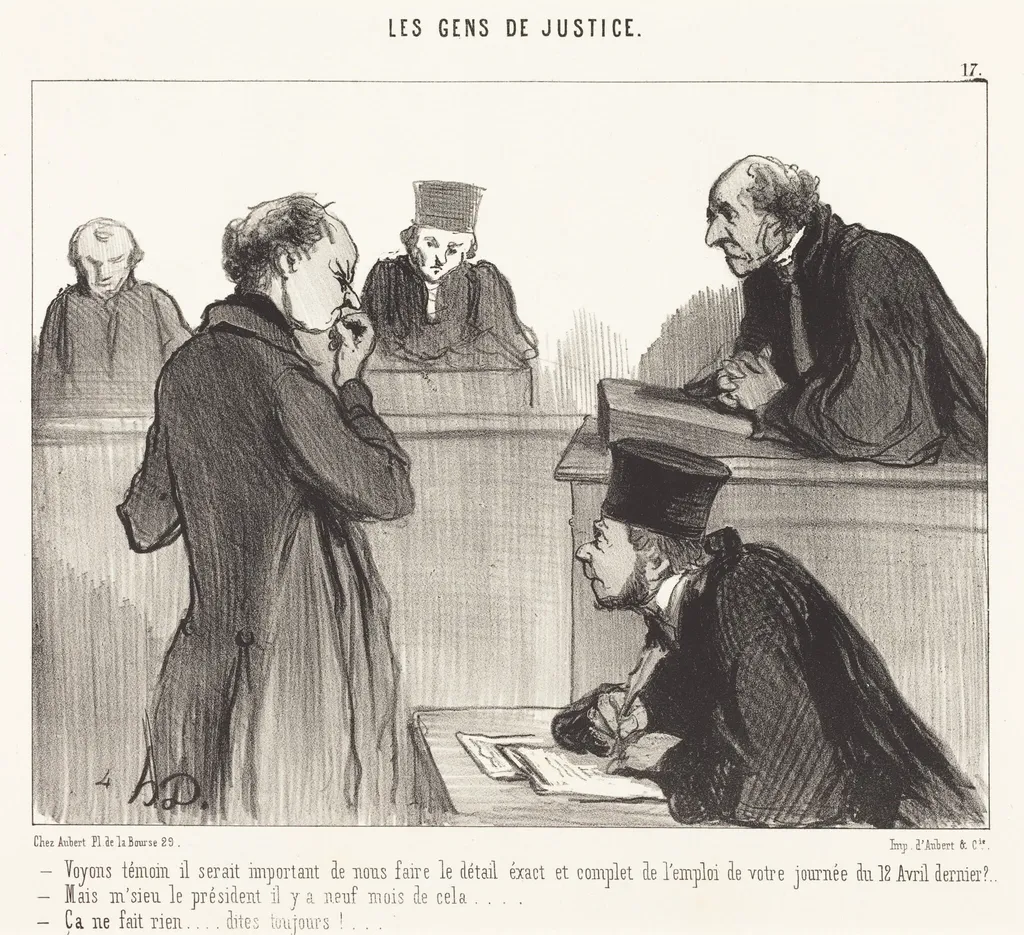
Voyons témoin il serait important de... is an ink print by the Romanticist artist Honoré Daumier. It dates from 1846 and is held in the collection of the National Gallery of Art.
About this work
The judge and two other men sit behind the bench, while another man sits at a desk in front of them, writing on a piece of paper.
This painting depicts a courtroom scene, with a man standing before a judge's bench. The judge and two other men sit behind the bench, while another man sits at a desk in front of them, writing on a piece of paper.
The man standing before the judge's bench appears to be speaking, with his hand raised to his mouth. The judge and the other men behind the bench look on, their faces serious. The overall atmosphere of the painting is one of solemnity and gravity.
The painting is a lithograph, created by Honoré Daumier in 1846. It is an example of Romanticism, a movement that emphasized emotion and imagination in art. To learn more about this style, explore the movement: Romanticism.
Overview
Honoré Daumier’s 1846 lithograph, titled *Voyons témoin il serait important de…*, presents a courtroom tableau in which a standing figure addresses a bench of three men, including a judge. The composition captures a moment of formal deliberation, the speaker’s hand raised to his mouth, while the officials observe with solemn expressions. The work exemplifies Daumier’s engagement with contemporary public life through the medium of print.
Subject & Meaning
The scene depicts a legal proceeding, likely intended as a commentary on the French judicial system and its role in upholding authority. By emphasizing the seriousness of the participants and the act of speaking, Daumier underscores the weight of public discourse and the power dynamics inherent in legal institutions, reflecting his broader concern with the mechanisms of power.
Technique & Style
Executed as a lithograph, the image relies on bold line work and stark contrasts to convey the gravity of the courtroom. Daumier’s handling of the medium allows for rapid reproduction, a characteristic of his satirical prints. While rooted in Romantic sensibilities that value emotional intensity, the piece also anticipates the realist attention to everyday social scenes that would later define his oeuvre.
History & Provenance
Created in 1846, the lithograph was produced during the period when Daumier contributed regularly to satirical journals such as *La Caricature* and *Le Charivari*. These publications disseminated his critiques of monarchy, aristocracy, and clerical influence across Parisian society, and the print likely circulated among the same readership, reinforcing his republican perspective.
Context
Mid‑19th‑century France was marked by political turbulence, with frequent clashes between monarchical restoration and emerging republican ideals. Daumier’s work responded to this climate, using courtroom imagery to question the legitimacy of institutional authority and to voice the concerns of a citizenry seeking greater democratic participation.
Legacy
Although less celebrated than Daumier’s caricatures, this lithograph contributes to the artist’s reputation as a visual chronicler of French civic life. Its focus on legal authority anticipates later realist and naturalist depictions of institutional settings, and it remains a valuable example of how print media served as a vehicle for political commentary in the 1840s.
Artist & collection

Artist
Honoré-Victorin Daumier was a French painter, sculptor, and printmaker, whose many works offer commentary on the social and political life in France, from the Revolution of 1830 to the fall of the Second French Empire in 1870.