Artwork
Libby Prison
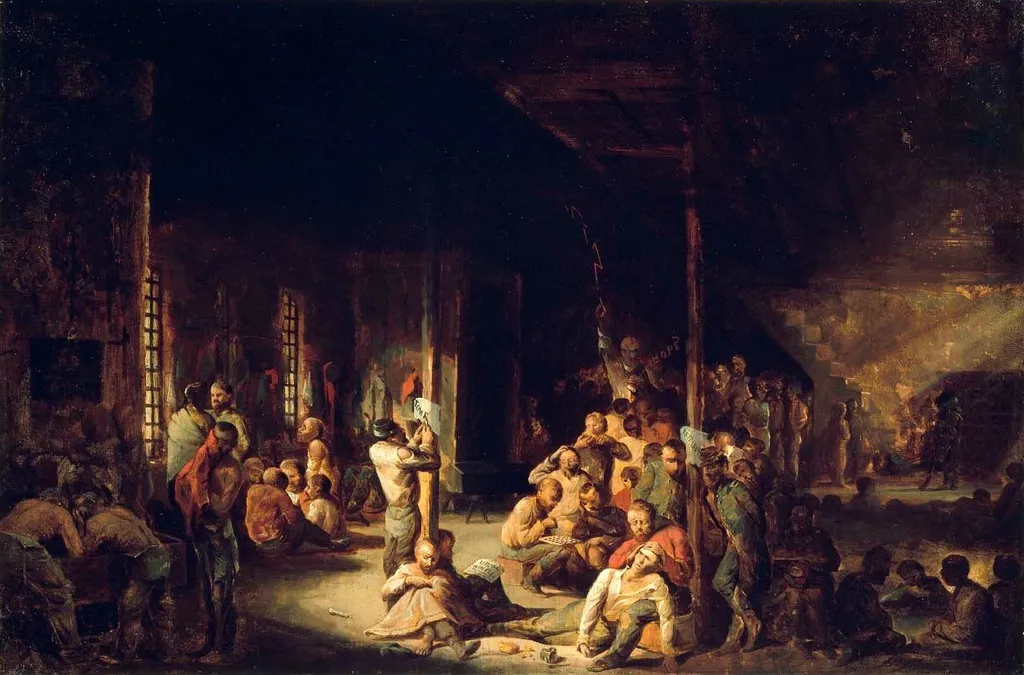
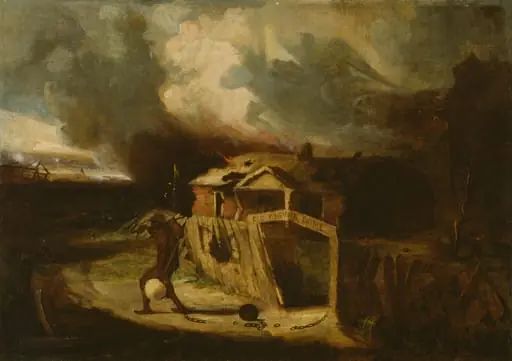
Libby Prison is an oil painting by the American Folk Art artist David Gilmour Blythe. It dates from 1863 and is held in the collection of the Museum of Fine Arts Boston.
About this work
Overview
Though trained in portraiture and known for satirical works, this piece diverges into documentary realism, capturing a moment from the Civil War.
David Gilmour Blythe, a self-taught artist from Pennsylvania, painted *Libby Prison* in 1863 using oil on canvas. Though trained in portraiture and known for satirical works, this piece diverges into documentary realism, capturing a moment from the Civil War. The painting reflects his engagement with contemporary events and his ability to translate social suffering into visual form, distinguishing him as a key figure in 19th-century regional art.
Subject & Meaning
The scene portrays Union soldiers imprisoned in Libby Prison, a Confederate-held facility in Richmond. Crowded, exhausted figures fill a stone-walled chamber, their postures conveying fatigue and resignation. Blythe avoids heroism, instead emphasizing collective endurance. The absence of guards or overt violence heightens the sense of institutional neglect, turning the prison into a silent witness to human suffering during wartime.
Technique & Style
Blythe employed a restrained palette of grays, browns, and muted earth tones to reinforce the gloom of the interior. His brushwork is precise but unembellished, focusing on texture—tattered fabric, rough stone, and weary skin—to ground the scene in physical reality. Lighting is dim and uneven, pooling around huddled figures, which draws attention to individual expressions amid the mass, enhancing the emotional weight without melodrama.
History & Provenance
Painted during the Civil War, *Libby Prison* was created as public awareness of Confederate prison conditions grew. Blythe likely drew from newspaper accounts and soldier testimonies, as direct access to the prison was impossible. The work remained in private collections after its completion and was later acquired by institutions interested in Civil War-era art, preserving its role as a visual record of wartime captivity.
Context
Libby Prison became notorious for overcrowding and poor sanitation, with thousands of Union captives held there. Blythe’s painting emerged amid a surge of Northern propaganda and humanitarian concern. Unlike official military imagery, his work avoided glorification, instead aligning with emerging public sentiment that demanded accountability for prisoner treatment, making it a quiet but potent commentary on the war’s human cost.
Legacy
Blythe’s *Libby Prison* stands as one of the earliest American paintings to treat wartime imprisonment with unvarnished realism. It influenced later artists seeking to depict the civilian and soldierly toll of conflict. Though not widely exhibited in his lifetime, the painting now serves as a primary visual reference for understanding how 19th-century Americans perceived the moral dimensions of war beyond the battlefield.
Artist & collection
Artist
David Gilmour Blythe (May 9, 1815 – May 15, 1865) was a self-taught American artist best known for paintings which satirically portrayed political and social situations.