Artwork
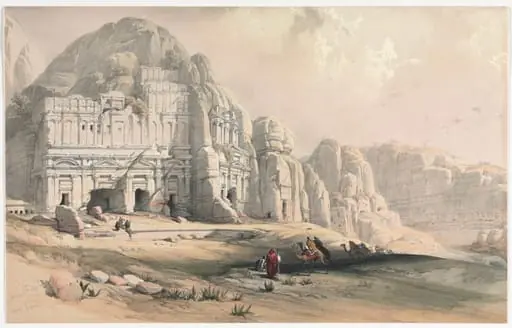
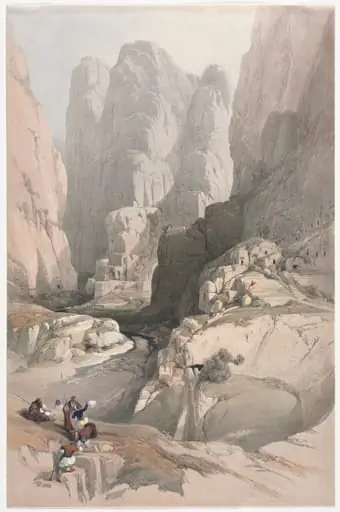
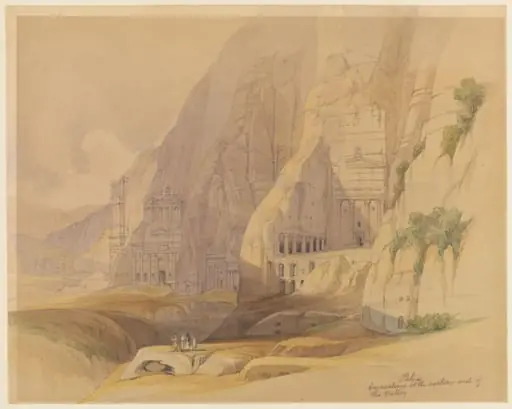
Petra, Lower End of the Valley, Viewing the Acropolis
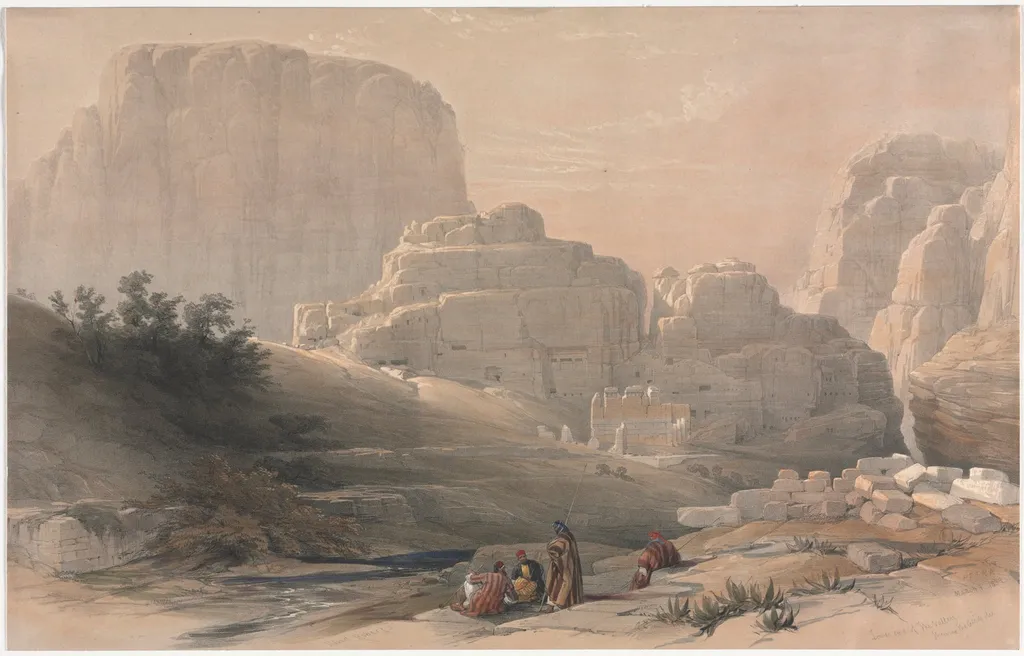
Petra, Lower End of the Valley, Viewing the Acropolis is a print by the Romanticist artist David Roberts. It dates from 1839 and is held in the collection of the Cleveland Museum of Art.
About this work
Roberts made this trip in 1839, one of the first Europeans to document Petra in detail.
This painting shows a sweeping view of Petra’s rocky valley. Bright sunlight hits the cliffs while shadows pool in the ravines. A lone figure stands near the center, wearing a hooded robe.
Roberts made this trip in 1839, one of the first Europeans to document Petra in detail. His images helped people in Britain see the Middle East without leaving home.
If you like this, check out David Roberts (Scottish, 1796–1864).
Overview
David Roberts, a Scottish artist and traveler, produced this detailed view of Petra in 1839 during a journey through the Near East. The work is part of a larger body of illustrations documenting ancient sites he encountered, later compiled into a published series. His precise rendering of architecture and landscape offered European audiences one of the earliest visual records of Petra, then largely unknown outside regional circles.
Subject & Meaning
The scene captures the entrance to Petra’s valley, with towering sandstone cliffs framing the ancient city’s ruins. A solitary figure in traditional attire stands near the center, emphasizing the scale and isolation of the site. The composition invites contemplation of human presence against vast, enduring geology, suggesting both reverence and the passage of time rather than overt narrative or symbolism.
Technique & Style
Roberts employed careful draftsmanship and controlled light to convey the stark contrasts of the desert environment. Sunlight strikes the cliff faces while deep shadows gather in the ravines, enhancing the sense of depth and texture. His attention to architectural detail and atmospheric conditions reflects a topographical precision typical of 19th-century travel documentation, blending observation with artistic composition.
History & Provenance
Roberts visited Petra in 1839, one of the first Europeans to sketch the site with systematic detail. His sketches from the journey were later transformed into lithographs for publication. The original work likely served as a preparatory study for these prints, which gained wide circulation in Britain. His documentation contributed to the growing European interest in Near Eastern antiquities during the period.
Context
In the 1830s, European fascination with ancient civilizations was expanding alongside colonial and archaeological expeditions. Roberts’s images arrived at a time when travel literature and illustrated volumes were becoming popular among the middle class. His depictions of Petra helped shape Western perceptions of the region, offering visual authority to distant lands previously known only through rumor or fragmented accounts.
Legacy
Roberts’s illustrations of Petra became foundational references for later scholars and travelers. His work influenced both archaeological recording practices and public imagination of the ancient Near East. Though later discoveries refined understanding of the site, his images remain significant as early visual records that bridged the gap between exploration and popular awareness in 19th-century Europe.
Artist & collection
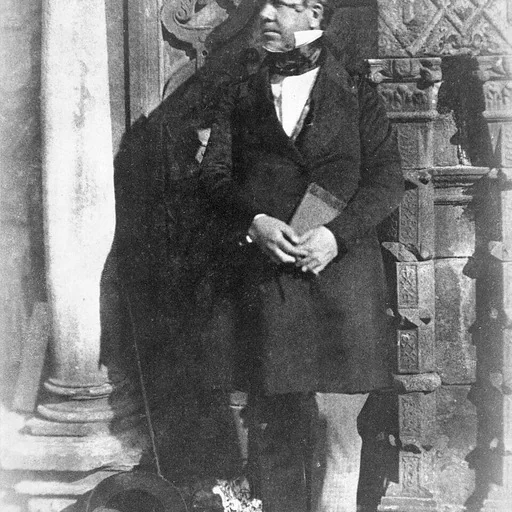
Artist
David Roberts (24 October 1796 – 25 November 1864) was a Scottish painter. He is especially known for The Holy Land, Syria, Idumea, Arabia, Egypt, and Nubia, a prolific series of detailed lithograph prints of Egypt and…