Artwork
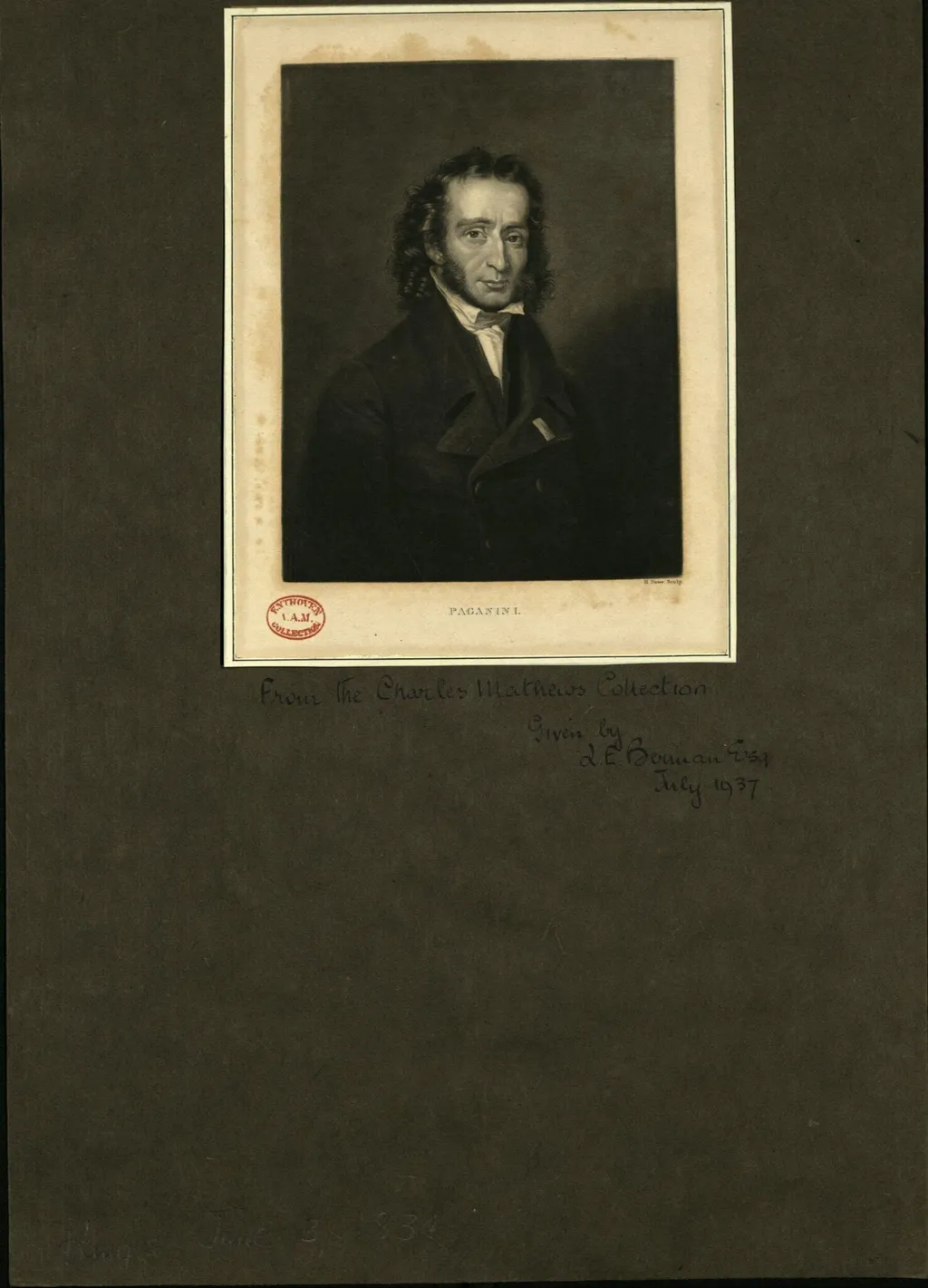
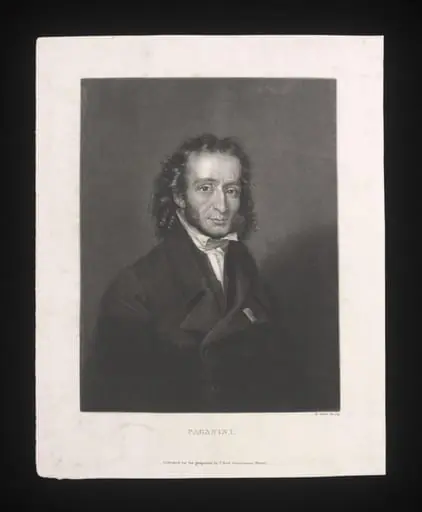
Print is a print by Henry Edward Dawe. It dates from 1850 and is held in the collection of the Victoria and Albert Museum.
About this work
Overview
The image emphasizes his physical engagement with the instrument, aligning with contemporary accounts of his unorthodox posture and dexterity.
This print depicts Nicolò Paganini, the renowned Italian violinist, captured mid-performance. Created by Henry Edward Dawe, it reflects the public fascination with Paganini’s extraordinary technique during his 1831 London tour. The image emphasizes his physical engagement with the instrument, aligning with contemporary accounts of his unorthodox posture and dexterity. As a lithographic portrait, it served to disseminate his image to a broad audience beyond the concert hall.
Subject & Meaning
Paganini is portrayed not merely as a performer but as an almost supernatural figure of musical mastery. His posture—left shoulder lowered, arm twisted inward—mirrors descriptions by witnesses who marveled at his physical adaptations for playing. The image conveys the awe his technique inspired, suggesting a fusion of human anatomy and artistic genius. It frames him as an object of fascination, blurring the line between musician and marvel.
Technique & Style
Executed in lithography, the print employs fine linework to render the subtle contours of Paganini’s body and violin. Dawe’s style is precise yet restrained, avoiding theatricality in favor of documentary clarity. The focus on hand placement and body alignment reflects an interest in anatomical detail, consistent with 19th-century fascination with physical uniqueness. The tonal range is limited, enhancing the graphic clarity of the musician’s form against a neutral background.
History & Provenance
The print was produced shortly after Paganini’s 1831 London debut, capitalizing on the intense media attention he received. Henry Edward Dawe, known for his portraits of notable figures, likely based the image on sketches or eyewitness accounts. It was circulated as a commercial print, intended for public consumption rather than private commission. Its survival in institutional collections suggests early recognition of its cultural significance as a visual record of musical celebrity.
Context
In the early 1830s, Paganini’s performances ignited a wave of public enthusiasm across Europe, often described in near-mystical terms. His physical peculiarities—reported by journalists and physicians alike—were widely discussed, contributing to his mythic status. This print emerged within a broader culture of celebrity portraiture, where visual media helped construct the public image of artists, transforming virtuosity into a subject of popular fascination.
Legacy
The print endures as a visual anchor for historical accounts of Paganini’s technique. It preserves the physicality of his playing at a time when audio recording did not exist, offering insight into how his body became an extension of his instrument. While not an artistic innovation in technique, it remains a significant artifact of 19th-century musical culture, documenting the intersection of performance, perception, and public image.
Artist & collection