Artwork
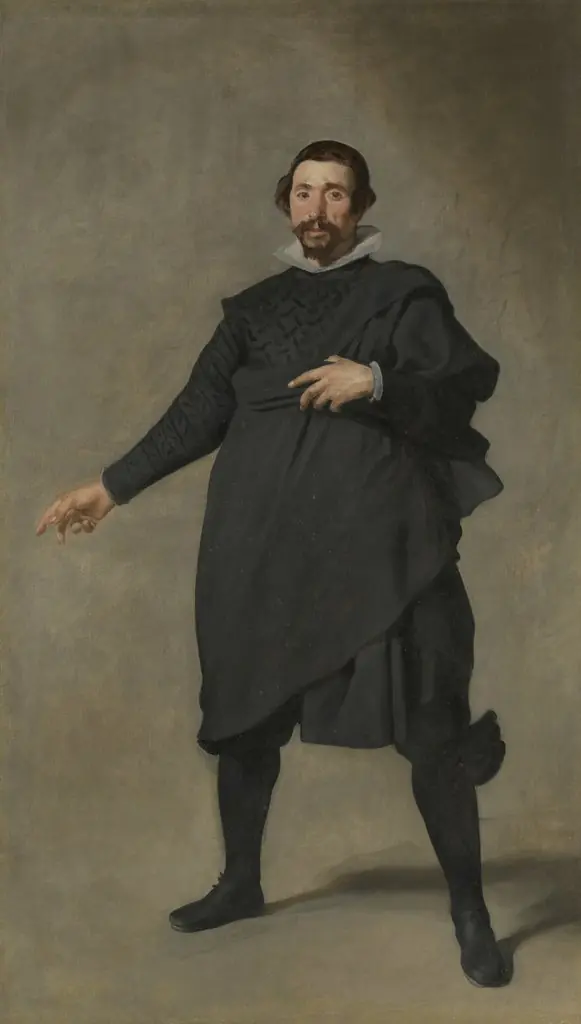
Portrait of the Jester Calabazas
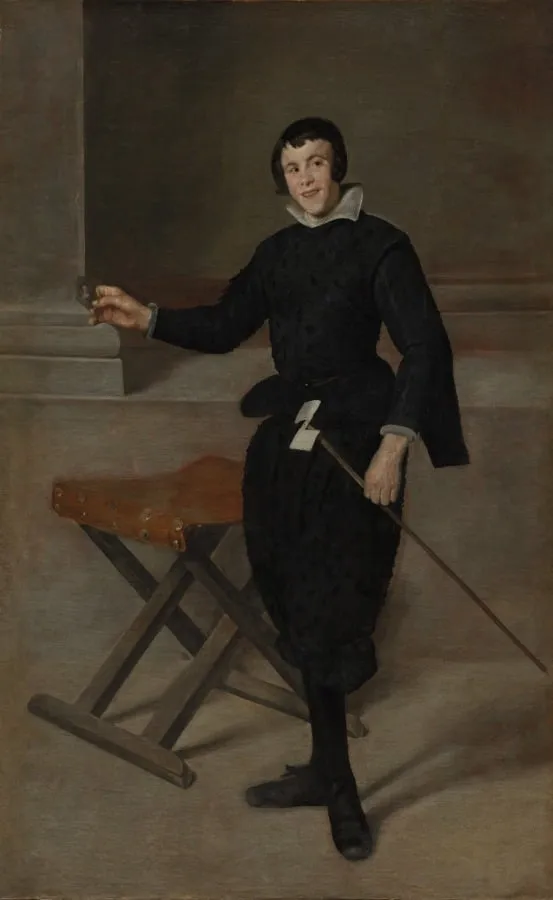
Portrait of the Jester Calabazas is an unspecified painting by the Baroque artist Diego Velázquez. It dates from 1632 and is held in the collection of the Cleveland Museum of Art.
About this work
Look up Diego Velázquez (Spanish, 1599–1660) to see how he broke the rules.
You see a man in fancy clothes with a big white ruff collar. His face twists a bit—one eye higher than the other. He leans on a stick. The painting feels real, not stiff like most royal portraits.
This is a jester named Calabazas from Spain. Velázquez shows his disabilities without hiding them. That was rare back then. The artist treats him like any other person, not just a funny sidekick.
Look up Diego Velázquez (Spanish, 1599–1660) to see how he broke the rules.
Overview
Diego Velázquez’s full‑length portrait depicts Calabazas, a court jester serving King Philip IV of Spain. The painting presents the figure in elaborate costume with a white ruff, leaning on a staff, his facial expression marked by an asymmetrical gaze that hints at physical and mental impairments. Unlike conventional court portraits that idealize their subjects, this work foregrounds the jester’s individuality and condition.
Subject & Meaning
Calabazas was known at the Spanish court for both his role as a performer and his disabilities, which were openly acknowledged by his contemporaries. Velázquez chooses to render these traits plainly, allowing the viewer to recognize the jester as a person rather than merely a source of amusement. The composition thereby challenges the marginal status typically assigned to entertainers in 17th‑century Spain.
Technique & Style
Executed in oil on canvas, the portrait employs the formal conventions of royal portraiture—full‑length stance, sumptuous fabrics, and a neutral background—while maintaining a naturalistic approach to flesh and fabric. Velázquez’s brushwork captures the texture of the ruff and the sheen of the costume, and his handling of light creates a three‑dimensional presence that avoids the stiffness of many contemporary court images.
History & Provenance
Created during Velázquez’s tenure as court painter in the early 1630s, the work remained within the Spanish royal collection before entering the public museum sphere in the 19th century. It has been documented in inventories of the Palacio Real and is now housed in the Museo del Prado, where it is displayed among other portraits that illustrate the painter’s range of subjects.
Artist & collection
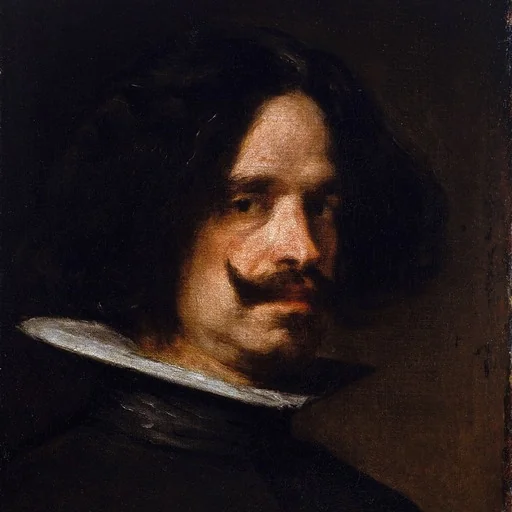
Artist
Diego Rodríguez de Silva y Velázquez was a Spanish Baroque painter, the leading artist in the court of King Philip IV of Spain and Portugal, and of the Spanish Golden Age.