Artwork
The Triumph of Bacchus
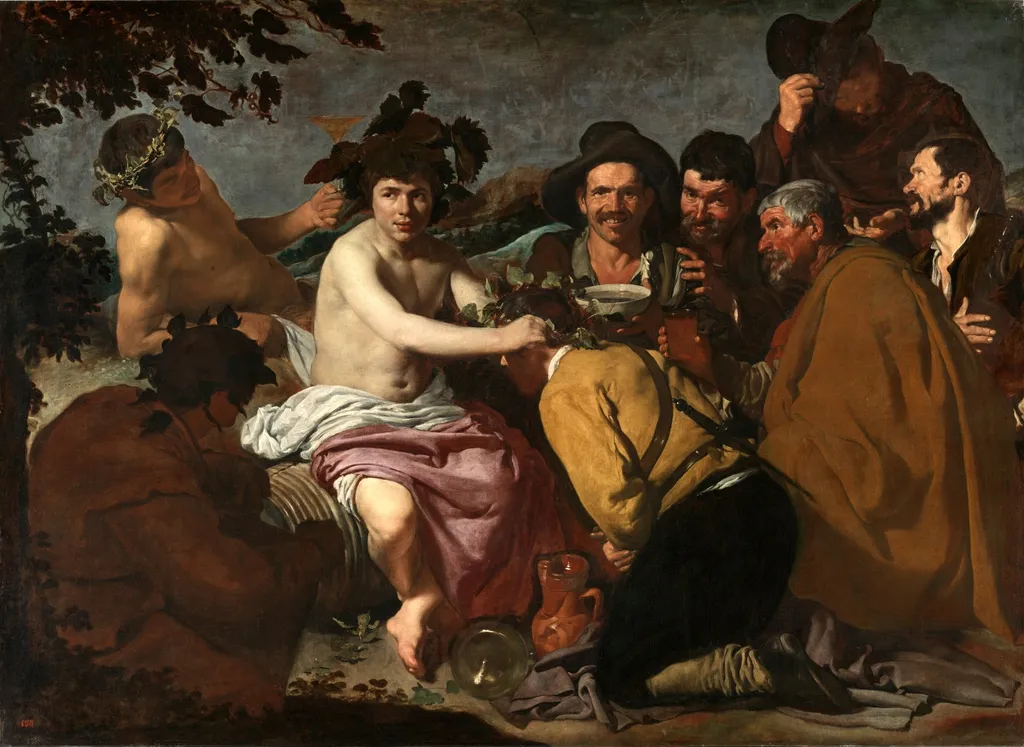
The Triumph of Bacchus is an oil painting by the Early Baroque Italian artist Diego Velázquez. It dates from 1628 and is held in the collection of the Museo del Prado.
About this work
Overview
Diego Velázquez’s oil painting The Triumph of Bacchus, also known as Los Borrachos, is housed in Madrid’s Museo del Prado. Executed shortly after the artist’s move from Seville and before his first trip to Italy, the work was commissioned by King Philip IV, who paid Velázquez a fee of one hundred ducats.
Subject & Meaning
The composition depicts the Roman god of wine, Bacchus, in a semi‑nude state, crowned with a vine wreath and offering a bunch of grapes to a group of ordinary drinkers. The figures, rendered as rough‑looking men sharing clay cups, blend mythic celebration with everyday revelry, suggesting a convergence of divine indulgence and common festivity.
Technique & Style
Velázquez employs a pronounced chiaroscuro, using strong contrasts of light and shadow to isolate the figures against a dark, atmospheric backdrop of trees and a hazy sky. The palette is dominated by warm, earthy tones, and the brushwork balances detailed rendering of the faces with looser treatment of the surrounding landscape.
History & Provenance
Completed for Philip IV, the painting entered the royal collection and later became part of the Prado’s holdings. Its creation coincided with Velázquez’s exposure to the king’s Italian masterpieces, which likely influenced his handling of mythological subject matter and the nude form.
Context
The work reflects the early 1620s Spanish Baroque interest in combining classical mythology with realistic genre scenes. Velázquez’s encounter with Italian art in Madrid introduced him to the tradition of depicting gods in naturalistic settings, a practice evident in the earthy treatment of Bacchus and his companions.
Legacy
The Triumph of Bacchus is frequently cited as the pinnacle of Velázquez’s output during the 1620s, illustrating his developing mastery of light, composition, and the integration of mythological narrative with everyday life.
Own this work as a print
Artist & collection

Artist
Diego Rodríguez de Silva y Velázquez was a Spanish Baroque painter, the leading artist in the court of King Philip IV of Spain and Portugal, and of the Spanish Golden Age.