Artwork
Martinus Alewijn (1634-84). Son of Abraham Alewijn and Geertruid Hooftman
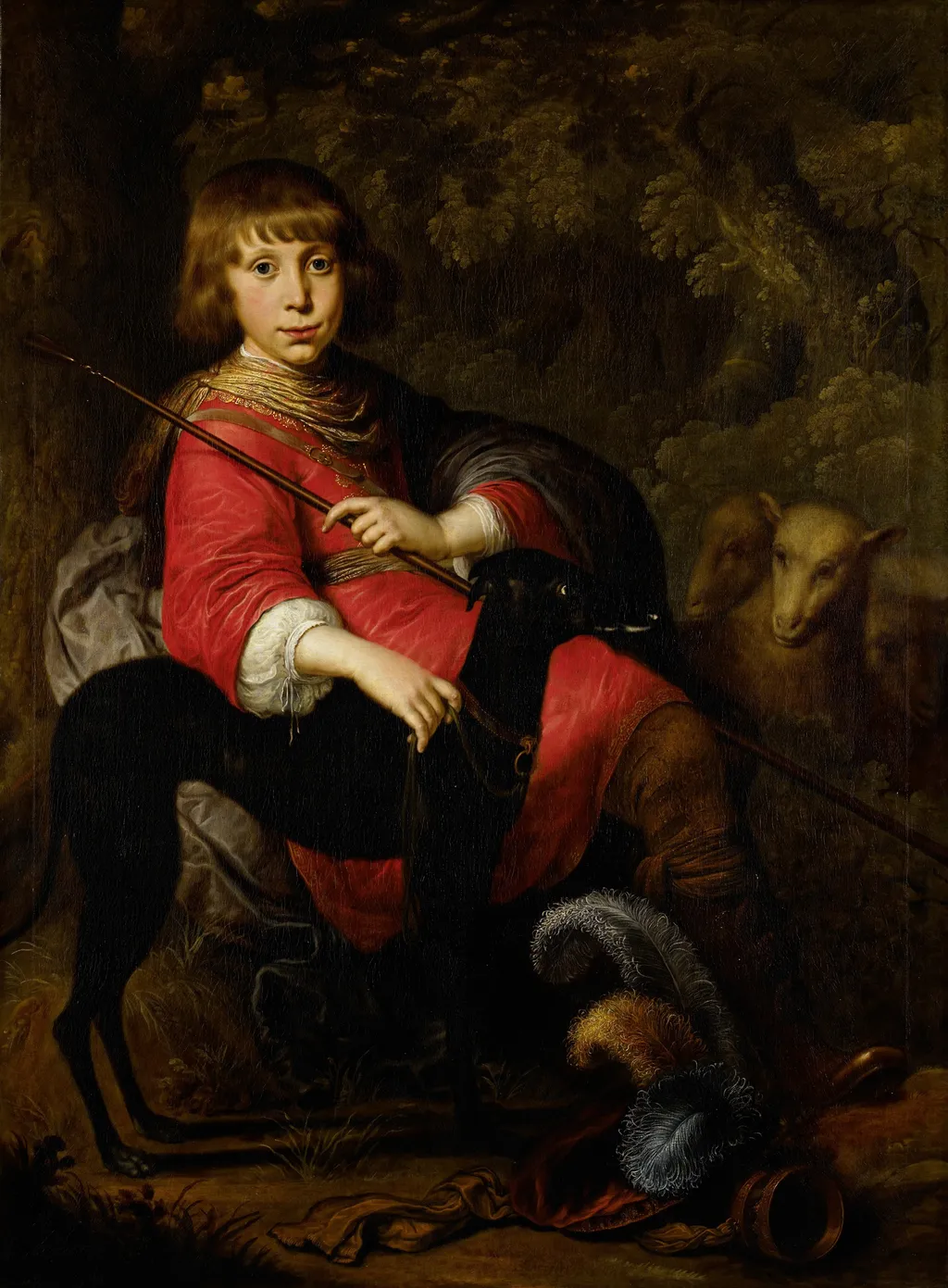
Martinus Alewijn (1634-84). Son of Abraham Alewijn and Geertruid Hooftman is an oil painting by the Dutch Golden Age artist Dirck van Santvoort. It dates from 1644 and is held in the collection of the Rijksmuseum.
About this work
Overview
Dirck van Santvoort’s oil portrait, executed in 1644, presents a young Martinus Alewijn, son of Abraham Alewijn and Geertruid Hooftman. The work is part of the Rijksmuseum’s collection and exemplifies mid‑seventeenth‑century Dutch portraiture, focusing on a solitary figure set against a muted, forested backdrop.
Subject & Meaning
The sitter, a boy in a red, gold‑trimmed tunic, holds a staff while a black dog rests at his side, his left hand resting on the animal’s back. A sheep appears behind him, suggesting a pastoral role or an idealized representation of youthful vigor and responsibility within a rural setting.
Technique & Style
Van Santvoort employs pronounced chiaroscuro, contrasting the illuminated figure with the shadowy woodland, which creates a three‑dimensional effect. The crisp rendering of fabrics, the subtle modeling of the dog’s fur, and the delicate handling of light on the boy’s skin demonstrate the artist’s command of oil paint to convey texture and depth.
History & Provenance
Created when the subject was a child, the portrait remained in private hands before entering the Rijksmuseum’s holdings, where it is displayed as part of the museum’s Dutch Golden Age collection. Its attribution to van Santvoort has been consistently affirmed by scholarly catalogues.
Context
The painting reflects the Dutch tradition of commemorating family members with individualized likenesses, often incorporating symbolic elements such as animals to denote status or occupation. The inclusion of a shepherd’s accoutrements aligns with contemporary ideals of innocence, diligence, and the pastoral virtues prized in 17th‑century Dutch society.
Own this work as a print
Artist & collection