Artwork
Rock Formations near Olevano
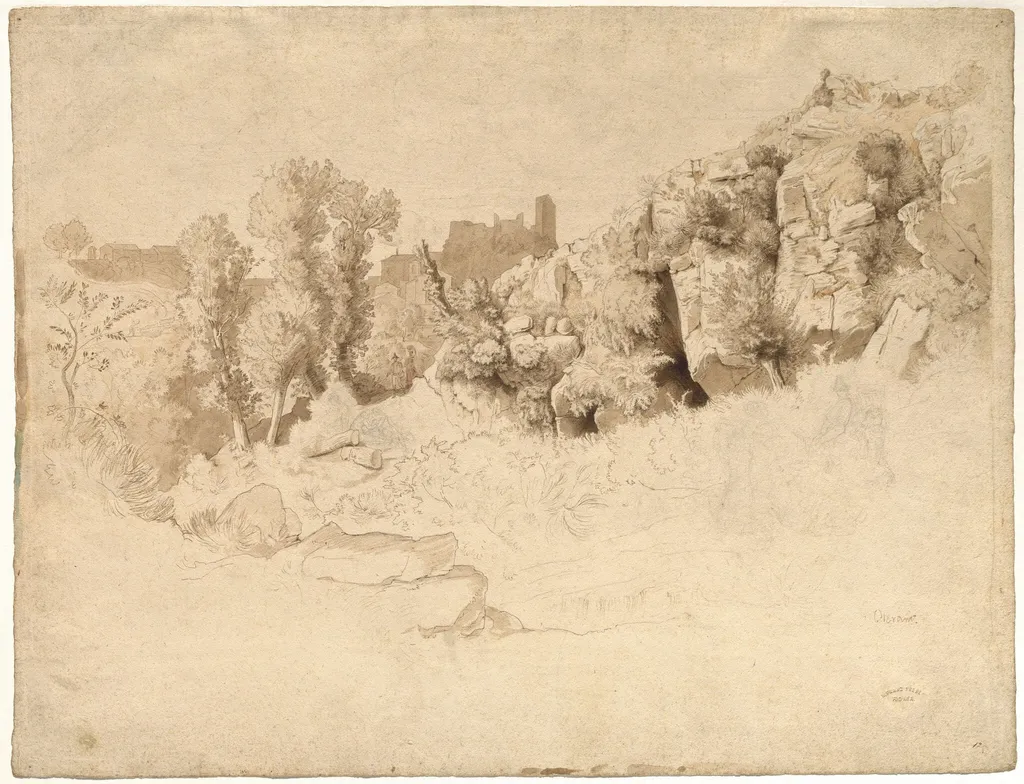
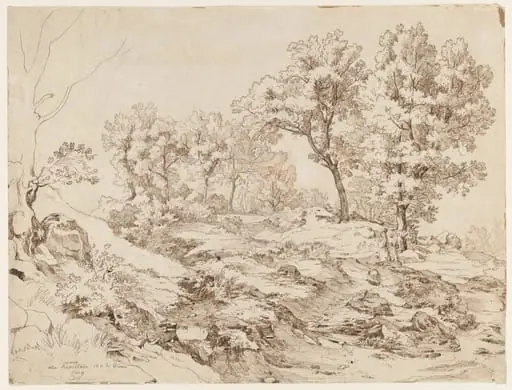
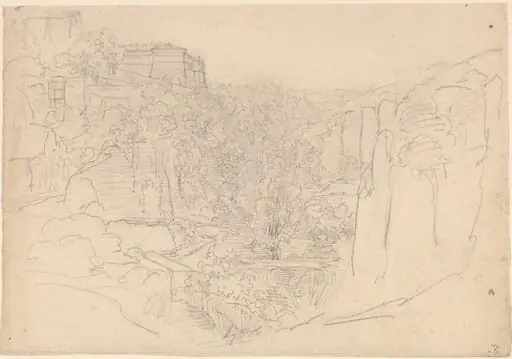
Rock Formations near Olevano is an ink drawing by the Romanticist artist Heinrich Dreber. It dates from 1848 and is held in the collection of the National Gallery of Art. This drawing, dated 1848, depicts natural rock formations near the Italian village of Olevano.
About this work
Overview
This drawing, dated 1848, depicts natural rock formations near the Italian village of Olevano. Executed in pen and brown ink with wash and subtle watercolor accents, it was made on wove paper over an initial graphite sketch. The work is a landscape study, not a finished painting, reflecting the artist’s direct observation of geological forms in the Roman countryside.
Subject & Meaning
The subject is a cluster of weathered limestone outcrops, their layered strata and erosion patterns rendered with careful attention. There is no human presence or narrative; the focus lies in the quiet monumentality of the rock itself. The drawing suggests an interest in geology and the passage of time, aligning with 19th-century scientific and aesthetic inquiries into natural forms.
Technique & Style
The artist used fine pen lines to define contours and textures, layered with diluted brown ink washes to suggest depth and shadow. Light watercolor touches add muted tonal variation without overwhelming the linear structure. The underlying graphite underdrawing remains visible in places, revealing a methodical, observational approach typical of topographical studies of the period.
History & Provenance
Created during Heinrich Dreber’s time in Italy, the work likely originated from his sketching trips in the Lazio region. It remained in private hands for much of its history and entered a public collection in the 20th century. No exhibition or publication record from the artist’s lifetime is known, suggesting it was intended as a personal study rather than a public work.
Context
Dreber’s drawing reflects a broader 19th-century European trend among artists and naturalists to document landscapes with scientific precision. Similar studies were made by German and British travelers in Italy, drawn to the region’s ancient geology and classical ruins. This piece fits within a tradition of topographical drawing that valued accuracy over romantic embellishment.
Legacy
Though not widely exhibited or reproduced, the drawing contributes to understanding Dreber’s practice as a meticulous observer of nature. It stands as an example of how 19th-century artists engaged with the physical world through direct sketching, preserving a quiet record of place that predates modern geological documentation.
Artist & collection