Artwork
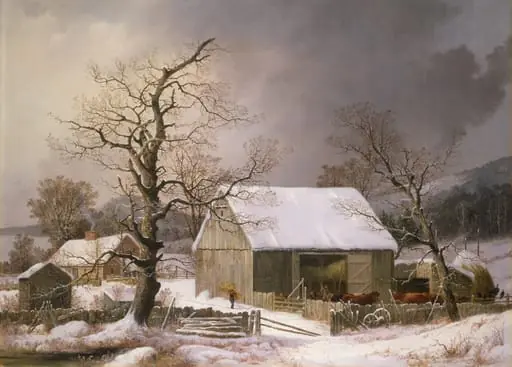
The Farm-Yard in Winter
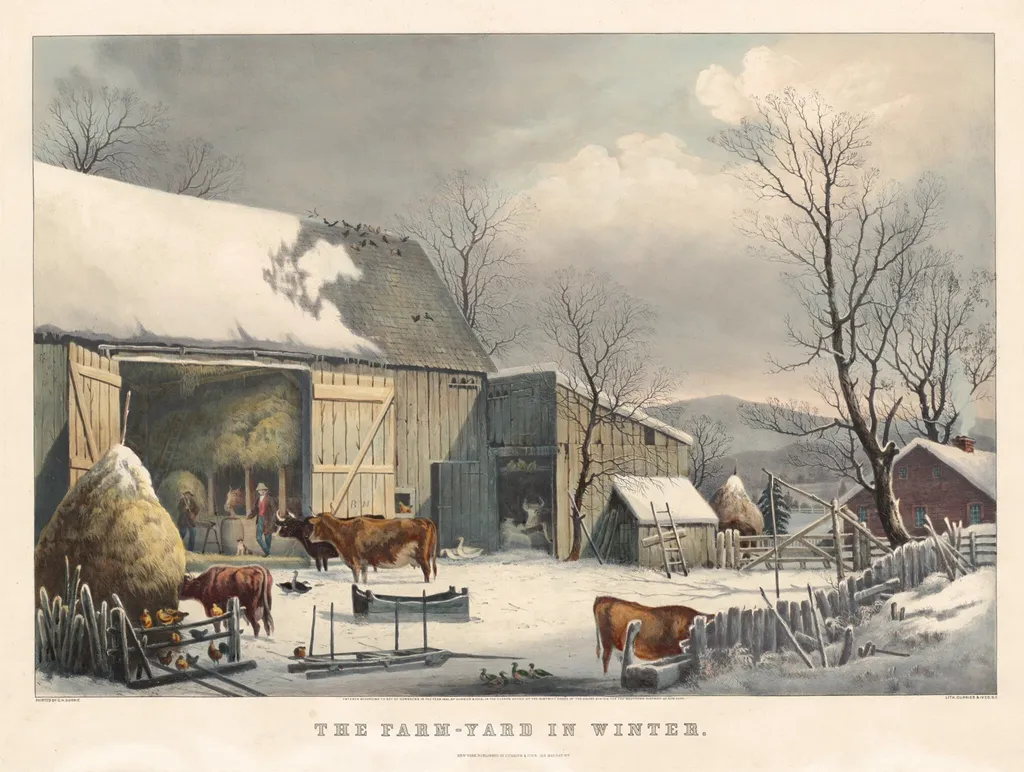
The Farm-Yard in Winter is an ink print by the Impressionist artist George Henry Durrie. It dates from 1861 and is held in the collection of the National Gallery of Art.
About this work
Overview
Its modest scale and domestic subject align with 19th-century American interest in everyday life, rendered with careful attention to seasonal detail.
Created in 1861, The Farm-Yard in Winter is a hand-colored lithograph by George Henry Durrie, produced on wove paper with subtle additions of gum arabic for texture. The work belongs to the print medium, not painting, and reflects the artist’s skill in translating a quiet rural scene into a reproducible image. Its modest scale and domestic subject align with 19th-century American interest in everyday life, rendered with careful attention to seasonal detail.
Subject & Meaning
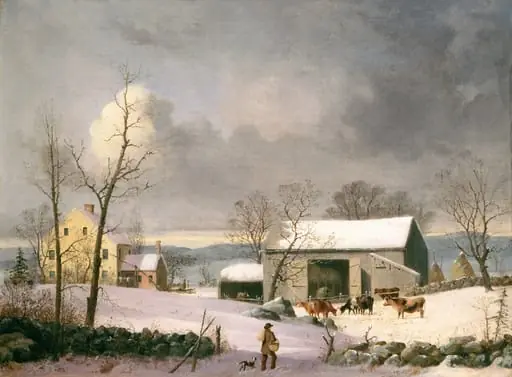
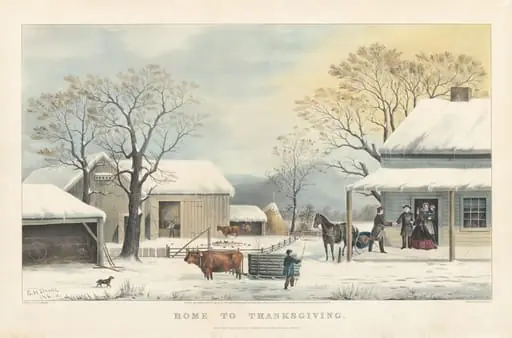
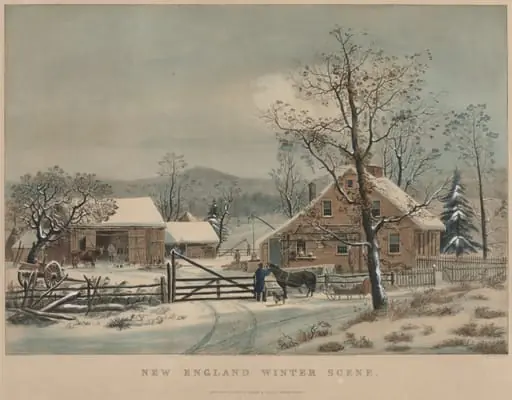
The scene depicts a modest farmyard blanketed in snow, with a large barn at its center, smoke curling from its chimney. Cows, chickens, and a few figures move quietly through the space, while hay bales rest against a wooden fence and bare trees frame the background. No dramatic event occurs; instead, the image conveys the stillness and routine of winter labor, suggesting dignity in ordinary rural existence without idealization.
Technique & Style
Durrie employed lithography to achieve fine linear detail, then added color by hand using water-based pigments and gum arabic to enhance depth and luminosity. The palette is restrained—grays, browns, and muted whites—mirroring winter’s subdued tones. Soft shading and delicate brushwork in the snow and clouds lend a sense of atmosphere, while the composition’s balance and lack of focal point reinforce the calm, uneventful mood of the scene.
History & Provenance
The print was produced during the height of Durrie’s career, when his winter landscapes gained popularity through commercial lithographic publishers. Though originally made for mass distribution, surviving examples are now rare due to the fragility of hand-colored paper. The work was likely sold as a decorative print for middle-class homes, reflecting a growing market for affordable, sentimental American scenes in the years before the Civil War.
Context
In the early 1860s, as industrialization reshaped American life, images of rural winter scenes offered nostalgic comfort. Durrie’s prints resonated with urban audiences seeking connection to an idealized agrarian past. His work coincided with the rise of illustrated periodicals and the popularity of Hudson River School aesthetics, though his focus remained on humble, human-scaled landscapes rather than grand wilderness.
Legacy
Durrie’s winter farm scenes influenced later American illustrators and helped establish a visual language for rural life in print. Though not widely studied today, his prints remain important as early examples of accessible art that documented everyday American experience. The Farm-Yard in Winter exemplifies how lithography democratized imagery, bringing quiet moments of rural winter into homes far from the countryside.
Artist & collection

Artist
George Henry Durrie (June 6, 1820 – October 15, 1863) was an American landscape artist noted especially for his rural winter snow scenes, which became very popular after they were reproduced as lithographic prints by Currier and Ives.