Artwork
The Bugle Call
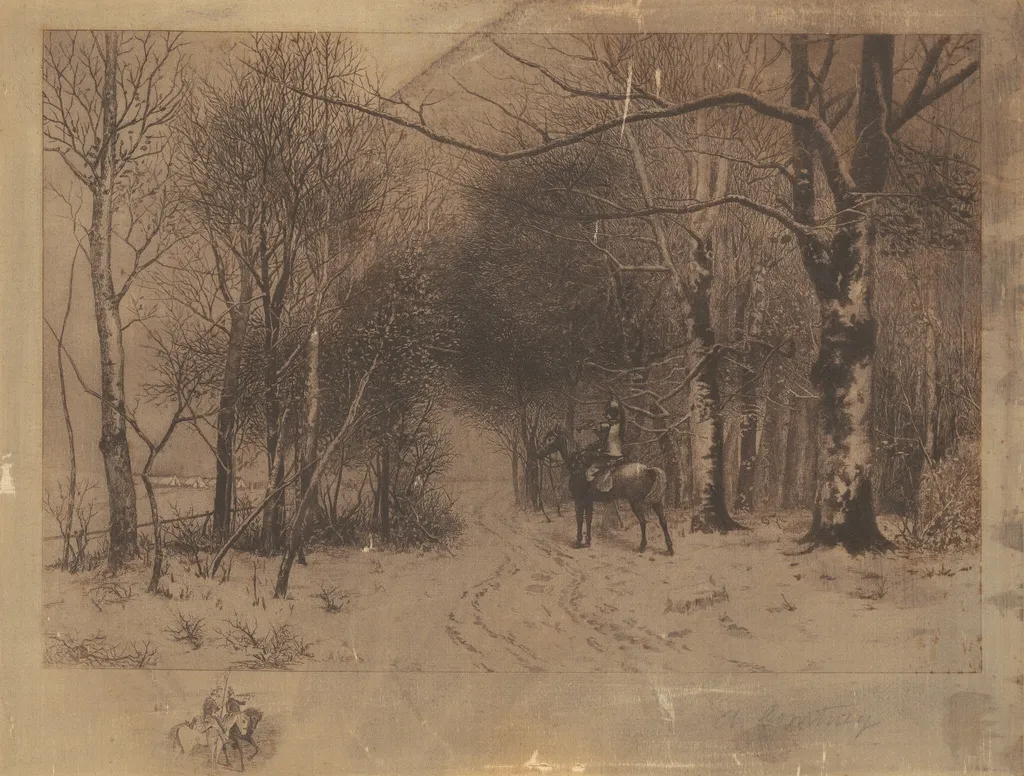
The Bugle Call is an ink print by the Impressionist artist A. Courtney. It dates from 1880 and is held in the collection of the National Gallery of Art. Created around 1880 by A.
About this work
Overview
The work belongs to the printmaking tradition of the late 19th century, where intimate, atmospheric subjects were favored over grand narratives.
Created around 1880 by A. Courtney, this print is an etching executed in black ink on silk, then adhered to a rigid board. Unlike traditional paper supports, the silk substrate introduces a delicate luminosity, enhancing the quiet atmosphere of the scene. The work belongs to the printmaking tradition of the late 19th century, where intimate, atmospheric subjects were favored over grand narratives.
Subject & Meaning
A solitary soldier in a dark blue uniform is depicted mid-blow, his face obscured by shadow. His posture suggests urgency, yet the composition avoids theatricality. The soft gray sky and minimal background focus attention on the act of sounding the bugle—an ordinary military signal rendered with solemn gravity. The image evokes quiet duty rather than battle, emphasizing the solitary nature of the role.
Technique & Style
The artist employed drypoint etching, scratching directly into a metal plate to create rich, velvety lines that hold ink deeply. This method produces subtle tonal variations, capturing the play of light on fabric and metal without sharp contrast. The silk backing amplifies the effect, lending a faint sheen that mimics the glint of polished brass under overcast light. The marks are deliberate, not ornate, conveying restraint and precision.
History & Provenance
The work’s early ownership is undocumented, but its materials and technique align with private print collections of the late Victorian era. It was likely produced for a limited audience, possibly as a personal or institutional commission. No major exhibitions or catalogues from the period list it, suggesting it remained in private hands rather than entering public discourse.
Context
In the decades following the American Civil War and during Britain’s imperial campaigns, military imagery in art often focused on heroism or ceremony. Courtney’s approach diverges—offering a moment of quiet routine rather than spectacle. This reflects a broader trend among printmakers who turned to understated, observational subjects, valuing mood over monumentality.
Legacy
The work remains obscure in art historical records, with no known reproductions or scholarly studies. Its survival as a single, intact piece underscores its status as a private, handcrafted object. While not influential in a broad sense, it stands as a quiet example of how technical subtlety and material choice could elevate everyday military life into a contemplative image.
Artist & collection