Artwork
Head of a Woman
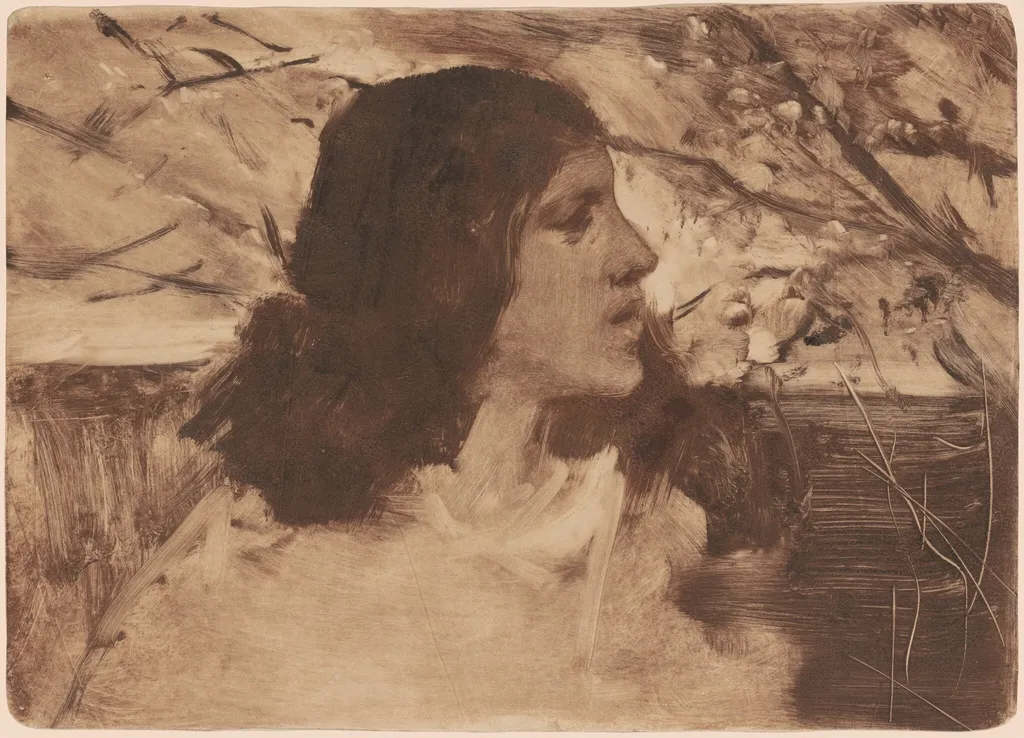
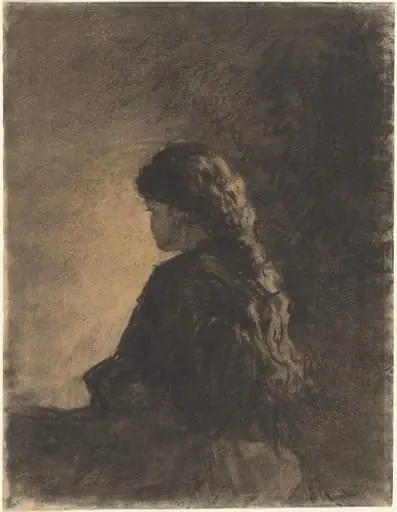
Head of a Woman is a print by the Impressionist artist Frank Duveneck. It dates from 1884 and is held in the collection of the National Gallery of Art.
About this work
Overview
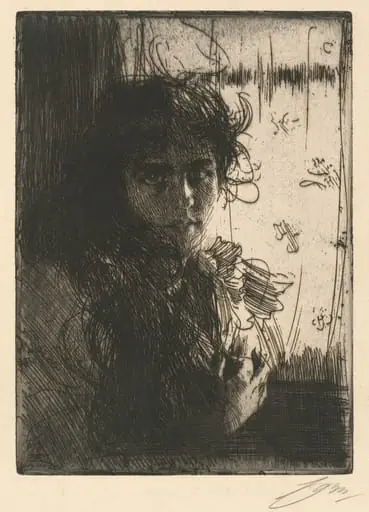
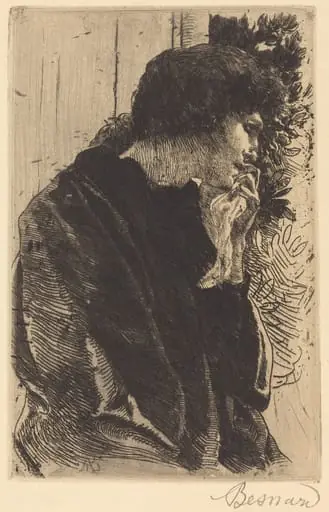
Frank Duveneck’s 1884 monotype, titled Head of a Woman, presents a solitary female profile rendered in muted brown and black tones on wove paper. The composition isolates the sitter, emphasizing the subtle interplay of light and shadow across her features, while the textured background contributes a sense of depth without distracting from the figure.
Subject & Meaning
The work depicts a woman turned slightly toward her right, her hair gathered back and her expression neutral, suggesting a moment of inward reflection. The restrained pose and softened contours invite viewers to consider the sitter’s inner state, conveying a quiet, contemplative mood rather than narrative detail.
Technique & Style
Created as a monotype, the image was produced by drawing or painting directly onto a smooth paper surface, then transferring the impression onto wove paper. Duveenck employed a limited palette of brown and black, allowing the paper’s texture to emerge through visible brushstrokes, which lend the piece a tactile, atmospheric quality.
History & Provenance
The monotype was executed in 1884, during a period when Duveenck explored printmaking alongside his more familiar oil paintings. While specific ownership records are scarce, the work remains associated with the artist’s broader output from the late nineteenth century, reflecting his interest in portraiture and experimental print techniques.
Artist & collection