Artwork
Victoria Dubourg
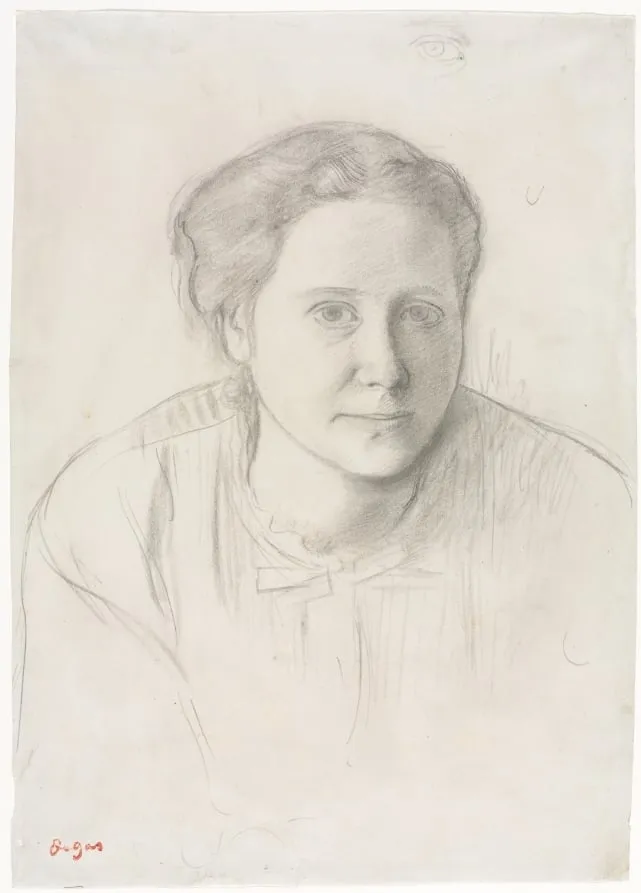
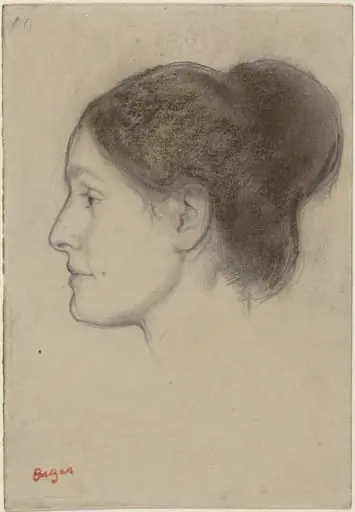
Victoria Dubourg is a drawing by the Impressionist artist Edgar Degas. It dates from 1866 and is held in the collection of the Cleveland Museum of Art.
About this work
Overview
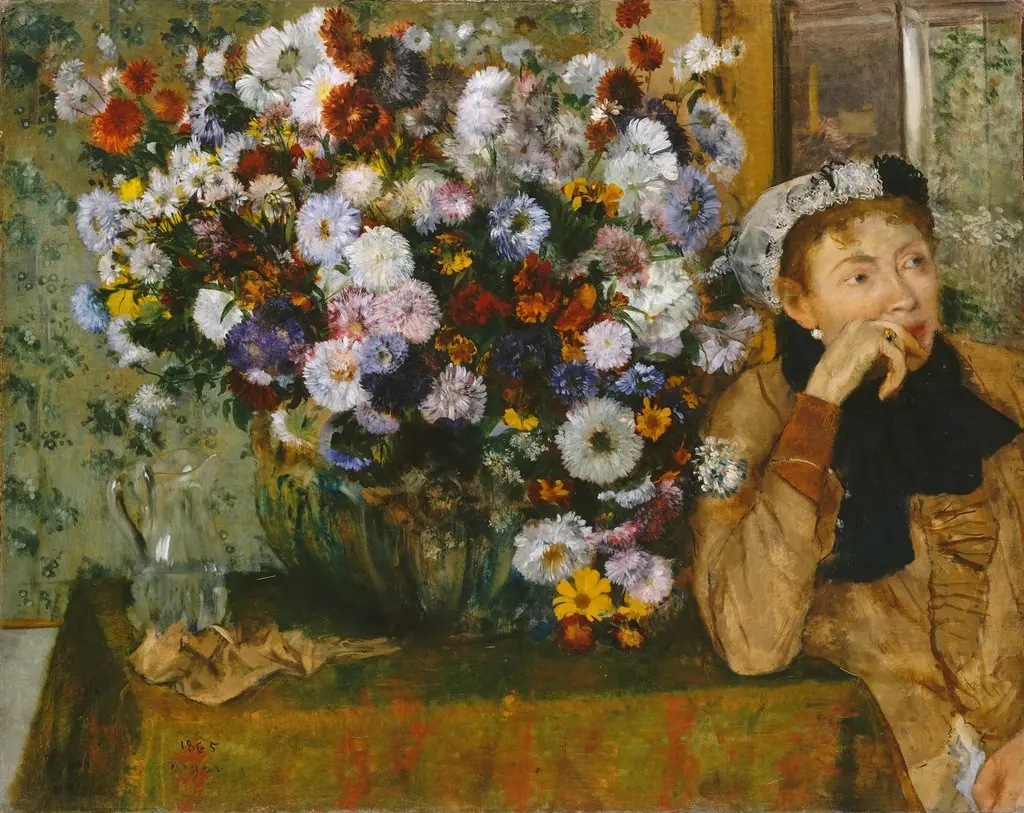
This drawing by Edgar Degas is a preparatory study for a painted portrait of Victoria Dubourg, a fellow artist known for her floral still lifes. Executed in dark, fluid lines, it captures Dubourg’s face with focused intensity, emphasizing her gaze as the central element. The sheet includes additional trial marks along the upper edge, revealing Degas’s iterative process in refining her expression.
Subject & Meaning
Victoria Dubourg is depicted with a direct, unwavering gaze that conveys quiet presence rather than emotion. As a painter of flowers, her stillness and attentiveness may have resonated with Degas’s interest in focused observation. The portrait does not idealize but records her as she is—intentional, composed, and engaged with the viewer through her eyes.
Technique & Style
The loose handling of the rest of the face suggests a working process, where precision was reserved for the most psychologically significant feature.
Degas used rapid, confident strokes to define the contours of Dubourg’s face, contrasting with the more tentative, layered lines around her eyes. He revisited the gaze multiple times, sketching over and beside the original to adjust its direction and intensity. The loose handling of the rest of the face suggests a working process, where precision was reserved for the most psychologically significant feature.
History & Provenance
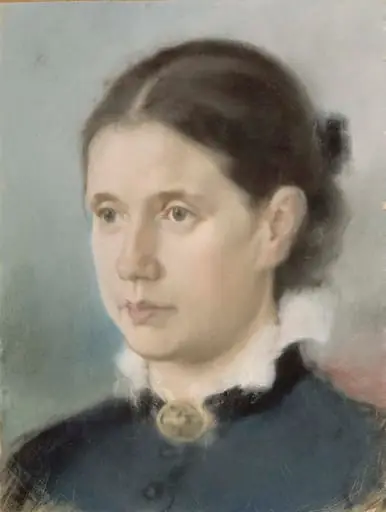
The drawing was created in the 1870s as part of Degas’s preparation for a finished portrait now held by the Toledo Museum of Art. It remained in the artist’s possession until his death and was later acquired by a private collector before entering a public collection. Its survival as a study offers insight into Degas’s method beyond the final painted work.
Context
During the 1870s, Degas frequently made detailed drawings to refine his portraits, often focusing on the eyes as conduits of character. Dubourg, though less known than her contemporaries, was part of a circle of artists who exchanged works and ideas. This study reflects a moment of mutual artistic respect, where one painter sought to capture the quiet intensity of another.
Legacy
The drawing exemplifies Degas’s belief that a portrait’s essence lies not in detail but in the alignment of gaze and expression. Its raw, unpolished quality has influenced later artists interested in the psychological weight of sketching. Unlike finished portraits, this study preserves the act of seeing—making it a document of perception as much as representation.
Artist & collection
Artist
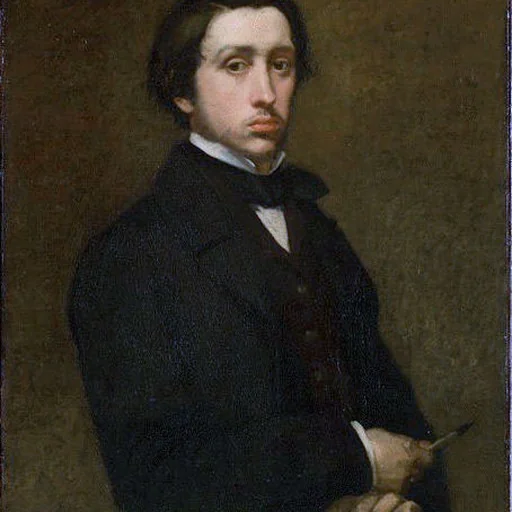
Born Hilaire-Germain-Edgar De Gas on 19 July 1834 in Paris, Edgar Degas came from an affluent banking family with aristocratic roots and spent his childhood among the cultivated circles of the French capital.