Artwork
Portrait of a Woman
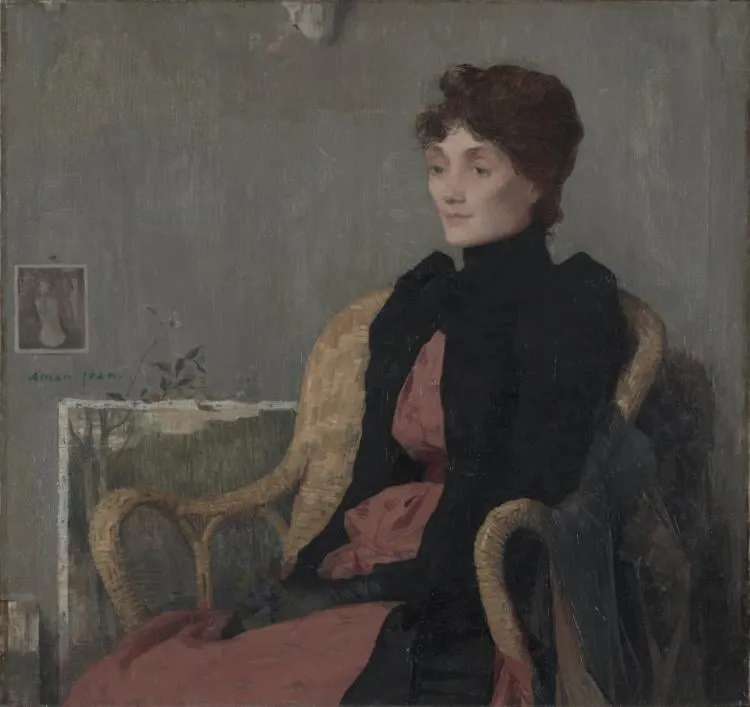
Portrait of a Woman is an unspecified painting by the Impressionist artist Edmond Aman-Jean. It dates from 1891 and is held in the collection of the Cleveland Museum of Art. Painted in the late 19th century, this portrait by Émile Aman-Jean presents a woman in a quiet, interior setting.
About this work
Overview
It was first shown at the 1891 Paris Salon, aligning with Symbolist tendencies to prioritize mood over narrative or realism.
Painted in the late 19th century, this portrait by Émile Aman-Jean presents a woman in a quiet, interior setting. Rather than capturing a specific individual, the work emphasizes atmosphere and emotional resonance. The composition avoids sharp detail, favoring soft contours and muted tones to evoke introspection. It was first shown at the 1891 Paris Salon, aligning with Symbolist tendencies to prioritize mood over narrative or realism.
Subject & Meaning
The sitter’s identity remains unknown, and her features are rendered with deliberate ambiguity. Her gentle expression and still posture suggest contemplation rather than individual character. The inclusion of a postcard, possibly depicting a Botticelli figure, introduces a layer of cultural memory, hinting at ideals of beauty and serenity drawn from earlier art. The image functions less as a likeness and more as a meditation on quietude and timeless femininity.
Technique & Style
Aman-Jean employs a restrained palette of soft grays, creams, and earth tones, avoiding strong contrasts. Forms are simplified into flat, decorative planes, echoing the stylized compositions of Puvis de Chavannes and Whistler. Brushwork is subdued, with no emphasis on chiaroscuro or textural detail. The result is a harmonious, almost mural-like surface that prioritizes emotional tone over physical realism.
History & Provenance
The painting was exhibited at the Paris Salon in 1891, a key venue for French artists seeking public and critical recognition. Its reception reflected contemporary interest in Symbolist approaches that moved beyond naturalism. While its early ownership is undocumented, its inclusion in the Salon confirms its status as a representative work of Aman-Jean’s mature period, aligned with the aesthetic currents of the fin de siècle.
Context
Created during a period when many artists rejected academic realism, this portrait reflects broader Symbolist interests in suggestion and inner states. The influence of Whistler’s tonal harmony and Puvis’s serene compositions is evident. The postcard alludes to Renaissance ideals, positioning the sitter within a lineage of idealized female figures, while the modern, flattened space grounds her in contemporary artistic concerns.
Legacy
Though not widely known today, the painting exemplifies a significant strand of late 19th-century French art that valued mood over documentation. Its quiet aesthetic influenced later artists exploring emotional abstraction and decorative form. As a representative of Symbolist portraiture, it remains a quiet testament to the era’s search for meaning beyond the visible.
Artist & collection
Artist
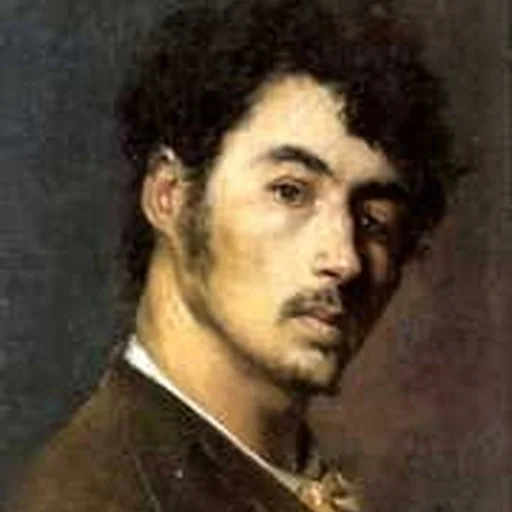
Edmond Aman-Jean (13 November 1858, Chevry-Cossigny – 25 January 1936, Paris) was a French symbolist painter, who co-founded the Salon des Tuileries in 1923.

 Portrait of the artist's first wife, née Ellen Cobden
 Istuva mustapukuinen nainen, "Thérèse noire"
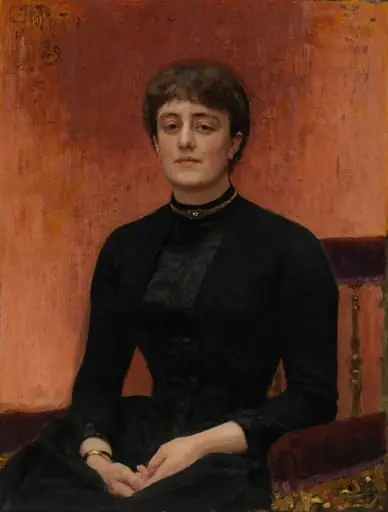 Taiteilija Jelizaveta Zvantsevan muotokuva
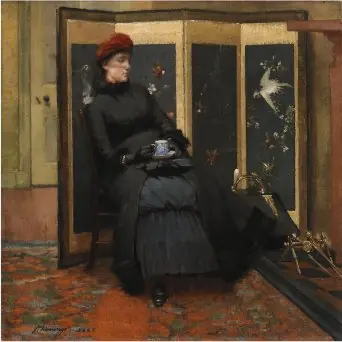 A Visitor
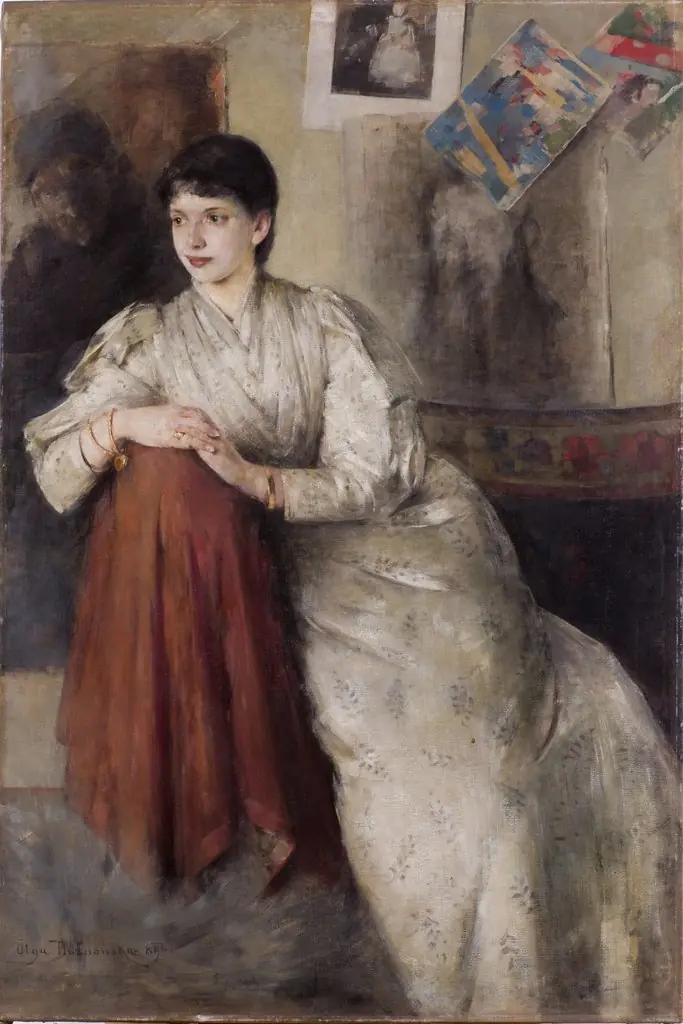 Portrait of a Woman in a White Dress
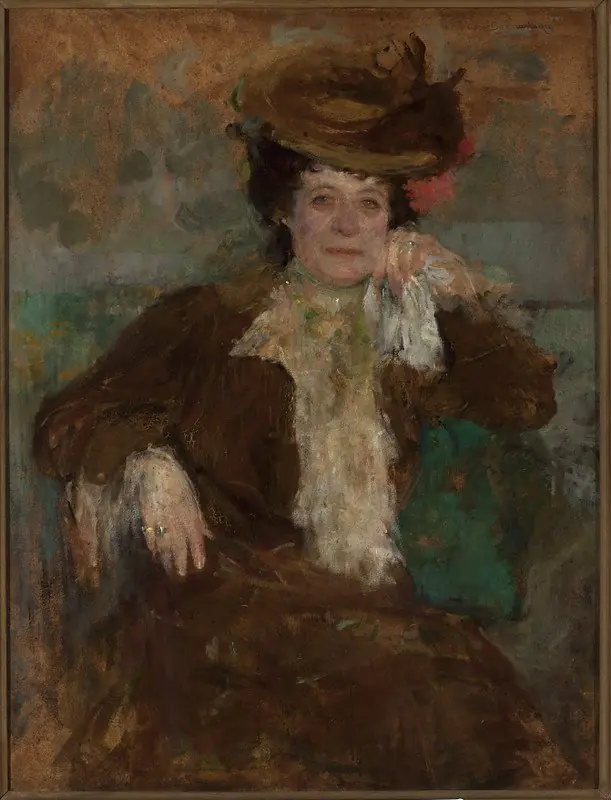 Portrait of a woman in a brown dress
 Head of a Girl
 Kreivitär Berthe de Vallombreuse
 Anne Page
 Concepción Miramón
 Reading