Artwork
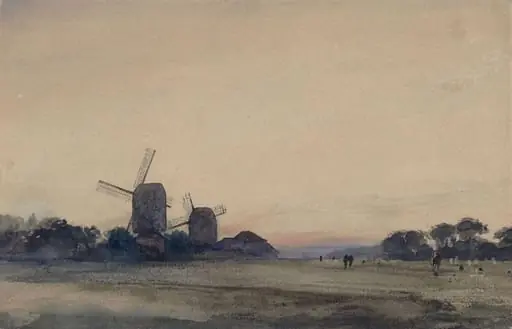
Windmill, Blackheath
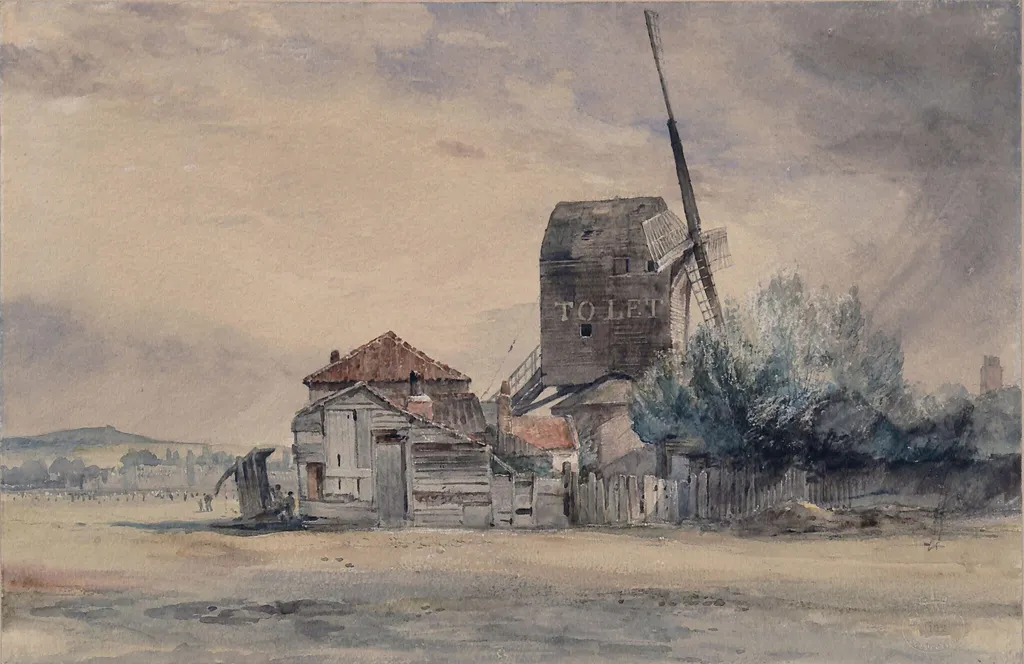
Windmill, Blackheath is a watercolor work on paper by Edward William Cooke. It dates from 1850 and is held in the collection of the Victoria and Albert Museum.
About this work
Overview
Windmill, Blackheath is a watercolor painting dated around 1850, attributed to the English artist Edward Cooke. It depicts a modest rural scene in the London suburb of Blackheath, rendered in delicate washes of transparent pigment. The work is part of the Victoria and Albert Museum’s collection, where it is preserved as an example of mid-19th-century British topographical watercolor.
Subject & Meaning
The painting captures a quiet, unremarkable corner of the English countryside: a wooden windmill with its blades at rest, beside a modest, weathered dwelling. The label 'TOLET' on the windmill appears to be a whimsical invention, not a historical name, suggesting a personal or humorous touch by the artist. The scene avoids grandeur, instead offering a contemplative glimpse into ordinary life.
Technique & Style
Cooke employed transparent watercolor to build subtle tonal variations, using soft washes to suggest the texture of weathered wood and the diffused quality of daylight. The sky is lightly clouded, with minimal detail, enhancing the calm atmosphere. The fence and distant hills are rendered with restrained linework, reinforcing the painting’s quiet, observational tone rather than dramatic emphasis.
History & Provenance
The painting entered the Victoria and Albert Museum’s collection in the 19th century, likely through acquisition or donation. Its provenance before that is undocumented, but its subject matter and style align with the growing 19th-century interest in recording everyday English landscapes, often by amateur or regional artists working outside academic traditions.
Context
During the 1850s, watercolor was widely used for topographical and domestic scenes, favored for its portability and suitability for private collections. Windmill, Blackheath reflects this trend, capturing a moment in a rapidly changing landscape where rural structures like windmills were becoming relics of a fading agrarian past.
Legacy
Though not widely exhibited or studied, the painting endures as a quiet testament to the value placed on unassuming rural views in Victorian Britain. It represents a broader cultural habit of observing and preserving the mundane, offering insight into how ordinary places were documented and remembered by artists of the period.
Own this work as a print
Artist & collection