Artwork
Rezidenz Platz (Salzburg)
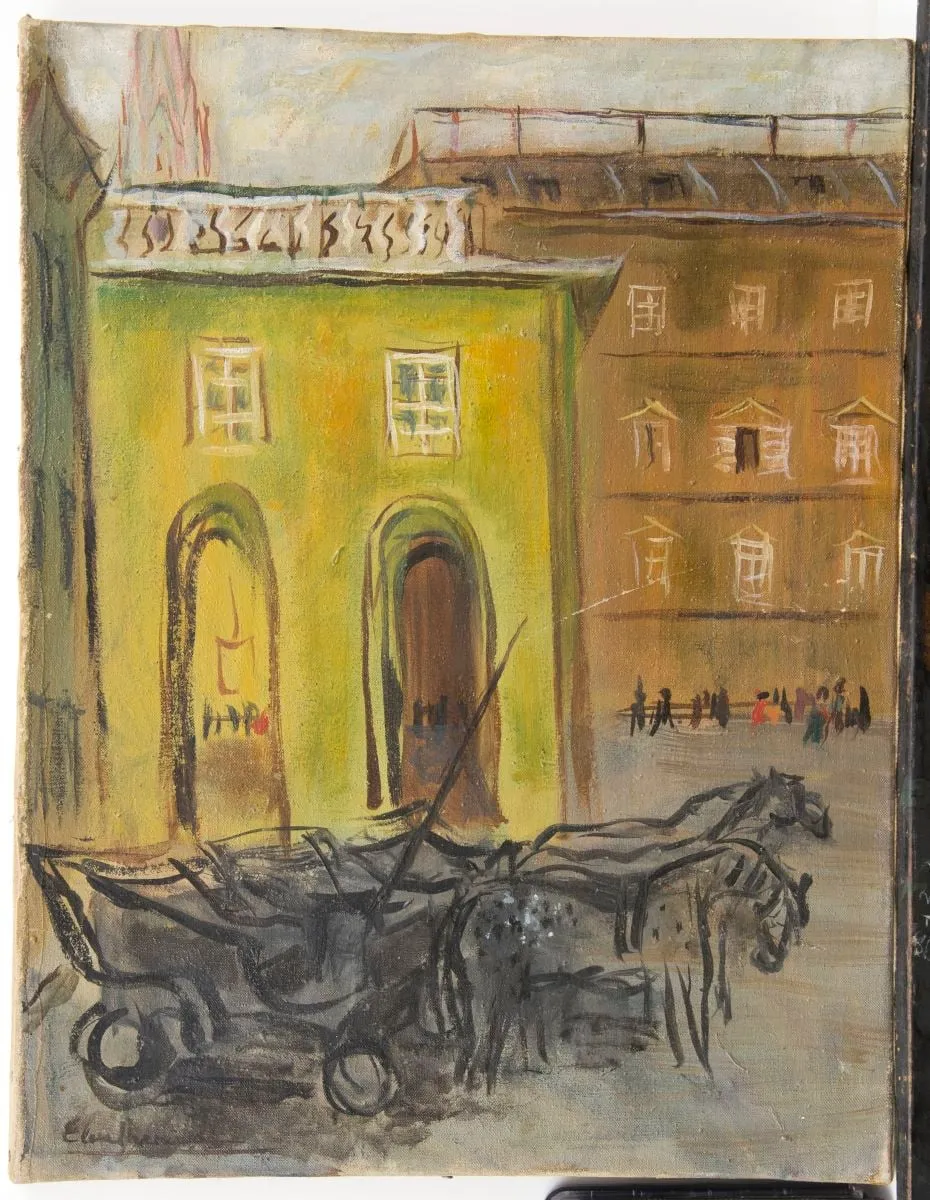
Rezidenz Platz (Salzburg) is an unspecified painting by Micaela Eleutheriade. It dates from 1972 and is held in the collection of the National Museum of Art of Romania.
About this work
Overview
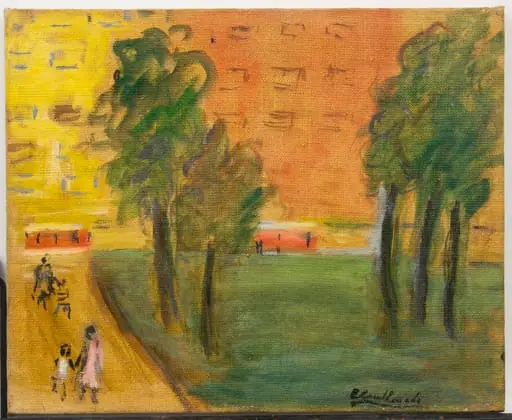
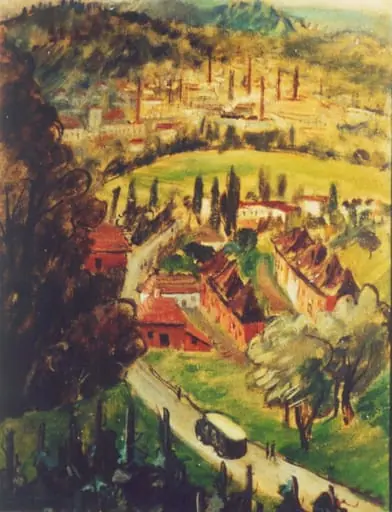
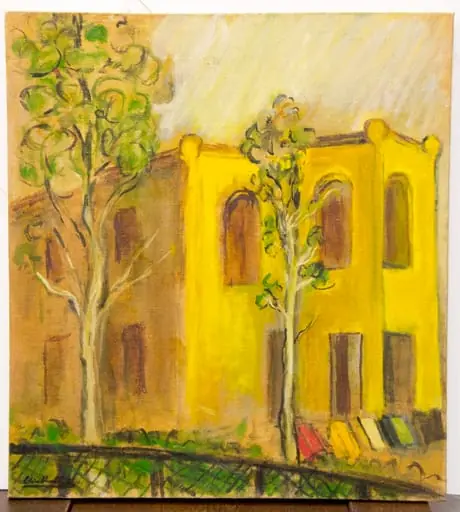
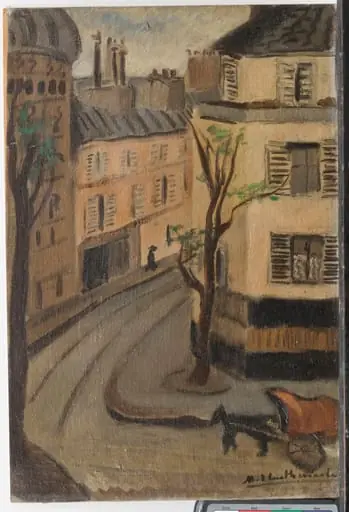
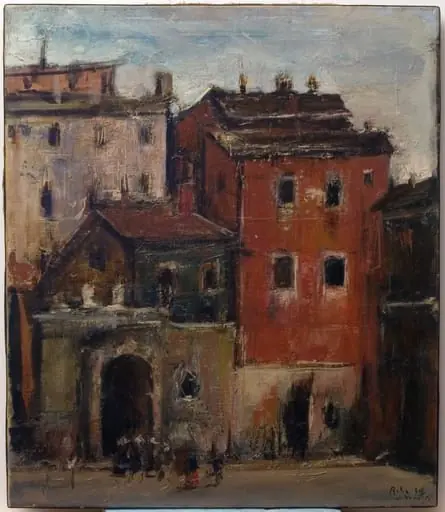
The composition centers on a modest yellow building flanked by dark archways, with a horse-drawn cart positioned prominently in the foreground.
Created in 1972 by Micaela Eleutheriade, this image captures a quiet urban corner in Salzburg’s Residenzplatz. The composition centers on a modest yellow building flanked by dark archways, with a horse-drawn cart positioned prominently in the foreground. Figures move along the sidewalk, and a secondary structure anchors the right edge. The work avoids narrative detail, instead focusing on the rhythm of everyday urban life through simplified forms and restrained color.
Subject & Meaning
The scene presents an unembellished view of a residential square, emphasizing routine rather than spectacle. The horse-drawn cart, still in use amid modern city life, suggests continuity between past and present. The sparse human figures, indistinct and distant, reinforce a sense of quiet observation. There is no overt symbolism; the meaning lies in the ordinary, the unremarkable moments that define urban texture.
Technique & Style
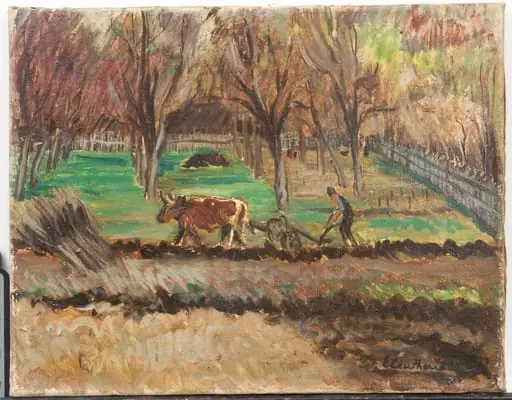
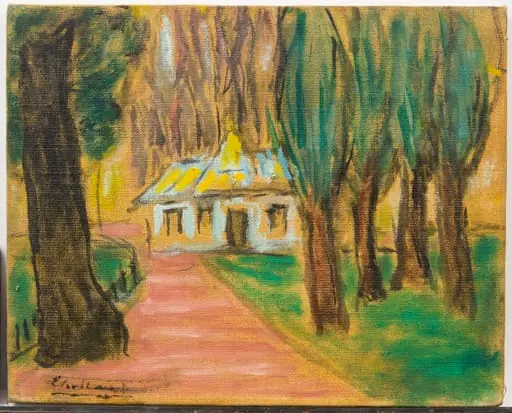
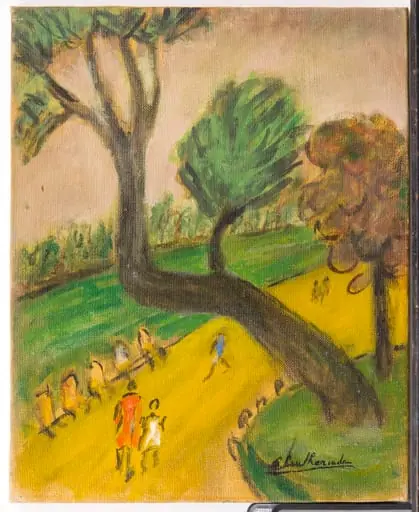
Brushwork is deliberately loose and uneven, conveying immediacy rather than polish. Paint is applied with minimal blending, resulting in flat planes of color without chiaroscuro or gradation. The surface lacks impasto or thick texture, favoring a matte, almost graphic quality. This approach aligns with a modernist tendency to reduce visual complexity, prioritizing structure and mood over realism.
History & Provenance
The work was completed in 1972 during a period when Eleutheriade was engaged with Austrian urban landscapes. It remains in private hands, with no public exhibition history documented. Its origin is tied to the artist’s personal observations of Salzburg’s streets, reflecting a quiet, introspective phase in her practice rather than a public or political statement.
Context
In early 1970s Austria, many artists turned toward everyday subjects as a counterpoint to abstraction and political art. Eleutheriade’s focus on a modest square aligns with this trend, echoing the quiet realism of regional painters who documented local environments without idealization. The work reflects a broader European interest in the mundane as a legitimate subject for visual inquiry.
Legacy
Though not widely exhibited, the piece contributes to a lesser-known strand of postwar Austrian painting that valued understated observation over dramatic expression. Its restrained aesthetic has influenced a small circle of regional artists interested in urban quietude. The work endures as a quiet record of a specific time and place, preserved through its unadorned visual language.
Artist & collection

Artist
Micaela Eleutheriade (1900–1982) was a noted Romanian painter and engraver. She was a descendant, through her mother, of the painter Gheorghe Tattarescu, the pioneer of neoclassicism in Romania.