Artwork
Statue of Liberty
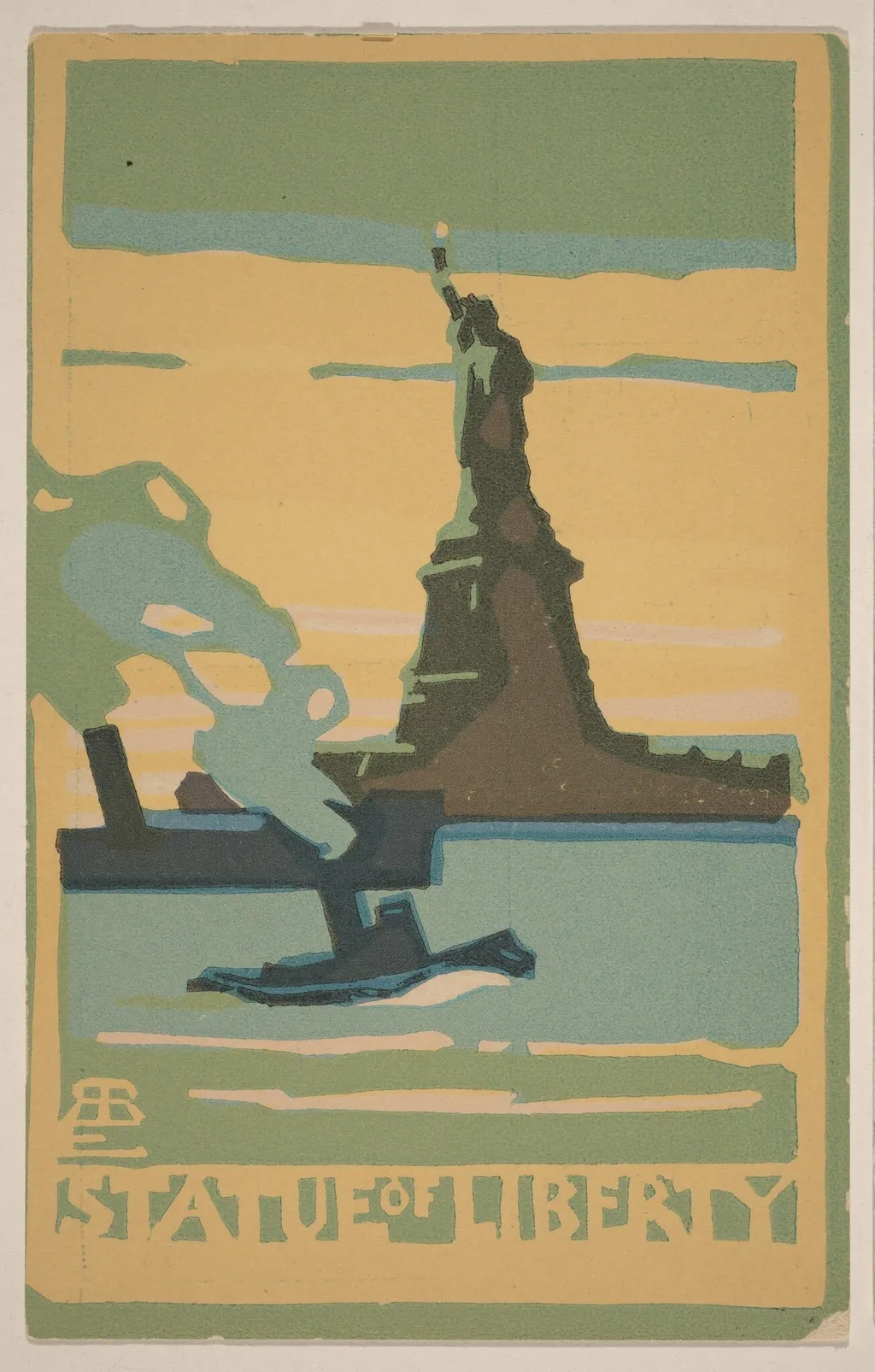
Statue of Liberty is a print by Rachael Robinson Elmer. It dates from 1916 and is held in the collection of the National Gallery of Art.
About this work
Overview
Created in 1916, Rachael Robinson Elmer’s Statue of Liberty is a linocut print that captures the monument in a reductive, graphic style.
Created in 1916, Rachael Robinson Elmer’s Statue of Liberty is a linocut print that captures the monument in a reductive, graphic style. Unlike traditional depictions, it avoids intricate detail, instead relying on bold outlines and flat planes of color. The composition emphasizes form over realism, using minimal elements to convey recognition and symbolism. The medium of linocut aligns with early 20th-century printmaking trends favoring accessibility and clarity.
Subject & Meaning
The statue is rendered in profile, right arm raised with torch extended, a universally recognized gesture of welcome and liberty. Positioned against a muted yellow field, the figure stands as a solitary emblem, isolated from urban or political context. A small boat at the base subtly anchors the monument in a real-world setting, suggesting arrival or observation. The image invites contemplation of freedom as both ideal and physical presence.
Technique & Style
Elmer employed linocut, a relief printing method that allows for sharp, carved lines and uniform color fields. The image uses minimal tonal variation, with solid hues and no shading. Horizontal lines in the background imply horizon and water without detail, reinforcing the abstracted tone. The style reflects modernist tendencies of the era—reducing forms to essentials while retaining symbolic power through clarity and structure.
History & Provenance
Made in 1916, the print emerged during a period of heightened national identity in the United States, just before American entry into World War I. Elmer, known for her work in commercial art and printmaking, likely produced this as part of a broader interest in patriotic imagery. The work remains in private and institutional collections, valued for its early modernist interpretation of a national symbol.
Context
In 1916, the Statue of Liberty had been a symbol for over three decades, but its meaning was evolving amid waves of immigration and wartime rhetoric. Elmer’s print reflects a cultural moment when visual simplicity could communicate complex ideas. Her approach aligns with contemporaneous movements like American modernism and the Arts and Crafts emphasis on handcrafted, accessible imagery.
Legacy
Elmer’s linocut stands as an early example of how modern printmaking reimagined national icons through abstraction. While not widely exhibited, it contributes to the history of American graphic art, demonstrating how everyday materials and techniques could elevate civic symbols. Its restrained aesthetic continues to inform how public monuments are visually interpreted in reduced, emblematic forms.
Artist & collection