Artwork
Two women on a balcony hung with green and red curtains; mediaeval buildings and blue sky beyond
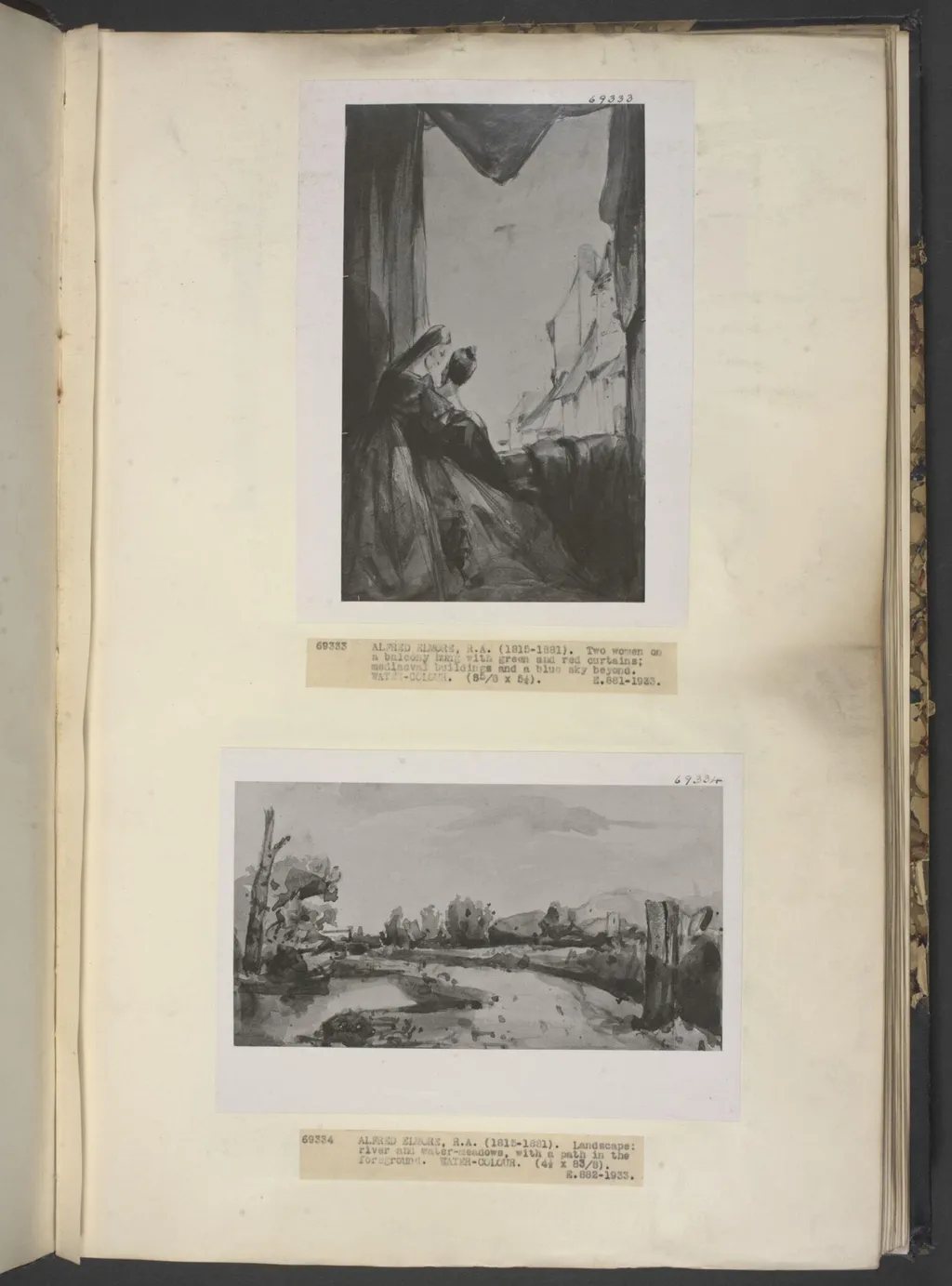
Two women on a balcony hung with green and red curtains; mediaeval buildings and blue sky beyond is a watercolor work on paper by the British Romanticist artist Alfred W. Elmore. It dates from 1840 and is held in the collection of the Victoria and Albert Museum. A watercolour depicts two figures on a balcony, framed by draped curtains in green and red.
About this work
Overview
No figures are named, and the setting avoids specific geographic markers, suggesting a generalized, atmospheric vision rather than a documented location.
A watercolour depicts two figures on a balcony, framed by draped curtains in green and red. Behind them, tall medieval-style structures rise under a clear blue sky. The scene is rendered with soft washes and delicate detail, characteristic of the medium’s luminous qualities. No figures are named, and the setting avoids specific geographic markers, suggesting a generalized, atmospheric vision rather than a documented location.
Subject & Meaning
The two women, dressed in long, flowing garments, appear absorbed in the view before them. Their posture is calm, neither engaged in conversation nor gesture, evoking quiet contemplation. The curtains, though vivid in color, serve as a framing device rather than a narrative element. The scene conveys introspection and serenity, aligning with Romantic ideals of solitude and emotional resonance within architectural surroundings.
Technique & Style
The work employs transparent watercolour washes to suggest depth and light, with minimal line work defining forms. The curtains are rendered in layered hues, creating texture without detail, while the buildings are simplified into vertical masses with steep roofs. The sky is a pale, even wash, enhancing the sense of openness. The style favors mood over precision, emphasizing atmosphere through tonal gradation rather than sharp definition.
History & Provenance
The painting’s origin and creator remain undocumented in available records. It lacks inscriptions, dates, or exhibition history that would anchor it to a specific artist or period. Its survival as a standalone watercolour suggests it may have been a private study or sketch, possibly intended as a personal meditation on light and space rather than a commissioned work.
Context
Created during the 19th century, the piece reflects Romanticism’s interest in emotional landscapes and architectural nostalgia. While not tied to a known school or movement, its emphasis on mood, solitude, and medieval forms aligns with broader trends in European art that idealized the past as a source of spiritual depth. The absence of human activity beyond the two figures reinforces a retreat from modernity.
Legacy
As an unattributed watercolour, it has not entered scholarly discourse as a significant work. Yet it persists as an example of quiet, intimate Romantic expression in a medium often reserved for sketches or travel studies. Its enduring presence in collections or archives speaks to its quiet appeal as a visual poem of stillness and observation.
Artist & collection
Artist
Alfred W. Elmore loved painting scenes where everyday life felt like a play. He once showed two women on a balcony wrapped in green and red curtains, their ordinary moment framed by medieval buildings and a bright sky.…