Artwork
Capture of a Village (Prise d'un village)
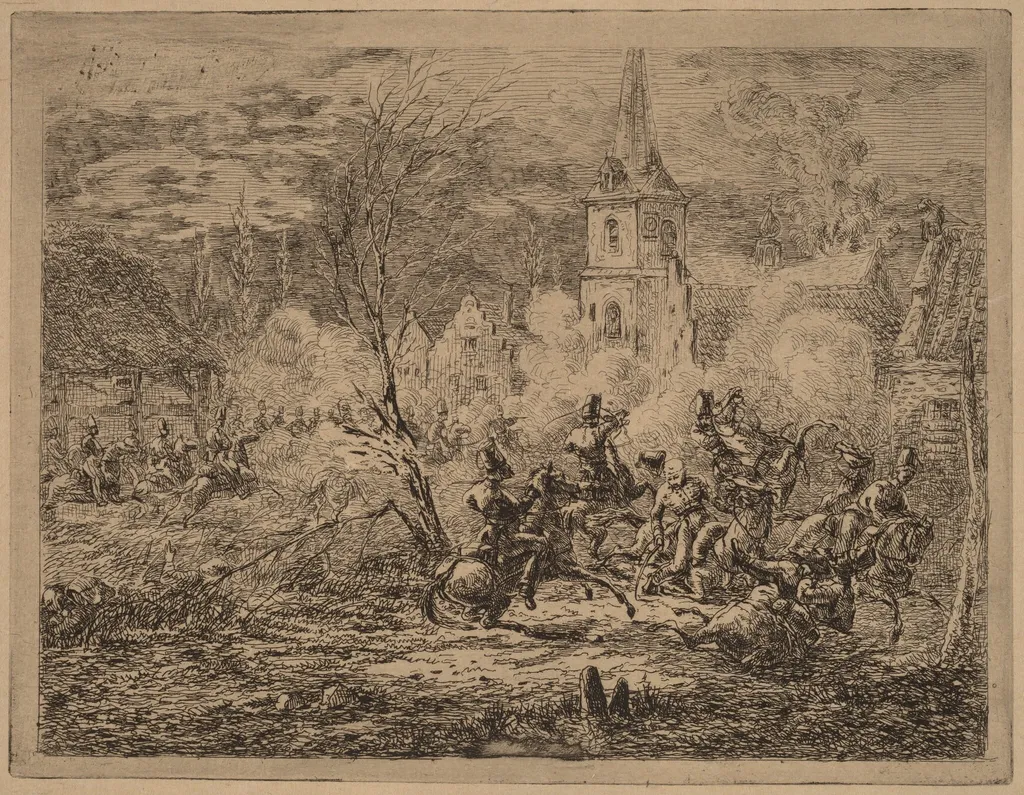
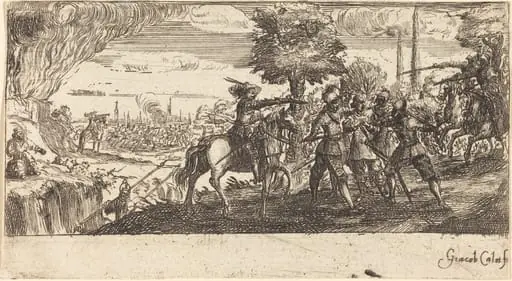
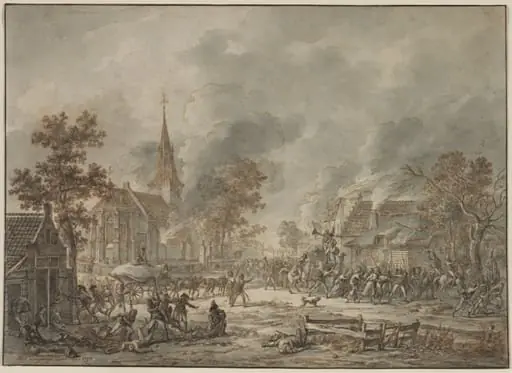
Capture of a Village (Prise d'un village) is an ink print by the Romanticist artist Gerhardus Emaus de Micault. It dates from 1826 and is held in the collection of the National Gallery of Art.
About this work
Overview
Capture of a Village (Prise d’un village) is an 1826 etching by the French printmaker Gerhardus Emaus de Micault. Executed as a single‑plate print, the work measures the dramatic moment when an occupied settlement succumbs to invading troops. The composition is dominated by a darkening sky, billowing smoke, and a crowd of soldiers advancing toward the burning houses.
Subject & Meaning
The image presents a civilian settlement under siege rather than a conventional battlefield scene. Flames engulf the village while a lone figure collapses to his knees, suggesting surrender or desperation. The juxtaposition of disciplined soldiers and vulnerable inhabitants conveys the harsh realities of war’s impact on non‑combatants and the moment of capitulation that follows violent conquest.
Technique & Style
The crisp line work and controlled tonal gradations reflect the early‑19th‑century French print tradition, where clarity of narrative was paramount.
Created through traditional intaglio etching, Micault incised fine, sharply defined lines into a copper plate, allowing for precise rendering of architectural detail, smoke, and human forms. The high contrast between deep, dark areas and delicate hatching emphasizes the bleak atmosphere. The crisp line work and controlled tonal gradations reflect the early‑19th‑century French print tradition, where clarity of narrative was paramount.
History & Provenance
The print was produced in 1826, a period marked by numerous European conflicts that inspired artists to document wartime scenes. While specific ownership records are scarce, the work has appeared in several 19th‑century print collections and is now held by institutions specializing in French graphic art, illustrating Micault’s contribution to the visual record of military encounters.
Context
Micault’s etching emerges from a broader artistic interest in the consequences of war on civilian life, a theme explored by contemporaries such as Goya and Delacroix. By focusing on a village’s surrender rather than heroic combat, the work aligns with Romantic sensibilities that emphasized human suffering and the tragic dimensions of conflict.
Artist & collection


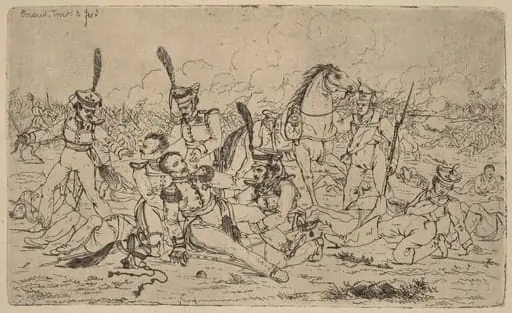 Death of a Russian General (Le Mort d'un general russe)
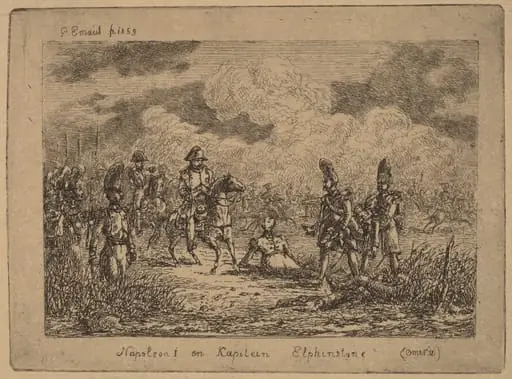 Napoleon I and Captain Elphinstone (Napoleon I et le Capitaine Elphinstone)
![The Affair near Konigstein (L'Affaire pres d e Koenigstein) [verso], by Gerhardus Emaus de Micault](https://artifactworldgallery.com/img/gerhardus-emaus-de-micault--the-affair-near-konigstein-l-affaire-pres-d-e-koenigstein-ve--8a75200d7cdf56c0-w320.webp) The Affair near Konigstein (L'Affaire pres d e Koenigstein) [verso]
The Affair near Konigstein (L'Affaire pres d e Koenigstein) [verso]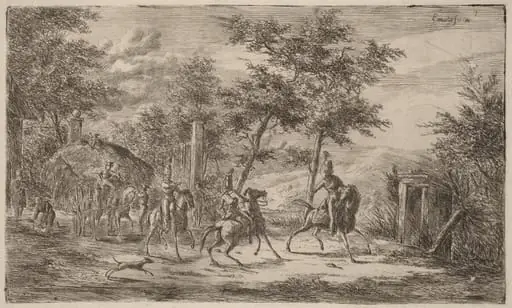 Cavalry and Hay Wagon
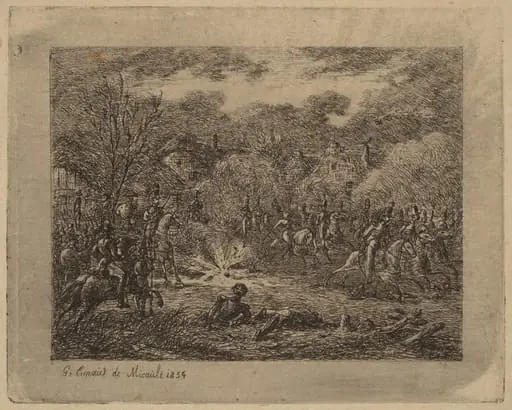 Explosion of a Grenade (L'Explosion d'une grenade)
![The Affair near Konigstein (L'Affaire pres de Koenigstein) [recto], by Gerhardus Emaus de Micault](https://artifactworldgallery.com/img/gerhardus-emaus-de-micault--the-affair-near-konigstein-l-affaire-pres-de-koenigstein-rec--a9edc3187b52f5be-w320.webp) The Affair near Konigstein (L'Affaire pres de Koenigstein) [recto]
The Affair near Konigstein (L'Affaire pres de Koenigstein) [recto]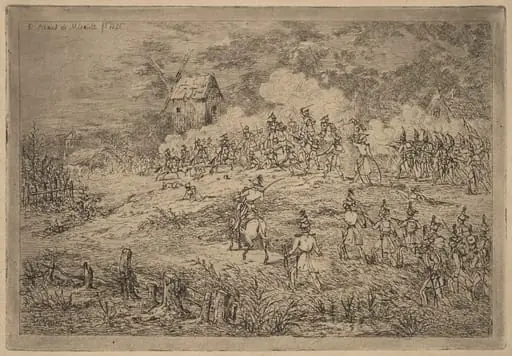 Charge of the Cavalry (Charge de cavalerie contre des chasseurs)
![Cossacks before a Fireplace (Les cosaques devant la cheminée de la ferme en Hollande) [recto], by Gerhardus Emaus de Micault](https://artifactworldgallery.com/img/gerhardus-emaus-de-micault--cossacks-before-a-fireplace-les-cosaques-devant-la-cheminee--c41496699dc183bb-w320.webp) Cossacks before a Fireplace (Les cosaques devant la cheminée de la ferme en Hollande) [recto]
Cossacks before a Fireplace (Les cosaques devant la cheminée de la ferme en Hollande) [recto]