Artwork
Napoleon I and Captain Elphinstone (Napoleon I et le Capitaine Elphinstone)
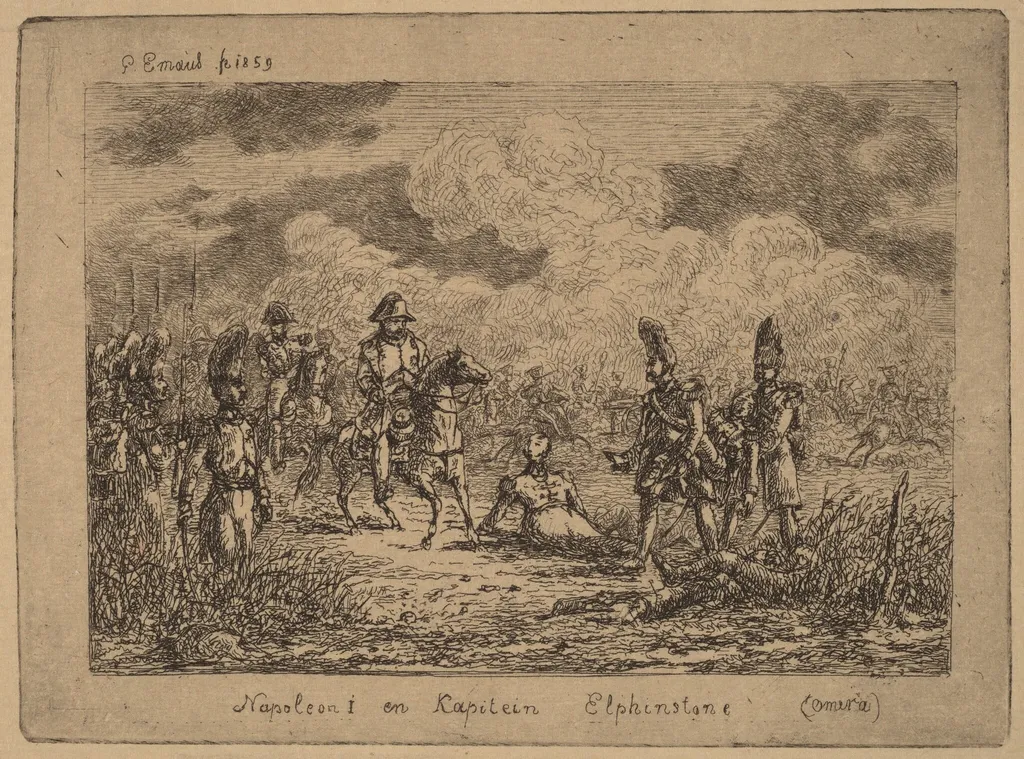
Napoleon I and Captain Elphinstone (Napoleon I et le Capitaine Elphinstone) is an ink print by the Impressionist artist Gerhardus Emaus de Micault. It dates from 1859 and is held in the collection of the National Gallery of Art. Napoleon I and Captain Elphinstone is an 1859 etching by Emaus de Micault, Gerhardus, depicting a tumultuous battle scene.
About this work
Overview
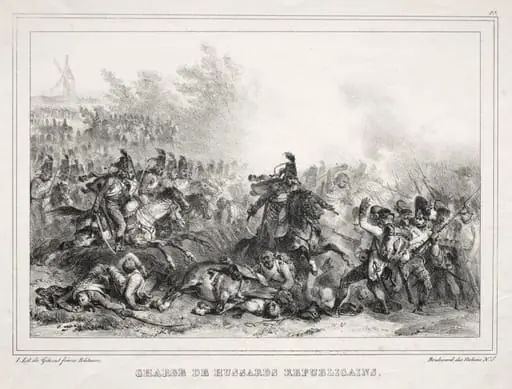
Napoleon I and Captain Elphinstone is an 1859 etching by Emaus de Micault, Gerhardus, depicting a tumultuous battle scene.
Subject & Meaning
The etching captures a chaotic moment in a historical battle, centering on a prominent horseback figure amidst surrounding turmoil. The inclusion of Napoleon I and Captain Elphinstone in the title grounds the scene in a specific historical context, though the artwork emphasizes the intense, disorderly nature of the conflict.
Technique & Style
Executed in etching, the piece utilizes the medium to convey dynamic energy. The dark, swirling clouds and rough, uneven terrain are rendered with expressive lines, enhancing the overall sense of chaos and movement.
History & Provenance
Created in 1859 by Emaus de Micault, Gerhardus, the etching's provenance details are not specified here, focusing instead on its creation date and artist.
Context
While the exact historical event depicted is not detailed, the presence of Napoleon I suggests it relates to one of his military campaigns, placing the work within the broader context of 19th-century historical and military art.
Legacy
The etching's impact or influence on subsequent art or historical representation is not provided, emphasizing instead its depiction of a historical moment through the lens of chaotic battle.
Own this work as a print
Artist & collection


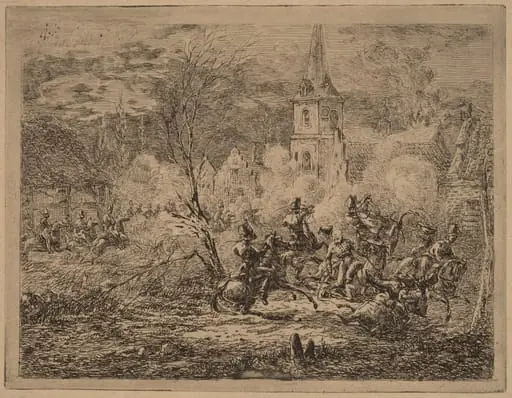 Capture of a Village (Prise d'un village)
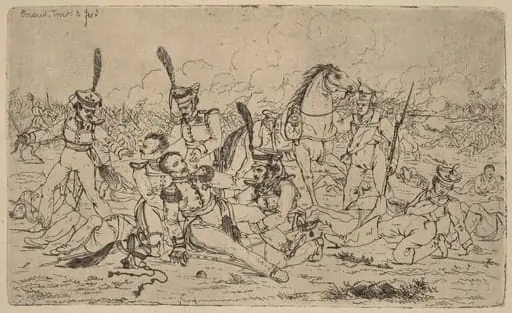 Death of a Russian General (Le Mort d'un general russe)
![The Affair near Konigstein (L'Affaire pres d e Koenigstein) [verso], by Gerhardus Emaus de Micault](https://artifactworldgallery.com/img/gerhardus-emaus-de-micault--the-affair-near-konigstein-l-affaire-pres-d-e-koenigstein-ve--8a75200d7cdf56c0-w320.webp) The Affair near Konigstein (L'Affaire pres d e Koenigstein) [verso]
The Affair near Konigstein (L'Affaire pres d e Koenigstein) [verso]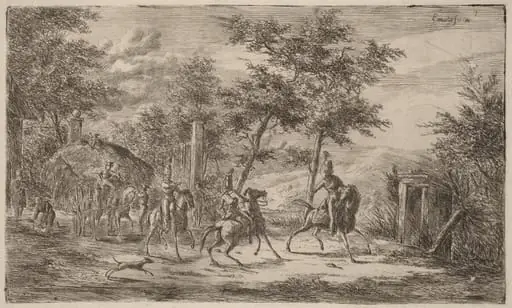 Cavalry and Hay Wagon
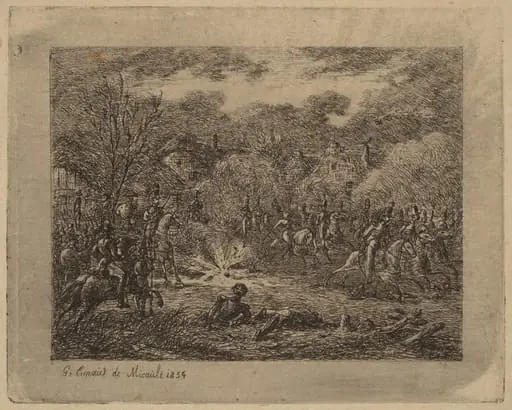 Explosion of a Grenade (L'Explosion d'une grenade)
![The Affair near Konigstein (L'Affaire pres de Koenigstein) [recto], by Gerhardus Emaus de Micault](https://artifactworldgallery.com/img/gerhardus-emaus-de-micault--the-affair-near-konigstein-l-affaire-pres-de-koenigstein-rec--a9edc3187b52f5be-w320.webp) The Affair near Konigstein (L'Affaire pres de Koenigstein) [recto]
The Affair near Konigstein (L'Affaire pres de Koenigstein) [recto]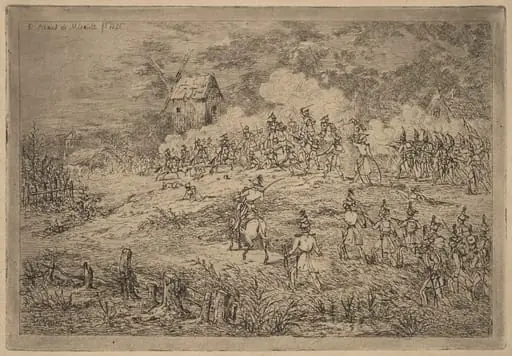 Charge of the Cavalry (Charge de cavalerie contre des chasseurs)
![Cossacks before a Fireplace (Les cosaques devant la cheminée de la ferme en Hollande) [recto], by Gerhardus Emaus de Micault](https://artifactworldgallery.com/img/gerhardus-emaus-de-micault--cossacks-before-a-fireplace-les-cosaques-devant-la-cheminee--c41496699dc183bb-w320.webp) Cossacks before a Fireplace (Les cosaques devant la cheminée de la ferme en Hollande) [recto]
Cossacks before a Fireplace (Les cosaques devant la cheminée de la ferme en Hollande) [recto]