Artwork
Sand Hills near Grünau
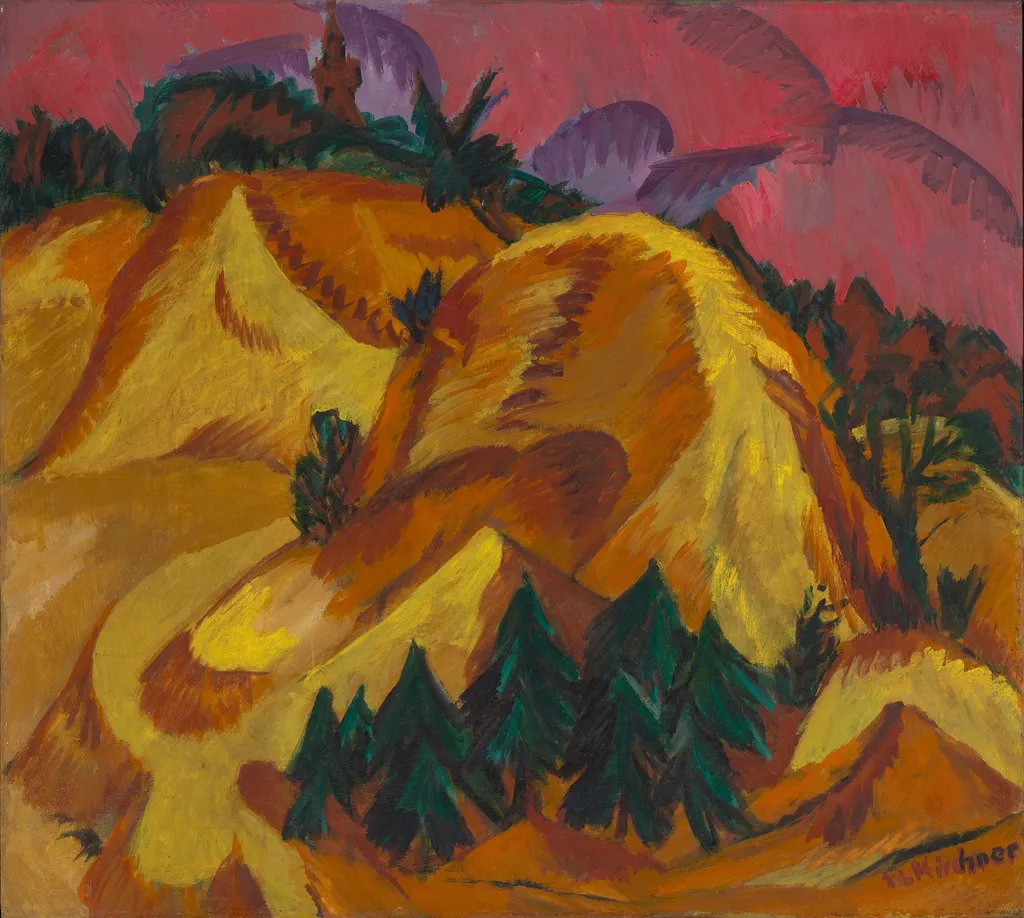
Sand Hills near Grünau is an oil painting by Ernst Ludwig Kirchner. It dates from 1913 and is held in the collection of the Museum of Modern Art.
About this work
Overview
As a co-founder of Die Brücke, Kirchner sought to convey emotional experience through color and form rather than naturalistic representation.
Ernst Ludwig Kirchner painted *Sand Hills near Grünau* in 1913 using oil on canvas. The work captures the Müggelberge hills southeast of Berlin, a landscape he encountered during a summer stay. As a co-founder of Die Brücke, Kirchner sought to convey emotional experience through color and form rather than naturalistic representation. The painting reflects his interest in the vitality of nature and the psychological resonance of place.
Subject & Meaning
The painting depicts undulating sand dunes under a crimson sky, with sparse vegetation and distant structures suggesting human presence. Kirchner does not aim for topographical accuracy but instead emphasizes the land’s dynamic energy. The towering building on the horizon may hint at encroaching modernity, contrasting with the raw, shifting terrain. The scene feels alive, charged with an internal rhythm that mirrors the artist’s inner state.
Technique & Style
Kirchner employed thick, directional brushwork and saturated hues to animate the landscape. Yellow and orange dunes surge across the canvas, while dark green foliage provides sharp contrast. The sky’s intense red heightens emotional tension. Forms are simplified and distorted, rejecting academic perspective in favor of expressive intensity. The brushstrokes themselves seem to mimic the wind’s motion, giving the hills a sense of perpetual movement.
History & Provenance
Created during Kirchner’s productive period in Grünau, the painting remained in private hands until acquired by the Museum of Modern Art in New York. It entered MoMA’s collection in the mid-20th century, part of a broader effort to document European Expressionism. Its presence in a major American institution helped solidify Kirchner’s international recognition beyond Germany’s borders.
Context
In 1913, Kirchner was deeply engaged with Die Brücke’s mission to break from traditional artistic norms. Urbanization and industrialization were reshaping German society, and artists like him turned to nature as both refuge and subject for emotional expression. *Sand Hills near Grünau* reflects this tension—nature is not serene but turbulent, echoing the anxieties of a rapidly changing world.
Legacy
The painting exemplifies Kirchner’s contribution to Expressionism’s visual language: color as emotion, form as psychological signal. While less known than his urban scenes, this landscape reveals his sensitivity to natural forces and his ability to translate inner experience into outward form. It remains a key reference for understanding how German Expressionists reimagined the relationship between person and environment.
Own this work as a print
Artist & collection
Artist
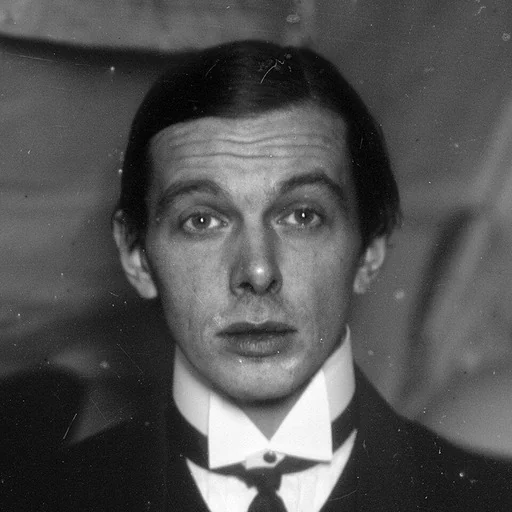
Ernst Ludwig Kirchner (6 May 1880 – 15 June 1938) was a German expressionist painter and printmaker.

![Dance Hall Bellevue [obverse], by Ernst Ludwig Kirchner](https://artifactworldgallery.com/img/ernst-ludwig-kirchner--dance-hall-bellevue-obverse--d1e14aac4297c69e-w320.webp)
![Nude Figure [reverse], by Ernst Ludwig Kirchner](https://artifactworldgallery.com/img/ernst-ludwig-kirchner--nude-figure-reverse--4b135f0364753e98-w320.webp)
![Two Nudes [obverse], by Ernst Ludwig Kirchner](https://artifactworldgallery.com/img/ernst-ludwig-kirchner--two-nudes-obverse--eb3914183f0bc96d-w320.webp)
![Dancing Couple in the Snow [reverse], by Ernst Ludwig Kirchner](https://artifactworldgallery.com/img/ernst-ludwig-kirchner--dancing-couple-in-the-snow-reverse--87ca007d7c05b553-w320.webp)