Artwork
Untitled
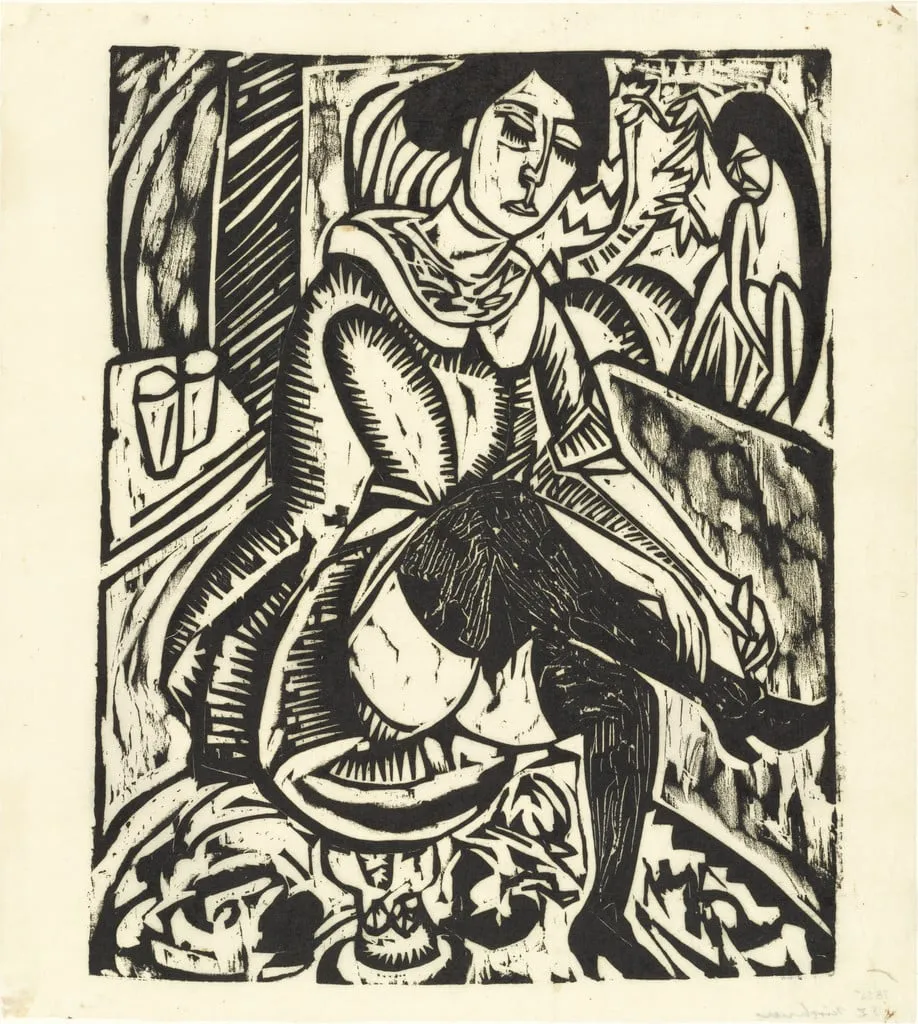
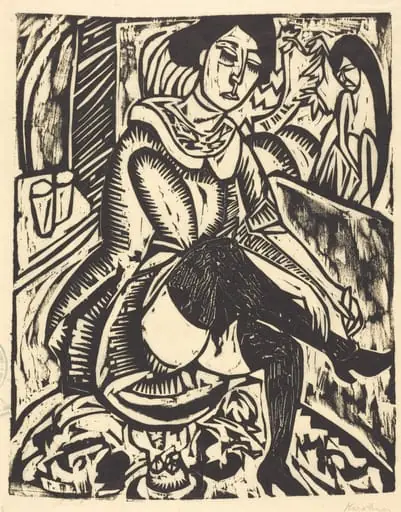
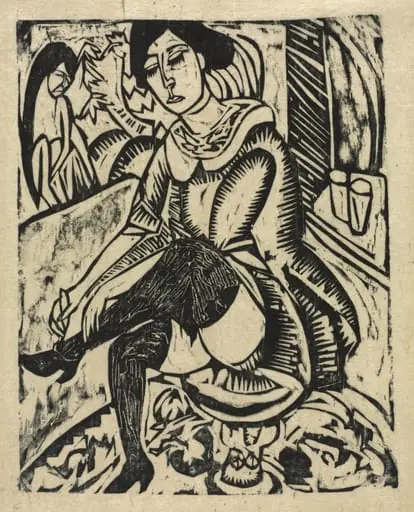
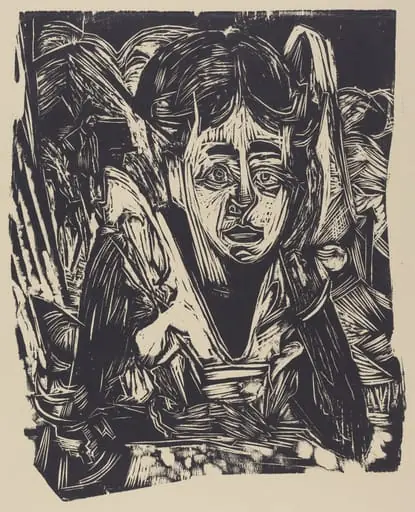
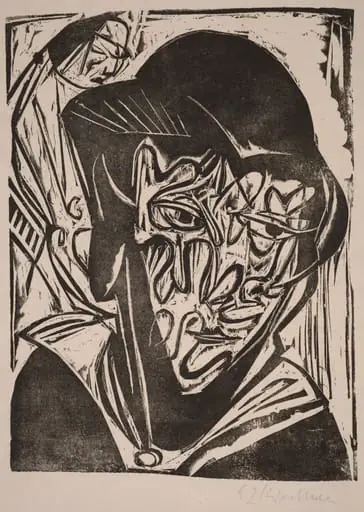
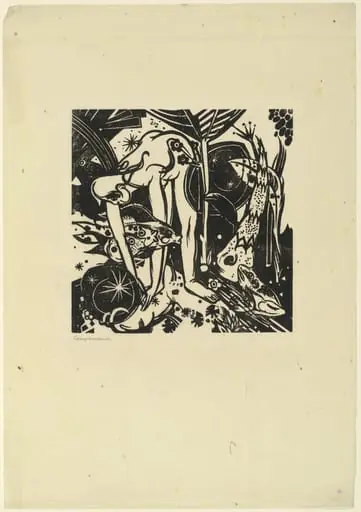
Untitled is an ink print by Ernst Ludwig Kirchner. It dates from 1912 and is held in the collection of the Museum of Modern Art.
About this work
Overview
The work exemplifies the group’s rejection of academic naturalism in favor of raw, emotional form.
Created in 1912, this woodcut by Ernst Ludwig Kirchner is one of many prints produced during his time with Die Brücke, a collective committed to redefining artistic expression. The work exemplifies the group’s rejection of academic naturalism in favor of raw, emotional form. Carved directly into wood and printed in black ink on a white ground, the image relies on stark contrasts and fractured lines to convey psychological tension rather than realistic detail.
Subject & Meaning
A seated woman, holding a fan and gazing downward, is paired with a standing man whose arms stretch upward in an ambiguous gesture. Their spatial relationship feels uneasy, as if caught in an unspoken moment of isolation or longing. The figures are reduced to essential shapes, their gestures stripped of narrative clarity, inviting interpretation through mood rather than story. The composition suggests inner turmoil, a hallmark of Expressionist concerns with modern alienation.
Technique & Style
Kirchner employed the woodcut medium to exploit its inherent roughness, carving sharp, jagged lines that emphasize angularity and tension. The black ink forms dominate the white paper, with no gradations or shading—only bold, flat areas and visible wood grain. This technique prioritizes emotional impact over illusionistic depth, flattening space and compressing the figures into a crowded, almost claustrophobic plane.
History & Provenance
Produced during Kirchner’s most active period with Die Brücke, the print predates his later struggles under Nazi rule. In the 1930s, the regime labeled his work 'degenerate,' leading to the confiscation and destruction of hundreds of his pieces. While this particular woodcut survived, its existence today reflects the precarious fate of Expressionist art under totalitarian censorship.
Context
In early 20th-century Germany, artists like Kirchner sought to break from traditional representation, responding to urban anxiety and industrial change. Die Brücke’s interest in primal forms, non-Western art, and emotional authenticity shaped this print’s aesthetic. The work aligns with broader European movements rejecting realism, instead embracing distortion to express inner experience over external appearance.
Legacy
Kirchner’s woodcuts, including this untitled work, helped establish printmaking as a vital medium for modernist expression. Their directness and emotional force influenced later generations of artists exploring psychological depth through simplified form. Though once vilified by the state, these prints are now recognized for their role in redefining the boundaries of visual language in modern art.
Artist & collection
Artist
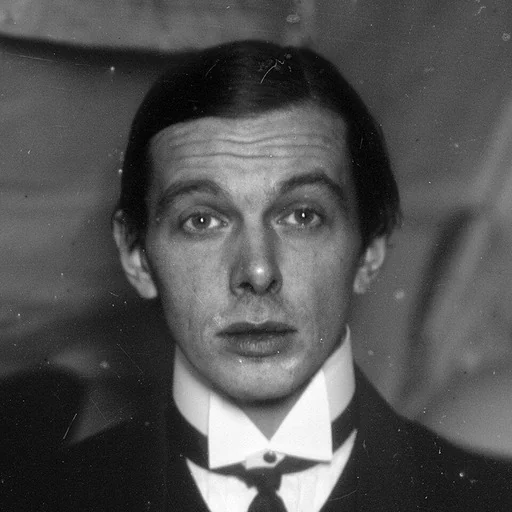
Ernst Ludwig Kirchner (6 May 1880 – 15 June 1938) was a German expressionist painter and printmaker.

![Dance Hall Bellevue [obverse], by Ernst Ludwig Kirchner](https://artifactworldgallery.com/img/ernst-ludwig-kirchner--dance-hall-bellevue-obverse--d1e14aac4297c69e-w320.webp)
![Nude Figure [reverse], by Ernst Ludwig Kirchner](https://artifactworldgallery.com/img/ernst-ludwig-kirchner--nude-figure-reverse--4b135f0364753e98-w320.webp)
![Two Nudes [obverse], by Ernst Ludwig Kirchner](https://artifactworldgallery.com/img/ernst-ludwig-kirchner--two-nudes-obverse--eb3914183f0bc96d-w320.webp)
![Dancing Couple in the Snow [reverse], by Ernst Ludwig Kirchner](https://artifactworldgallery.com/img/ernst-ludwig-kirchner--dancing-couple-in-the-snow-reverse--87ca007d7c05b553-w320.webp)