Artwork
A Trapped Tiger
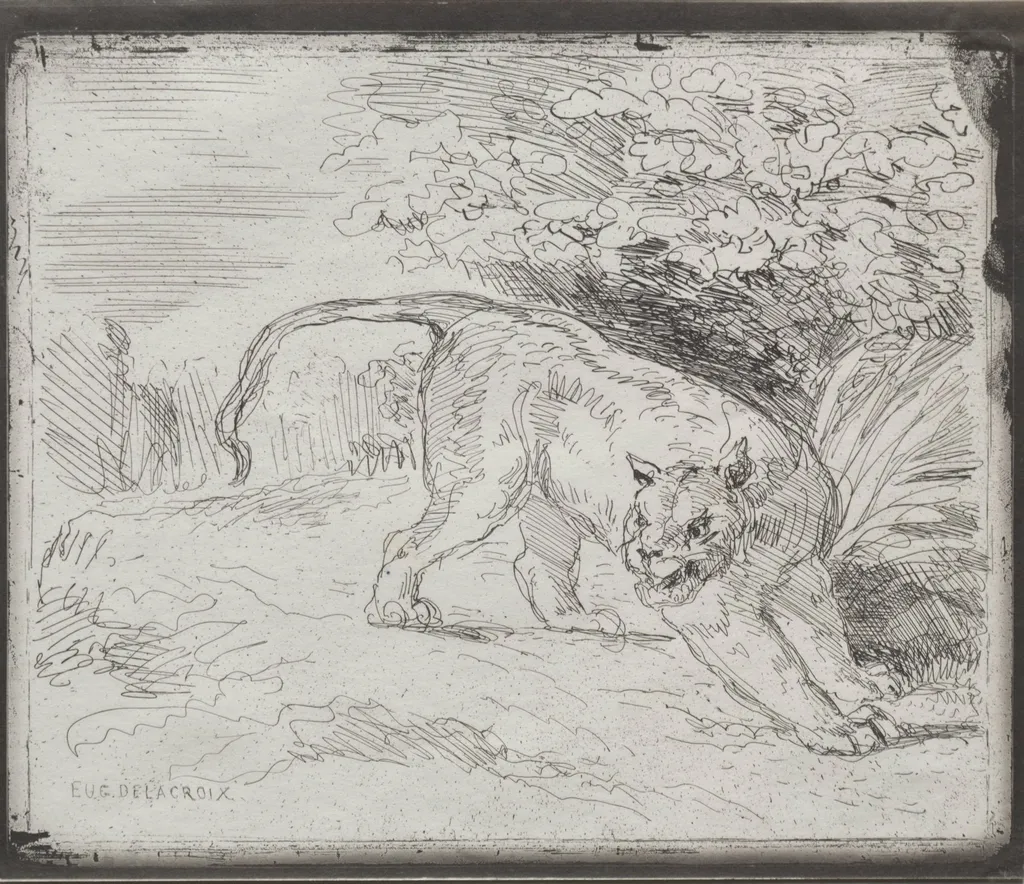
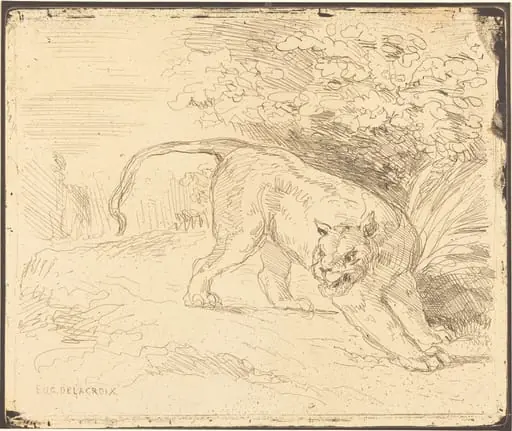
A Trapped Tiger is a print by the Impressionist artist Eugène Delacroix. It dates from 1854 and is held in the collection of the Cleveland Museum of Art.
About this work
Overview
Delacroix, a central figure in French Romanticism, favored emotional intensity and dynamic composition over academic restraint.
Painted in 1854 by Eugène Delacroix, this print captures a tiger confined in a tight, shadowed space. Delacroix, a central figure in French Romanticism, favored emotional intensity and dynamic composition over academic restraint. The work reflects his lifelong engagement with wild animals as symbols of untamed force, rendered with a focus on movement and atmospheric depth rather than anatomical exactness.
Subject & Meaning
The tiger, coiled and strained against invisible barriers, embodies a struggle between nature and constraint. Its twisted posture suggests desperation, not aggression. Delacroix avoids anthropomorphism, instead presenting the animal as a force of primal energy trapped within human-made limits. The absence of context—no cage bars, no landscape—heightens the sense of psychological confinement and existential tension.
Technique & Style
Delacroix employed thick, layered brushwork to build the tiger’s fur in deep browns and blacks, contrasting with a cool, muted gray background. Chiaroscuro intensifies the animal’s form, casting sharp shadows that define its musculature and movement. His approach, influenced by Rubens and Venetian colorists, prioritizes expressive tone and texture over linear precision, creating a visceral sense of motion within stillness.
History & Provenance
The work entered the collection of The Cleveland Museum of Art in the 20th century, though its earlier ownership remains undocumented. It was likely produced as a study or independent print, not part of a larger commission. Delacroix often revisited animal subjects in his later years, using them to explore themes of power and vulnerability outside the constraints of historical or mythological narrative.
Context
In mid-19th century France, interest in exotic animals grew alongside colonial expansion and the rise of natural history collections. Delacroix’s depiction diverges from scientific illustration, instead aligning with Romanticism’s fascination with the sublime and the untamed. His tiger reflects broader cultural anxieties about control, freedom, and the limits of human dominion over nature.
Legacy
Though less known than his large-scale historical paintings, this work exemplifies Delacroix’s enduring interest in animal psychology and expressive form. It influenced later artists drawn to emotional realism and the raw energy of nature, particularly in 19th-century animalier sculpture and Symbolist printmaking. Its quiet intensity continues to resonate as a study in confinement and vitality.
Artist & collection
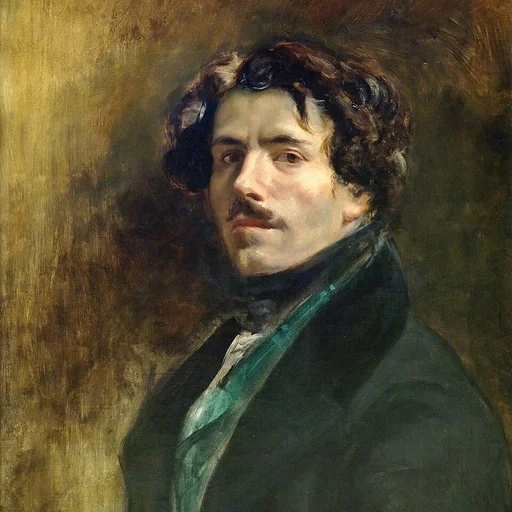
Artist
Ferdinand Victor Eugène Delacroix ( DEL-ə-krwah, -KRWAH; French: ; 26 April 1798 – 13 August 1863) was a French Romantic artist who was regarded as the leader of the French Romantic school.