Artwork
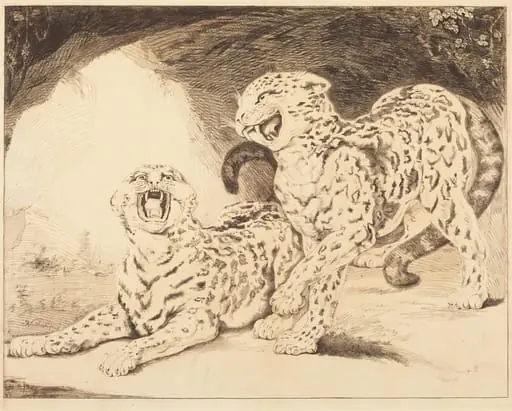
Young Tiger Playing with its Mother
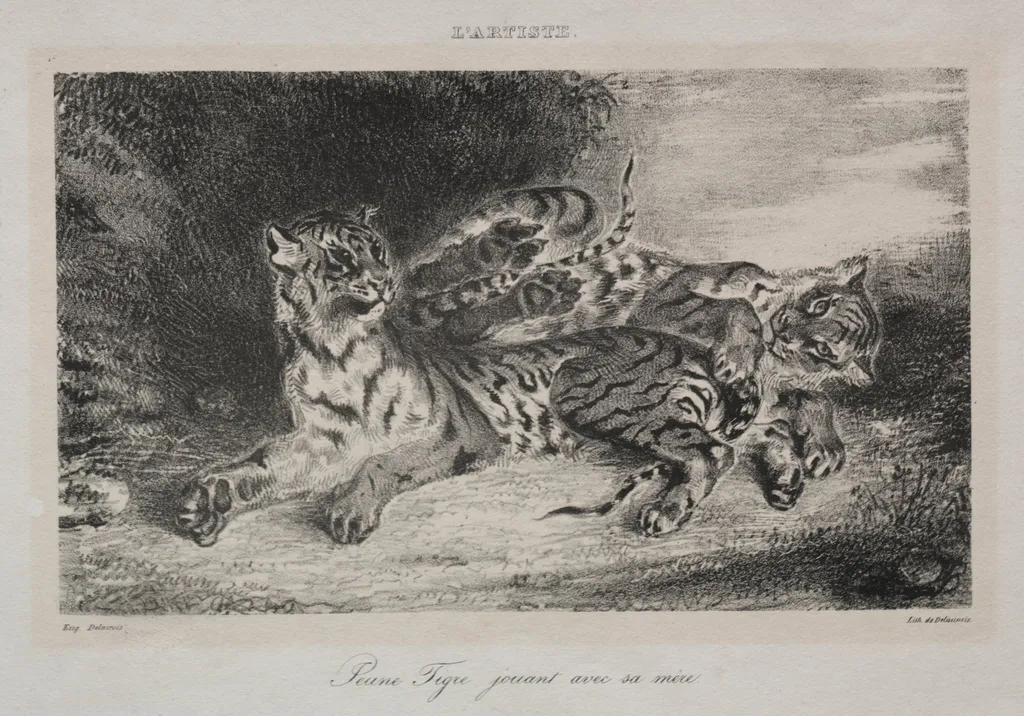
Young Tiger Playing with its Mother is a print by the Romanticist artist Eugène Delacroix. It dates from 1831 and is held in the collection of the Cleveland Museum of Art.
About this work
Overview
Though often associated with oil paintings, Delacroix also produced works in graphic media that conveyed his fascination with animal vitality.
Created in 1831, this black-and-white print by Eugène Delacroix captures a moment of interaction between a tiger and its cub. Though often associated with oil paintings, Delacroix also produced works in graphic media that conveyed his fascination with animal vitality. The composition emphasizes motion and emotional intensity, aligning with his broader Romantic sensibility. The piece resides in the Cleveland Museum of Art’s collection.
Subject & Meaning
The scene depicts a wild tiger and its young cub engaged in playful behavior, avoiding anthropomorphism in favor of observed naturalism. Delacroix presents the animals not as symbols but as living beings immersed in instinctual interaction. The intimacy of their physical contact—cub climbing over the mother’s back—suggests a quiet, untamed bond, reinforcing Romantic ideals of nature’s raw authenticity over human order.
Technique & Style
Using dense, expressive linework and varied shading, Delacroix rendered fur and movement with a sketchlike urgency. The contrast between the cub’s dynamic limbs and the mother’s relaxed form creates a sense of kinetic tension. The rough, unpolished handling of the medium enhances the impression of spontaneity, rejecting academic refinement in favor of visceral immediacy and tactile texture.
History & Provenance
The print emerged during a period when Delacroix was deeply engaged with animal subjects, following his 1825 trip to England and exposure to zoological collections. It was likely produced as a study or independent print, not a reproduction of a painting. Its presence in the Cleveland Museum of Art’s holdings reflects early 20th-century acquisitions focused on Romantic-era graphic works.
Context
In early 19th-century France, Romantic artists turned to nature as a source of emotional truth, countering Neoclassical restraint. Delacroix’s interest in wild animals paralleled broader cultural fascination with exoticism and the sublime. This print aligns with contemporaneous works that valorized untamed life, reflecting both scientific curiosity and a philosophical shift toward nature’s autonomy.
Legacy
Though less known than his large-scale paintings, this print exemplifies Delacroix’s enduring influence on the depiction of animals in modern art. Its emphasis on movement and emotional resonance prefigured later naturalist and expressionist approaches. The work remains a quiet testament to his belief that vitality could be conveyed through direct, unidealized observation.
Artist & collection
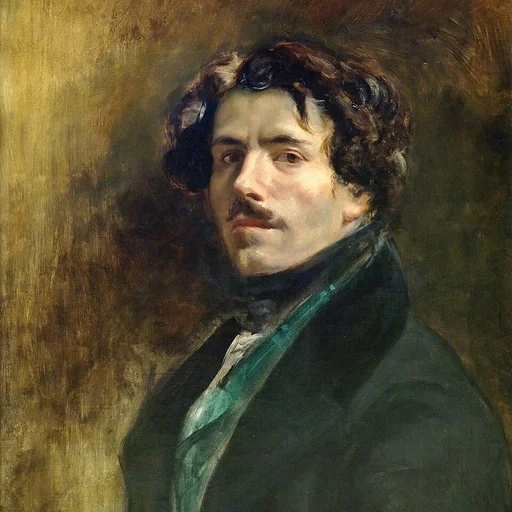
Artist
Ferdinand Victor Eugène Delacroix ( DEL-ə-krwah, -KRWAH; French: ; 26 April 1798 – 13 August 1863) was a French Romantic artist who was regarded as the leader of the French Romantic school.