Artwork
The Cliff: Bay of Saint-Malo
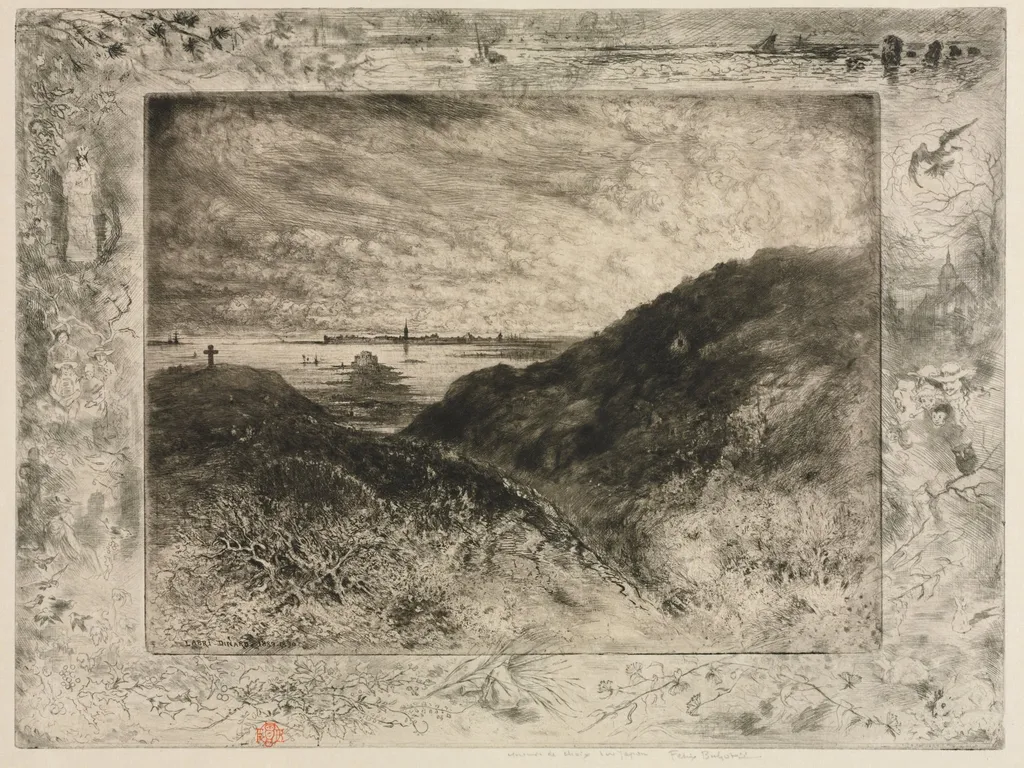
The Cliff: Bay of Saint-Malo is a print by the Impressionist artist Félix-Hilaire Buhot. It dates from 1888 and is held in the collection of the Cleveland Museum of Art. This etching by Félix Hilaire Buhot captures the rugged shoreline of Saint-Malo on Brittany’s Emerald Coast.
About this work
Overview
Executed in two distinct copper plates, the print layers a sweeping seascape with a surrounding border of smaller, intricate vignettes.
This etching by Félix Hilaire Buhot captures the rugged shoreline of Saint-Malo on Brittany’s Emerald Coast. Executed in two distinct copper plates, the print layers a sweeping seascape with a surrounding border of smaller, intricate vignettes. The main image conveys the force of nature along the coast, while the marginal elements introduce human and ecological details that expand the scene’s narrative depth without overwhelming its atmospheric tone.
Subject & Meaning
The central view depicts towering cliffs battered by a churning sea, emphasizing the raw power of the Breton coastline. Surrounding this, the marginal remarques portray local life: villagers in traditional dress, a vessel struggling against the waves, native rock formations, and coastal flora and fauna. These elements do not merely decorate but suggest a quiet interdependence between the land, sea, and its inhabitants, grounding the landscape in lived experience.
Technique & Style
Buhot employed a dual-plate etching method, separating the primary landscape from supplementary imagery to achieve layered visual complexity. The main plate renders the cliffs and sea with bold, fluid lines that evoke movement and texture, while the secondary plate introduces delicate, miniature scenes in the border. This technique allowed him to merge broad atmospheric effects with intimate, observational details, characteristic of his printmaking innovation.
History & Provenance
Created in the late 19th century, this print emerged during Buhot’s most active period as a printmaker, when he focused on coastal scenes of northern France. It was part of a broader series documenting regional life and geography, circulated among collectors and institutions interested in topographical printmaking. Its survival in multiple museum collections reflects its recognition within the etching revival of the period.
Context
Buhot worked amid a resurgence of interest in etching as a fine art medium, distinct from mass-produced illustrations. His focus on Saint-Malo aligned with contemporary fascination with regional identity and natural grandeur in post-industrial France. The inclusion of local costume and maritime activity reflects a broader cultural movement to document and preserve vernacular life against rapid modernization.
Legacy
This print exemplifies Buhot’s influence on the evolution of etching as a vehicle for both landscape and social observation. His use of remarques—small, autonomous scenes framed within a larger composition—inspired later printmakers to treat margins as narrative spaces. Though less widely known than his contemporaries, his technical precision and thematic depth secured his place in the history of French printmaking.
Artist & collection

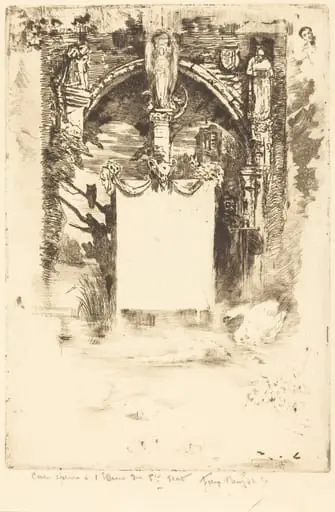 Ex-Libris pour "L'Ensorcelée" (Bookplate for "L'Ensorcelée")
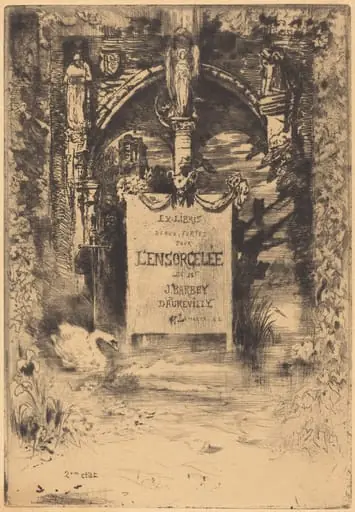 Ex-Libris pour "L'Ensorcelée" (Bookplate for "L'Ensorcelée")
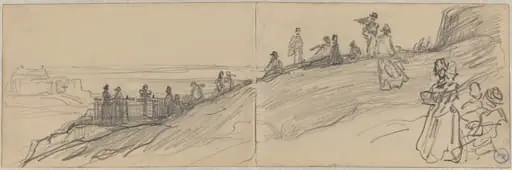 Figures on Top of a Hill, Overlooking the Sea
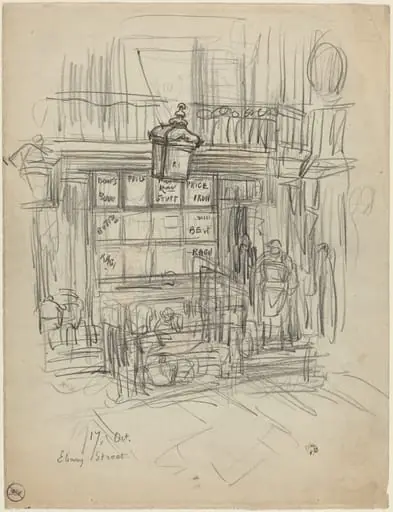 Ebury Street
 A Gathering in an Interior; A Curtained Doorway
 Frontispiece for L'Illustration Nouvelle: The Burial of the Burin
 Fan with Wildflowers and Butterflies against the Norman Coast
![Gillingham Pier, London [verso], by Félix-Hilaire Buhot](https://artifactworldgallery.com/img/felix-hilaire-buhot--gillingham-pier-london-verso--641e03dd7de8217b-w320.webp) Gillingham Pier, London [verso]
Gillingham Pier, London [verso]
![Landscape [Paesaggio], by Carlo Paolo Agazzi](https://artifactworldgallery.com/img/carlo-paolo-agazzi--landscape-paesaggio--e606f4ada87d2052-w320.webp)