Artwork
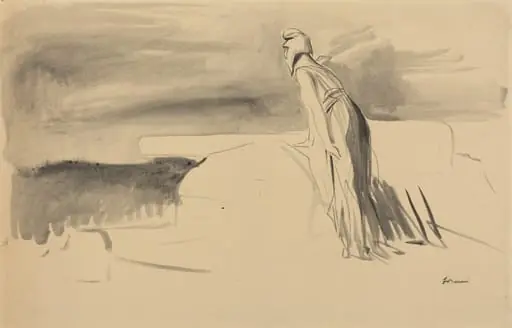
Ceux de la priemiere heure. "Sire! ou en somme-nous de "la guerre fraiche et joyeuse"?..."
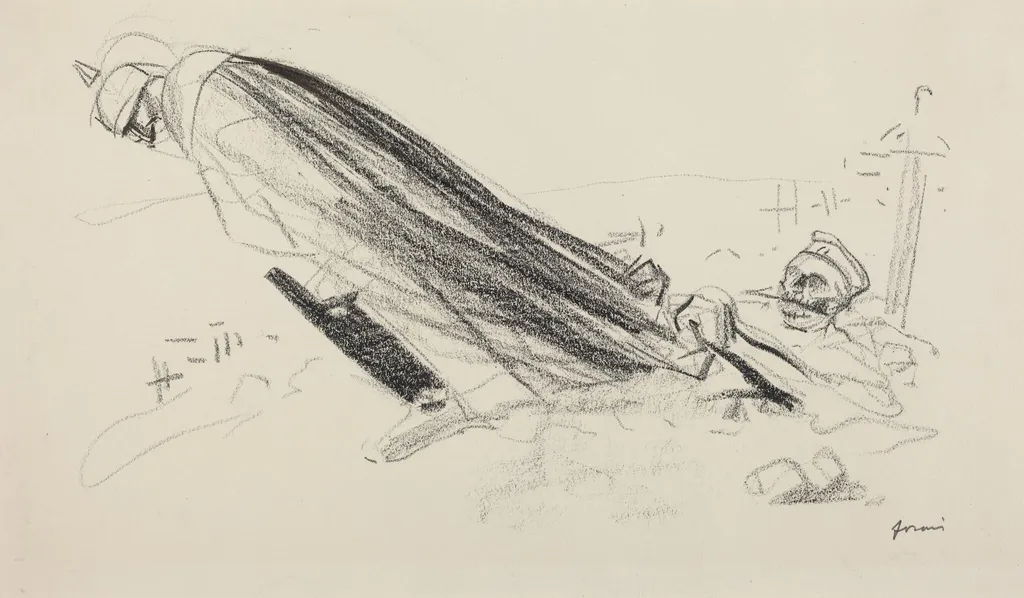
Ceux de la priemiere heure. "Sire! ou en somme-nous de "la guerre fraiche et joyeuse"?..." is a crayon drawing by Jean-Louis Forain. It dates from 1916 and is held in the collection of the National Gallery of Art.
About this work
Overview
Executed with rapid, gestural strokes, the work reflects the artist’s shift toward urgent, topical subjects amid the conflict.
Created around 1916, this drawing by Jean-Louis Forain employs black crayon and ink on wove paper to capture a moment of aerial warfare during the First World War. Executed with rapid, gestural strokes, the work reflects the artist’s shift toward urgent, topical subjects amid the conflict. Though Forain was once celebrated for his satirical and observational art, this piece reveals a more somber engagement with modern warfare, distinct from his earlier, lighter subjects.
Subject & Meaning
The drawing depicts a single aircraft flying low over an indistinct, textured landscape, its cockpit housing two indistinct figures. The title, quoting a sarcastic phrase about a 'fresh and joyful war,' underscores a tone of irony. Forain does not glorify combat but instead evokes its impersonal, mechanical nature—figures blurred, terrain chaotic—suggesting the dehumanizing scale of aerial bombardment in wartime.
Technique & Style
Forain used a combination of dry crayon and fluid ink to build dense, smudged forms with minimal detail. Cross-hatching and loose, overlapping strokes create depth and motion, while the absence of fine lines emphasizes haste and immediacy. The wove paper’s texture enhances the roughness of the medium, reinforcing the sketch’s sense of urgency. The work reads less as a finished image than as a visual note, capturing a fleeting impression of war.
History & Provenance
The drawing emerged during a period when Forain was deeply involved in documenting wartime France, though it remained largely private during his lifetime. Unlike his published lithographs, this piece was not widely circulated, contributing to its relative obscurity in later scholarship. It entered institutional collections decades after his death, where it is now studied as a rare, intimate record of his wartime observations.
Context
In 1916, France was entrenched in total war, and aerial reconnaissance and bombing were newly prominent. Artists like Forain, once known for café scenes and theatrical satire, turned their attention to the front. This drawing aligns with a broader trend among illustrators who used quick sketches to respond to the war’s chaos, rejecting idealized imagery in favor of raw, unpolished testimony.
Legacy
Though Forain’s reputation faded compared to contemporaries like Degas or Toulouse-Lautrec, this work endures as a quiet testament to his adaptability as a chronicler of modern life. Its unembellished style and thematic gravity offer insight into how even established artists grappled with the psychological weight of industrialized conflict, leaving behind a modest but potent visual record.
Artist & collection

Artist
Jean-Louis Forain (French pronunciation: ; 23 October 1852 – 11 July 1931) was a French Impressionist painter and printmaker, working in media including oils, watercolour, pastel, etching and lithograph.

![Study for "Shoeing Calvary Horses at the Front" [verso], by John Singer Sargent](https://artifactworldgallery.com/img/john-singer-sargent--study-for-shoeing-calvary-horses-at-the-front-verso--6f6d1a163e84e9ab-w320.webp)