Artwork
Untitled
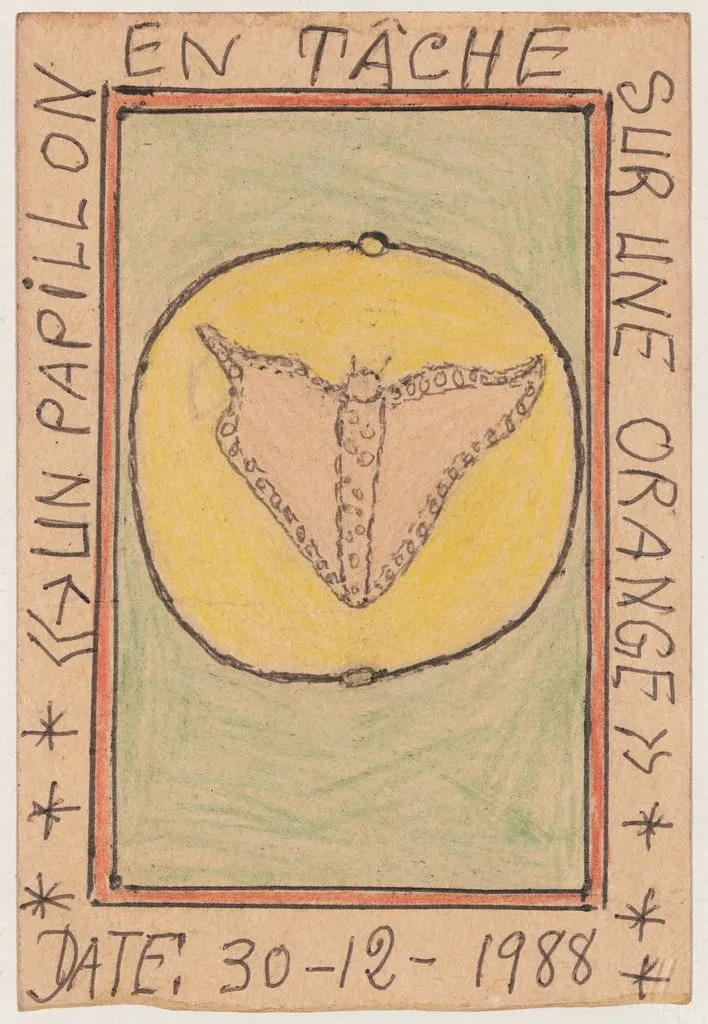
Untitled is a graphite drawing by Frédéric Bruly Bouabré. It dates from 1988 and is held in the collection of the Museum of Modern Art.
About this work
The artwork is bordered by a red line, with the words "EN TACHE SUR UNE ORANGE" written in black on the right and "UN PAPILLON" on the left.
This image showcases a vibrant, hand-drawn artwork on a board. At its center, a stylized butterfly is encircled by a yellow circle, which is itself framed by a larger, green rectangle. The butterfly's body and wings are rendered in a light, dotted pattern.
The artwork is bordered by a red line, with the words "EN TACHE SUR UNE ORANGE" written in black on the right and "UN PAPILLON" on the left. The date "30-12-1988" is inscribed at the bottom.
This piece invites contemplation of its intricate, hand-crafted details. For more works by the same artist, explore the creations of Frédéric Bruly Bouabré.
Overview
Created in 1988, this drawing by Frédéric Bruly Bouabré combines colored pencil and ballpoint pen on board. It features a central butterfly surrounded by geometric framing elements—a yellow circle within a green rectangle—bordered by a red outline. Text in black ink appears on either side, identifying the subject and offering a poetic phrase. The date is inscribed at the base, anchoring the work in a specific moment of the artist’s practice.
Subject & Meaning
The butterfly, labeled 'UN PAPILLON,' is the focal point, rendered with delicate dotting that suggests texture rather than solid form. The phrase 'EN TACHE SUR UNE ORANGE'—'a stain on an orange'—introduces a metaphorical layer, possibly linking the insect to fleeting, organic marks in nature. The work resists fixed interpretation, instead inviting reflection on symbols drawn from the artist’s personal cosmology and daily observations.
Technique & Style
Bouabré employed precise, hand-drawn lines and stippling to build form and pattern, using minimal materials: colored pencil and ballpoint pen. The composition is structured yet intimate, with bold outlines defining spatial relationships. The limited palette—yellow, green, red, and black—enhances clarity, while the meticulous dotwork on the butterfly’s wings reveals a patient, systematic approach to mark-making.
History & Provenance
The work entered the collection of The Museum of Modern Art as part of a broader acquisition of Bouabré’s drawings, which were assembled during the 1990s. Created in his home in Côte d’Ivoire, it reflects his lifelong practice of documenting knowledge through visual language. Its inclusion in MoMA’s holdings situates it within global conversations about self-taught art and non-Western epistemologies.
Context
Bouabré developed a unique visual system after a spiritual revelation in the 1940s, dedicating his life to recording oral histories, myths, and observations in thousands of small drawings. This piece belongs to his series of alphabet-like glyphs and symbolic narratives, which he called 'Bété' script. His work emerged outside formal art institutions, yet it resonates with broader 20th-century interests in indigenous knowledge systems.
Legacy
Bouabré’s drawings, including this one, have influenced how non-Western artistic practices are understood within modern art institutions. His method of encoding meaning through repetitive, systematic marks has been recognized as a form of visual writing. Though he worked in relative isolation, his legacy endures through institutional collections and scholarly attention to his codified worldview.
Artist & collection
Artist
Frédéric Bruly Bouabré (1923–2014) was an Ivorian artist, born in Idibouo-Zépréguhé.